A single decimal error in your spx spy ratio calculation during a 0DTE volatility spike invalidates your entire strike mapping protocol. Static 10:1 conversion models are technically obsolete. They fail to account for tracking divergence caused by the SPY 0.0945% expense ratio and the legacy Unit Investment Trust structure. Relying on stale data or manual arithmetic during rapid price action results in immediate slippage. You need a data-centric approach that accounts for the current $720 billion SPY AUM and its inherent cash drag.
Precision execution requires a move away from approximation. You understand that even minor ratio deviations lead to mispriced orders and failed hedge ratios. This technical reference provides the high-precision formula required for exact SPX to SPY options strike conversion. It eliminates the margin for error found in standard retail platforms. The focus remains strictly on the mathematical relationship between the index and the ETF.
The following sections detail the dynamic ratio formula and the variables driving tracking error. We outline a reliable strike mapping protocol to ensure your options positions reflect real-time market data. It’s a functional utility for traders who prioritize mathematical accuracy over general market sentiment. This guide provides the technical framework for maintaining strike price integrity in all market conditions.
Key Takeaways
- Execute precise spx spy ratio calculation by dividing current index spot by ETF mid-point prices to establish a dynamic conversion baseline.
- Account for ratio deviation factors such as SPY dividend distributions and risk-free interest rates to prevent strike mapping inaccuracies.
- Convert SPX strike prices into SPY equivalents using current ratios to identify the most liquid contract matches for 0DTE strategies.
- Mitigate arithmetic errors and execution latency by transitioning from manual calculations to automated tracking with 6-second refresh intervals.
Understanding the SPX to SPY Price Relationship
SPX functions as the primary benchmark. It is a theoretical, mathematical value derived from the market capitalization of 500 constituent companies. It represents the index spot price. There are no shares to trade. In contrast, the SPDR S&P 500 ETF Trust is a physical security. It tracks the index through direct asset ownership. Traders require an accurate spx spy ratio calculation to map index movements to tradeable ETF strike prices. The relationship is dynamic. It fluctuates based on market micro-structure and fund management variables.
The 10x Multiplier Baseline
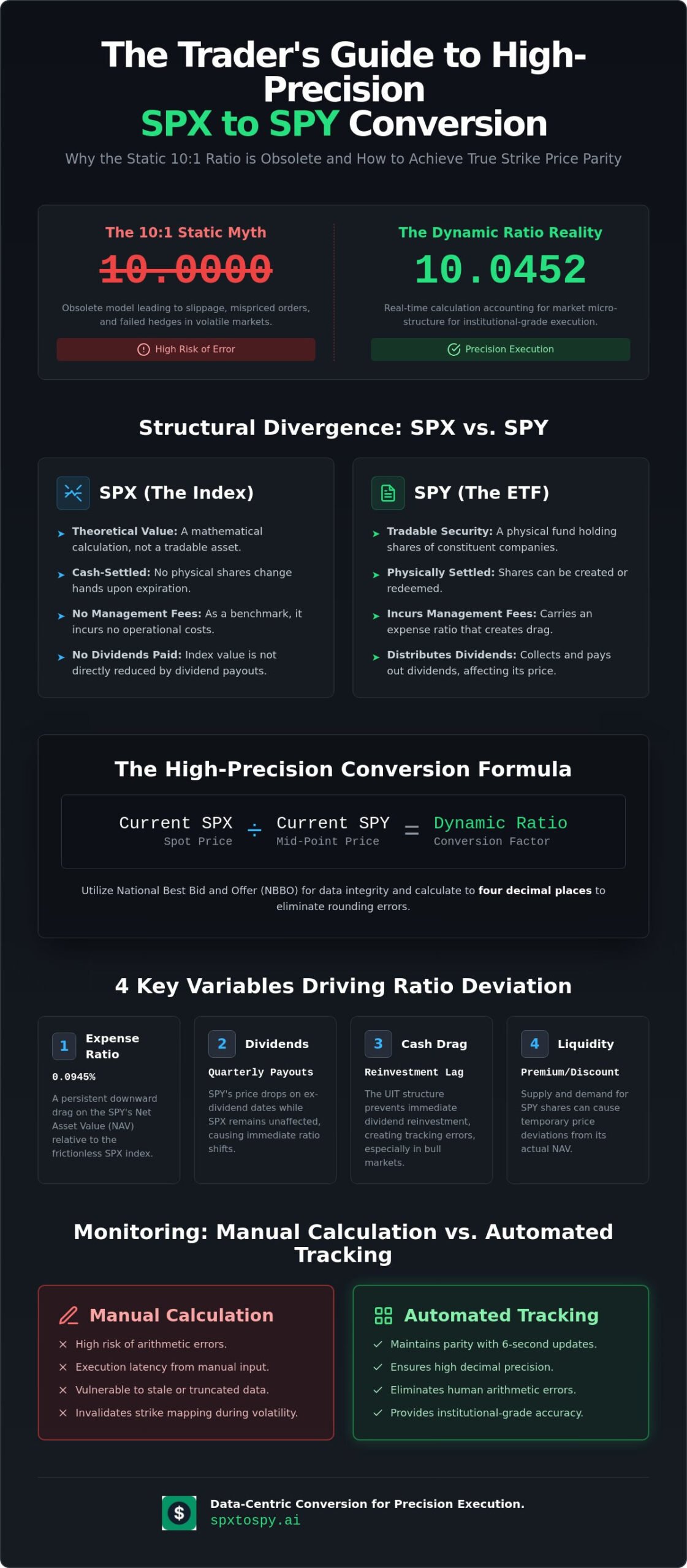
Historical design dictates a 10:1 relationship. SPY was engineered to trade at approximately 1/10th the value of SPX. This baseline simplifies mental arithmetic for retail participants. Standardized liquid option chains often reflect this 10x logic. It remains a useful approximation for long-term outlooks. It fails in high-frequency 0DTE environments. Precision scalping demands exact strike alignment. A 10.00 ratio might shift to 10.05 or 9.95. These small variances cause significant strike mapping errors. Decimal slippage results in sub-optimal entry points. You cannot rely on a fixed constant for institutional-grade execution. For a complete technical breakdown of why this shortcut fails, review the spx spy 10x ratio explained analysis covering expense ratio drag, dividend yield impact, and the divergence between cash-settled and physically-delivered contracts.
Index vs. ETF Structural Divergence
Structural differences prevent a permanent 10:1 alignment. SPX is cash-settled. It has no physical underlying. It does not incur management fees. It does not pay dividends. SPY is a Unit Investment Trust (UIT). It holds physical shares of the index constituents. This structure introduces several divergence factors:
- Expense Ratio: SPY carries an annual fee of 0.0945%. This cost is deducted from the Net Asset Value (NAV). It creates a persistent downward drag on the ETF price relative to the index.
- Dividend Distributions: When constituent stocks pay dividends, SPY collects them. The ETF price drops on the ex-dividend date. SPX remains unaffected. This event shifts the spx spy ratio calculation immediately.
- Cash Drag: The UIT structure prevents immediate dividend reinvestment. Cash sits in the trust until quarterly distribution. This creates tracking error during bull markets.
- Market Liquidity: SPY trades on an exchange. Supply and demand for the ETF shares can cause temporary premiums or discounts to the NAV.
Precise mapping requires identifying the current dynamic multiplier. You must account for these structural variables to ensure your SPY strikes align with SPX price targets. Failure to adjust for divergence leads to execution lag and mispriced risk. Understanding the full spx spy ratio meaning — including how UIT cash drag and European-style settlement differences drive deviation — is essential for maintaining strike equivalence across all market conditions.
The SPX SPY Ratio Calculation Formula
Establishing a precise spx spy ratio calculation depends on raw data integrity. Formula: Current SPX Price / Current SPY Price = Ratio. This output functions as the primary conversion factor for strike mapping. Use mid-point prices for institutional-grade accuracy. This avoids bid-ask spread distortion during low-liquidity sessions. National Best Bid and Offer (NBBO) integration is mandatory for real-time validity. Don’t rely on single-exchange prints. NBBO feeds aggregate the best prices from all 16 US options exchanges. This ensures the denominator in your calculation isn’t skewed by a single exchange’s latency.
Verify the ratio against multiple data providers. Feed discrepancies indicate latency or stale data. Review the key differences between SPY and SPX to understand structural divergence. Contract sizing and settlement styles impact the required precision. Cross-reference calculated values against multiple liquidity sources. Large gaps signal broken feeds or localized liquidity shocks. Maintain a dual-feed system for immediate error detection. High-frequency traders monitor this ratio to adjust delta-neutral positions constantly.
Step-by-Step Computational Logic
Computational logic requires synchronized data snapshots. Capture the SPX index spot value. Simultaneously capture the SPY ETF last-trade price or mid-point. Perform the division: SPX Value ÷ SPY Value. The ratio is the coefficient required to equalize the notional value of both instruments. Lag between captures introduces arithmetic drift. It invalidates the conversion. Traders requiring immediate accuracy should use a real-time conversion tool to eliminate manual calculation risks. Recalculate every six seconds to maintain parity between index and ETF positions.
Decimal Precision and Significant Digits
Platform truncation at two decimal places is a systemic risk. Precision mapping requires four decimal places (e.g., 10.0452). Rounding errors in high-delta environments cause incorrect strike selection. A 0.005 error on a 5000 SPX strike creates a 2.5-point miscalculation on the SPY equivalent. This gap invalidates technical setups during 0DTE volatility. When the ratio shifts, the delta exposure of your SPY position relative to SPX changes. Failure to update the ratio leads to unintended directional bias. Accuracy at the fourth decimal is the baseline for professional execution.
Variables Driving Ratio Deviation
The theoretical 10:1 parity between SPX and SPY is subject to constant erosion. Mathematical constants don’t exist in live markets. Four primary variables dictate the divergence from the nominal baseline. Precise spx spy ratio calculation must account for these tracking errors to maintain strike mapping integrity. Failure to adjust for these factors results in execution slippage and misaligned risk parameters. The relationship is fluid; it requires continuous recalibration.
Operational costs represent the first tier of divergence. The ETF manager incurs rebalancing costs and management fees. These expenses are deducted from the fund’s Net Asset Value. This creates a persistent downward drag on the SPY price relative to the SPX index. Intraday price action further complicates the relationship. High market volatility induces rapid shifts in the 0dte spx spy ratio. During aggressive sell-offs or melt-ups, the ETF may trade at a temporary premium or discount to its NAV. This necessitates real-time monitoring of the spread to ensure strike alignment.
Dividend Drag and Ex-Date Adjustments
Dividend distributions cause the most significant discrete shifts in the ratio. SPY is a physical trust. It collects dividends from constituent stocks and distributes them quarterly. On the ex-dividend date, the SPY price drops by the dividend amount. The SPX index remains unchanged. This event causes an immediate spike in the spx spy ratio calculation. The ETF trades at a relative discount. Traders must adjust calculations for long-dated option expiry cycles to account for expected future distributions. Static models fail to project these predictable price resets. This leads to inaccurate strike mapping for LEAPS or monthly contracts. The specific mechanics of how the 1.02% dividend yield compounds this deviation over time are detailed in the spx spy 10x ratio explained technical reference, which isolates each variable causing ratio drift from the nominal baseline.
Interest Rates and Cost of Carry
Risk-free interest rates influence the forward pricing of the ETF. Higher rates increase the cost of carry for market makers and arbitrageurs. This variable is embedded in the spx spy ratio formula. During high-rate economic cycles, the divergence between the index spot and the ETF price expands. The conversion ratio becomes more volatile. Conversely, low-interest environments provide relative stability to the ratio. The relationship between the cash index and the tradable security tightens. Current market conditions require dynamic interest rate inputs to ensure strike mapping accuracy across the entire term structure. Manual inputs are insufficient for 0DTE precision.
Mapping SPX Strikes to SPY Equivalents
Mapping requires applying the derived ratio to specific index levels. Formula: SPX Strike Price / Current Ratio = SPY Equivalent Strike. This converts theoretical index targets into tradable ETF contracts. Accuracy depends on the precision of the underlying spx spy ratio calculation. Even a 0.01 deviation shifts the target strike by several cents. This drift potentially moves the trade to a different strike price entirely. Traders using Robinhood or Webull must execute this conversion before entry. It ensures the SPY position reflects the intended SPX technical setup.
Rounding protocol is the next step. SPY options utilize $1 increments for most strikes. Some series offer $0.50 intervals. Round the calculated equivalent to the nearest liquid strike. Verify the liquidity and bid-ask spread of the selected SPY strike. High-volume strikes provide tighter fills. Risk mitigation involves cross-referencing the equivalent strike with your broker’s option chain. Confirm the delta and gamma profiles match the intended risk exposure. Manual errors during high-volatility 0DTE sessions lead to immediate losses. Automated mapping removes this execution risk.
Conversion Example: SPX 5800 Call
Input variables: SPX Strike 5800. Current Ratio 10.045. Calculation sequence: 5800 / 10.045 = 577.40. Execution choice: Select the 577 or 578 SPY strike. The 577 strike provides a higher delta and sits closer to the money. The 578 strike is further out of the money with a lower premium. Your choice depends on specific risk-reward requirements for the scalp. A static 10:1 ratio would’ve suggested the 580 strike. That’s a 3-point error. This gap represents a significant difference in contract pricing and Greeks. Precision is the difference between a profitable hedge and a failed entry.
Strike Equivalence Divergence
A 5800 SPX strike doesn’t equal a 580 SPY strike. Structural drag and dividend timing create “Last Digits Chaos.” This is the drift where index levels and ETF strikes no longer align on the decimal. Professional day traders recognize that the spx spy ratio calculation is never a flat 10.000. It’s usually a floating decimal like 10.0452 or 9.9871. Use the spx to spy converter to automate this mapping. It ensures your SPY entries track the SPX price action with zero arithmetic latency. Eliminate manual rounding errors by using a Real-Time SPX to SPY Strike Price Converter for all 0DTE trades.
Automated vs. Manual Ratio Monitoring
Manual spx spy ratio calculation introduces systemic risk. Human arithmetic is prone to error during rapid price expansion. Execution latency increases when traders manually divide index spot by ETF midpoints. Seconds lost in calculation result in missed fills or incorrect strike selection. Professional 0DTE strategies require sub-ten-second accuracy. Manual updates every few minutes are insufficient for high-frequency scalping. Stale data leads to mispriced premiums and failed hedge ratios.
Automation ensures data integrity. It removes the cognitive load of constant division. Live market feeds provide the necessary inputs for a precise spx spy ratio calculation. This eliminates reliance on outdated snapshots or static 10:1 estimates. Integrating automated tracking into a high-frequency workflow minimizes the gap between technical signal and trade execution. It establishes a reliable bridge between SPX targets and SPY orders. Precision is non-negotiable when managing high-gamma positions.
Operational Specifications of spxtospy.ai
Functional efficiency defines the spxtospy.ai utility. The system provides real-time ratio tracking refreshed every six seconds. This frequency aligns with institutional data cycles. It ensures strike price mapping remains accurate during high-gamma movements. The interface is clinical. It prioritizes data points over visual flair. This design minimizes distraction during active market hours. Traders receive instantaneous mapping outputs without navigating complex menus. It’s a single-purpose tool for a single-purpose task.
Protocol for Active Traders
Follow this standardized protocol to maintain execution speed. Consistency reduces operational errors. Use the following steps for every 0DTE entry:
- Step 1: Identify the target SPX strike level based on your technical setup.
- Step 2: Reference the live ratio on spxtospy.ai for the current coefficient.
- Step 3: Select and execute the equivalent SPY strike on your retail platform immediately.
Verification remains a secondary safety layer. Cross-reference the calculated SPY strike against the broker’s option chain liquidity. Ensure the bid-ask spread is within acceptable parameters. This three-step process bridges the gap between theoretical index levels and physical ETF execution. Automated monitoring provides the precision required for professional-grade strike mapping. It’s the final component of a high-precision trading workflow.
Optimizing Strike Selection Accuracy
Strike mapping integrity depends on the transition from static estimates to dynamic data models. You’ve identified how structural divergence, expense ratios, and dividend drag invalidate the legacy 10:1 multiplier. Precise spx spy ratio calculation requires continuous monitoring of NBBO feeds to maintain parity between index spot levels and physical ETF contracts. Manual arithmetic during high-volatility sessions introduces unacceptable latency and arithmetic risk. Professional 0DTE workflows demand sub-ten-second data updates to ensure entry precision and delta-neutral integrity.
Eliminate calculation drift with a dedicated technical utility. Automated tracking provides the necessary bridge between theoretical index targets and tradable SPY strikes. Access the Real-Time SPX to SPY Converter to benefit from ratios refreshed every 6 seconds. This free technical utility ensures precision strike mapping for day traders who require clinical accuracy in all market conditions. Maintain your competitive edge through data-driven execution and reliable strike alignment.
Frequently Asked Questions
How is the SPX to SPY ratio calculated?
Divide the current SPX index spot price by the current SPY ETF price. The formula is SPX / SPY = Ratio. Use NBBO mid-point prices for increased accuracy. This spx spy ratio calculation establishes the multiplier needed to align notional values across both instruments. It functions as the primary coefficient for all subsequent strike mapping tasks.
Why is the SPX:SPY ratio not exactly 10.00?
Structural tracking errors prevent permanent 10:1 parity. Key factors include the SPY 0.0945% expense ratio, dividend drag, and cash drag within the Unit Investment Trust structure. These variables cause the ratio to float. It typically ranges between 10.02 and 10.06 depending on current market conditions and interest rate cycles. Static estimates are technically invalid.
How often does the SPX to SPY conversion ratio change?
The ratio fluctuates in real-time with every price update on the underlying exchange. Market micro-structure shifts and liquidity changes induce constant movement. Professional monitoring tools refresh every six seconds to maintain strike mapping integrity during active sessions. Stale data from five minutes ago is insufficient for high-frequency 0DTE execution. Precision requires constant recalibration.
What formula should I use to convert SPX strikes for Robinhood?
Use the formula: SPX Strike / Current Ratio = SPY Equivalent Strike. If the target SPX strike is 5800 and the ratio is 10.045, the calculation is 5800 / 10.045 = 577.40. Select the nearest liquid SPY strike, such as 577 or 578, based on your specific delta requirements. This ensures your retail platform entry matches the index level.
Does the SPX SPY ratio include dividend adjustments?
The ratio inherently reflects dividend distributions through price action. SPY prices drop on ex-dividend dates while SPX remains unchanged. This event causes a discrete spike in the spx spy ratio calculation. Accurate mapping requires using the current spot ratio to account for these resets. Failure to adjust for dividends leads to misaligned long-dated option positions.
How does the SPX SPY ratio affect 0DTE trading strategies?
Ratio precision determines strike alignment for high-gamma scalps. A 0.01 deviation can misalign the target strike by several points on the SPX scale. Correct mapping ensures that SPY entries reflect the intended technical support or resistance levels identified on the index. It eliminates the risk of trading the wrong contract during volatility spikes. Traders who fully grasp the spx spy ratio meaning and its structural drivers are better positioned to execute precise multi-leg strategies without tracking error.
Can I use a static 10x multiplier for SPX to SPY conversion?
Static 10x multipliers are technically obsolete for precise execution. Relying on an approximate 10:1 relationship leads to significant strike selection errors and decimal slippage. Professional traders require dynamic ratios to avoid mispriced option premiums. Using a fixed constant ignores the tracking divergence inherent in ETF structures. Accuracy demands real-time data inputs.
Where can I find a live SPX to SPY ratio tracker?
Real-time tracking is available via spxtospy.ai. This utility provides automated ratio updates every six seconds for 0DTE precision. It eliminates manual arithmetic errors and ensures strike mapping accuracy through clinical data delivery. The interface is optimized for rapid scanning during market hours. It functions as a dedicated single-purpose utility for active traders.