The 10x rule for index mapping is a mathematical oversimplification that leads to immediate capital loss. Relying on static division fails to account for the 0.0945% SPY expense ratio or the dividend drag evidenced by the June 30, 2026, ex-dividend date. Utilizing a professional SPX to SPY Converter is mandatory for traders navigating the high-velocity 0DTE environment. Precise strike mapping requires dynamic data to reconcile the $775.83 billion SPY AUM with the cash-settled SPX index. It’s the only way to maintain execution integrity.
Inaccurate conversions cause execution errors during peak volatility. You know that even a five-cent discrepancy in strike selection alters the risk-reward profile of a spread. This article provides the technical framework to master SPX to SPY strike mapping with institutional precision. We examine the mechanics of fluctuating ratios, the tax advantages of Section 1256 contracts, and how the June 2026 removal of the Pattern Day Trader rule affects liquidity. Expect a clinical breakdown of execution protocols designed for rapid market scanning and immediate tactical application.
Key Takeaways
- Analyze how dividend cycles and NAV-to-price variances disrupt static 10:1 conversion models.
- Deploy the spx to spy converter to reconcile technical levels with executable strike prices in real-time.
- Compare cash settlement protocols and Section 1256 tax benefits against physical delivery risks in 0DTE strategies.
- Apply a standardized execution protocol for transitioning from SPX technical analysis to SPY order entry.
- Optimize data latency using a 6-second refresh architecture to balance precision with market velocity.
The 10x Multiplier Myth: Why Simple Conversion Fails
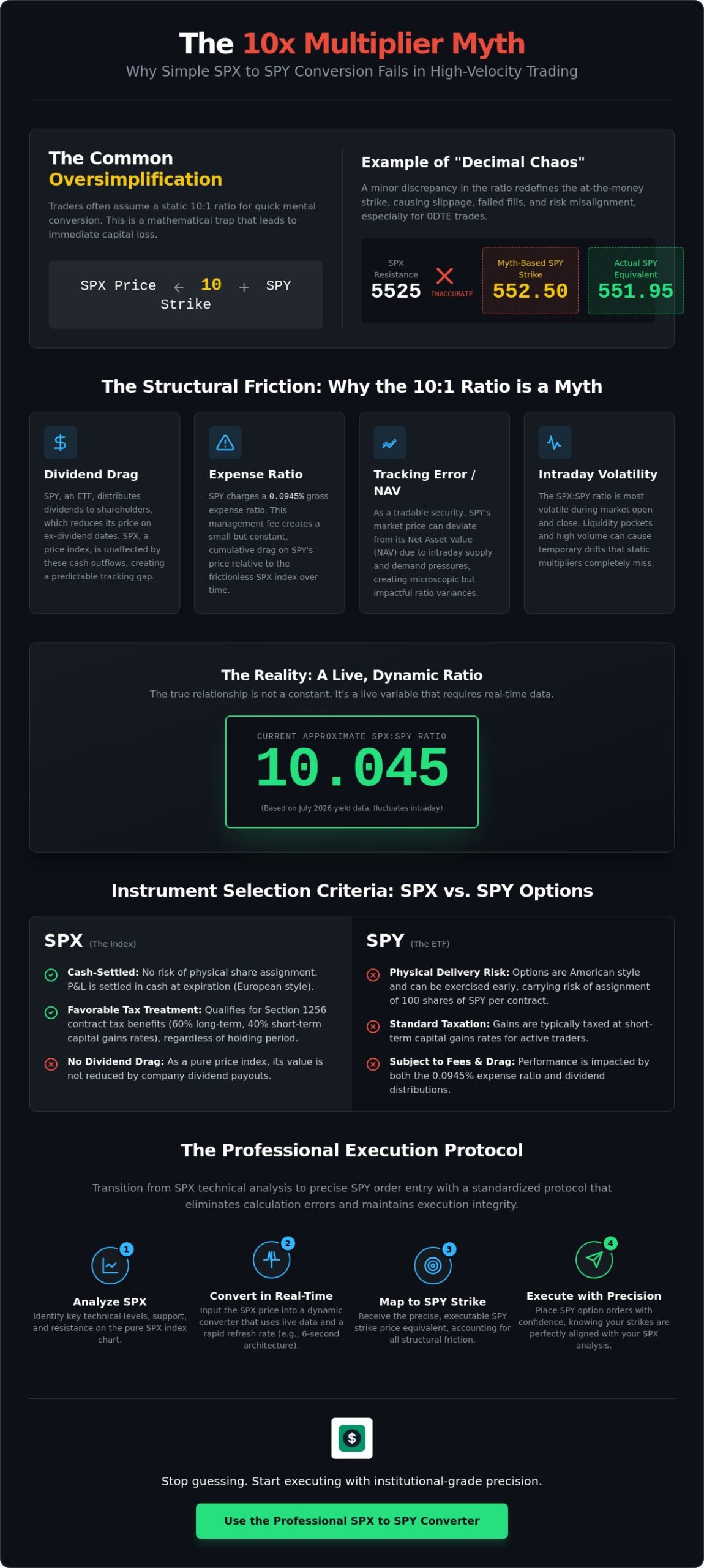
Historical correlation between the S&P 500 Index (SPX) and the SPDR S&P 500 ETF Trust (SPY) implies a static 10:1 ratio. Beginners rely on this 10x multiplier for rapid mental mapping. It’s a mathematical trap. Parity is rarely exact. Professional execution demands precision beyond whole numbers. For zero-days to expiration (0DTE) traders, “close enough” logic triggers capital loss. Inaccurate mapping distorts delta and gamma exposure. Drift to a 10.02 ratio causes incorrect strike selection. Traders targeting at-the-money (ATM) levels based on SPX price targets miss the actual SPY equivalent. This creates directional bias and risk misalignment. A dedicated spx to spy converter removes manual calculation risk.
The Cost of Inaccurate Strike Selection
Ratio deviations as small as 0.05 redefine the ATM strike. This variance creates slippage during limit order entry. SPX resistance at 5,525 doesn’t equate to a 552.5 SPY strike. Real-time data often shows the equivalent at 551.95 or 552.10. Traders using the 10x myth face “Decimal Chaos” in high-volatility regimes. Bid-ask spreads widen. Ratios fluctuate. Mismapped strikes cause failed fills or adverse entries. Gamma risk compounds near expiration. Minor mapping errors transform hedges into naked liabilities. Gamma acceleration requires sub-second accuracy. A one-tick error in SPY translates to significant P&L swings in high-notional SPX-equivalent positions. Institutional desks use dynamic mapping to arbitrage the difference between cash-settled and physically-settled Greeks. Traders who need a comprehensive technical reference for translating an spx strike price in spy can leverage the 2026 conversion guide to eliminate the decimal deviations that compound into significant execution errors.
Index vs. ETF: The Tracking Gap
SPX is a theoretical price index. SPY is a tradable basket of securities. Tracking error drives ratio divergence. SPY includes a 0.0945% gross expense ratio. Dividend drag is a constant factor. The June 30, 2026, ex-dividend date confirms this divergence. ETF price often deviates from Net Asset Value (NAV) due to supply and demand. The 10x multiplier ignores the compounding effect of the SPY management fee over multiple sessions. The SPX:SPY ratio is a dynamic variable. It’s not a constant. Use a live spx to spy converter to maintain synchronization between instruments. Professional traders treat the ratio as a live feed, not a historical average. Failure to account for these structural gaps leads to execution failure in fast-moving markets.
Mechanics of the SPX:SPY Ratio: Beyond the Decimal
SPX and SPY relationships are governed by structural friction. Price divergence is not random. It’s mechanical. Quarterly dividends represent the primary wedge. SPY distributions reduce share price on ex-dividend dates. SPX remains unaffected. This creates a permanent tracking gap. CBOE details key differences regarding settlement and price index mechanics. Dividends for SPY yielded approximately 0.95% as of mid-2026. The June 30, 2026, ex-dividend date caused a discrete shift in conversion math. Use a real-time spx to spy converter to adjust for these predictable price drops.
ETF supply and demand factors introduce Net Asset Value (NAV) variances. SPY trades at a premium or discount to its underlying basket. These microscopic deviations impact the conversion ratio. The 0.0945% gross expense ratio adds a cumulative, non-linear drag. It’s a persistent erosion of SPY price relative to the SPX index. Static division fails to capture these variables. Precision requires live market ratio tracking. Accuracy is mandatory for strike mapping in 0DTE environments.
Dividend Drag and the Price Index
SPY is structurally designed to lag SPX over long horizons. Dividends are stripped from the fund price during distribution. SPX is a pure price index. It doesn’t reflect these cash outflows. Normalizing the relationship requires a dynamic mathematical adjustment. The ratio expands during the distribution cycle. It contracts immediately following the ex-dividend date. Manual mapping is insufficient for high-frequency execution. Professional traders rely on automated spx to spy converter tools to maintain parity.
Intraday Volatility and Ratio Drift
Arbitrageurs maintain tight spreads between the index and the ETF. Parity is never perfect. High-volume periods at the market open and close increase ratio volatility. Liquidity pockets create temporary drift. The SPX:SPY ratio is currently approximately 10.045 based on July 2026 yield data but fluctuates based on intraday liquidity. Rely on an automated converter to handle these tick-by-tick shifts. Don’t assume yesterday’s ratio applies to today’s tape. Execution integrity depends on current data feeds.
SPX vs. SPY Options: Structural Selection Criteria
Contract selection depends on settlement requirements, tax efficiency, and capital scale. SPX and SPY options aren’t interchangeable despite their high correlation. SPX options utilize cash settlement. No shares change hands at expiration. SPY options require physical delivery of 100 shares per contract. This distinction is vital for 0DTE strategies. US-based traders gain tax advantages through Section 1256 contracts. SPX gains are taxed at a 60/40 blended rate. SPY options follow standard short-term capital gains rules. Contract sizing remains the primary operational difference. One SPX contract represents ten times the notional value of a SPY contract. Traders use an spx to spy converter to maintain leverage parity across different account sizes. Liquidity in SPY often attracts retail participants, but wider spreads can erode profits compared to institutional SPX volumes.
Settlement Risk and Early Assignment
SPY options follow American-style exercise. Holders can exercise contracts before expiration. This introduces early assignment risk. SPX options are European-style. Exercise occurs only at expiration. Traders avoid “pin risk” by using SPX. Pin risk in SPY occurs when the underlying price closes near the strike, creating uncertainty about share delivery. It’s a significant hazard for 0DTE traders. The spx to spy converter facilitates the transition from SPX technical levels to SPY strikes while managing these divergent risk profiles. SPX provides a clean close without the threat of unexpected share positions.
Margin and Capital Efficiency
Buying power requirements vary by instrument. SPX strategies offer superior capital efficiency in portfolio margin accounts. Executing ten SPY contracts to match one SPX contract increases commission drag. The converter helps traders scale positions accurately. It ensures technical levels on SPX charts map to the correct SPY strike for smaller accounts. June 2026 regulatory updates regarding the Pattern Day Trader rule have increased retail participation in 0DTE. Precise capital allocation is mandatory. Institutional-grade mapping prevents over-leveraging when switching between high-notional index options and lower-notional ETF options.
Execution Protocol: Mapping SPX Technicals to SPY Strikes
Precision execution requires a standardized mapping protocol. Traders must bridge the gap between SPX technical analysis and SPY order entry. Follow this five-step sequence for optimal strike selection.
- Step 1: Identify primary support and resistance levels on the SPX 1-minute chart. Focus on candle closes rather than wicks to determine high-probability reversal zones.
- Step 2: Input the identified SPX price target into the spx to spy converter for immediate strike translation.
- Step 3: Monitor the current market ratio refresh. Our architecture utilizes a 6-second cycle to capture intraday drift without the noise of tick-by-tick fluctuations.
- Step 4: Select the SPY strike providing the closest delta alignment to the original SPX strategy. Ensure the Greek profile matches the intended directional move.
- Step 5: Perform a final verification of the SPY bid-ask spread. High-velocity 0DTE environments can widen spreads, increasing slippage risk.
Optimizing for 0DTE Scalping
High-frequency scalping demands strike equivalence during rapid price expansion. Traders often fall victim to round number bias. They assume SPX 5500 maps perfectly to SPY 550.00. This is a technical error. Dividend drag and expense ratios create offsets. The 6-second refresh is critical for high-delta positions. It prevents traders from entering strikes that have drifted out of the money (OTM) during the execution lag. Rapid mapping ensures you capture the intended move before theta decay or gamma expansion alters the risk profile.
Retail Platform Integration (Robinhood/Webull)
Retail participants frequently track SPX charts while executing on platforms like Robinhood or Webull. These brokers often lack direct SPX index option access for smaller accounts. Traders must translate SPX psychological levels into executable SPY strikes. SPX 5500 might equate to SPY 549.85 depending on the session ratio. Managing the theta difference is also mandatory. SPY options decay differently than cash-settled index options. Use the spx to spy converter to maintain technical consistency across platforms. Accurate mapping prevents the execution of suboptimal strikes that don’t reflect the underlying index’s technical strength. Institutional-grade data feeds are the only way to avoid the decimal chaos inherent in retail-only charting. Traders operating across fragmented retail platforms benefit from a dedicated s&p 500 options strike converter that accounts for live ratio drift and eliminates manual input errors during rapid order entry.
SPX to SPY Converter: Operational Specifications
Operational efficiency requires a data feed architecture optimized for 0DTE velocity. The system refreshes the SPX:SPY ratio every six seconds. This frequency eliminates noise from tick-by-tick fluctuations. It prevents latency associated with 1-minute candle closes. High-frequency scalpers require immediate strike parity. Static 10:1 mapping fails during periods of rapid gamma expansion. The spx to spy converter utilizes professional-grade data streams to reconcile the cash-settled index with the tradable ETF. Minimalist UI design ensures data points are visible without distraction. UI is optimized for rapid scanning during high-volume sessions. Data reconciliation happens at the server level to minimize client-side lag. Ratio tracking accounts for the $775.83 billion SPY AUM and its impact on intraday liquidity.
The 6-Second Refresh Advantage
Tick-by-tick data often reflects temporary bid-ask imbalances rather than true ratio drift. Trading platforms updating every tick cause erratic mapping. This leads to hesitation during order entry. Conversely, tools relying on candle closes provide lagging data. A 6-second refresh cycle provides sufficient smoothing for accurate strike selection. It ensures the ratio reflects the most recent SPY dividend adjustments. The June 30, 2026, ex-dividend date illustrates the necessity of dynamic mapping. Comparing this refresh rate to standard web tools reveals a significant reduction in execution error. Professional traders don’t rely on delayed data feeds when capital is at risk. The tool accounts for the 0.0945% SPY expense ratio and the 0.95% dividend yield to maintain mathematical precision. Traders seeking a deeper technical breakdown of live-ratio mechanics can reference the spx spy strike price tool analysis, which details how zero-lag conversion eliminates the fixed-multiplier inaccuracies that compound during peak 0DTE volume.
Technical Disclaimer and Risk Management
Confirm all strike prices with your specific broker platform before final execution. The spx to spy converter functions as a decision-support utility. It’s not a financial advisory service. Market conditions, including widening spreads and liquidity gaps, impact the final fill price. Execution integrity remains the responsibility of the individual trader. Use this tool to normalize technical levels across instruments. Maintain a cautious, risk-aware stance. Continuous verification is mandatory for professional-grade trading. Precision instruments require responsible operation. Speed and accuracy are the only metrics that matter in 0DTE markets.
Beyond the trading desk, organizations that prioritize digital excellence can visit Sterck to learn how specialized consultancy can drive their technological transformation.
Access the Real-Time SPX to SPY Converter Tool Now
Institutional Execution Standards for SPX-SPY Mapping
Execution integrity in 0DTE markets requires extreme data precision. Reliance on the 10x multiplier myth introduces unacceptable slippage. Professional traders must reconcile SPX technical levels with SPY strike reality to maintain directional parity. This process demands a dynamic spx to spy converter to manage dividend drag. Accurate mapping ensures delta alignment. It eliminates decimal chaos during rapid price expansion. The system provides a 6-Second Real-Time Ratio Refresh to capture intraday drift. It maintains professional-grade mathematical precision. The architecture is optimized for 0DTE and high-velocity day trading. Use the data feed to synchronize technical targets with executable strikes. Live Market Ratio Tracking removes manual calculation errors. It’s the necessary bridge between theoretical index levels and tradable ETF strikes. Maintain technical discipline across all sessions. Execution accuracy is the primary differentiator in volatile regimes. It’s the only path to consistent spx strike price in spy selection that accounts for the 2026 ratio deviations affecting every 0DTE order entry.
Execute with Precision: Use the Live SPX to SPY Converter
Frequently Asked Questions
Why is the SPX to SPY ratio not exactly 10.00?
Structural friction prevents perfect 10.00 parity. SPY carries a 0.0945% expense ratio and experiences dividend drag. SPX is a pure price index. Market demand for the ETF creates Net Asset Value (NAV) variances that fluctuate throughout the session.
How often does the SPX to SPY converter refresh its data?
Data refreshes on a 6-second cycle. This architecture provides a professional-grade “Goldilocks” zone for execution. It filters jumpy tick-level noise while avoiding the lag inherent in candle-close data. Use the spx to spy converter for synchronized strike mapping.
Can I use this tool for 0DTE options trading?
Optimization for 0DTE is a core specification. High-gamma environments require sub-second precision during technical breakouts. The converter facilitates rapid strike selection before theta decay or price expansion alters the risk-reward profile of your position.
Do dividends affect the conversion between SPX and SPY?
Dividends are a primary driver of ratio drift. SPY share price reduces on ex-dividend dates, such as June 30, 2026. SPX does not adjust for these cash outflows. Dynamic mapping reconciles this structural gap to prevent strike selection errors.
Is it better to trade SPX or SPY options for taxes?
SPX provides superior tax efficiency for US-based traders. These are classified as Section 1256 contracts. Gains receive 60% long-term and 40% short-term treatment. SPY options are taxed at standard short-term rates for positions held under one year.
What happens if I use an incorrect strike price conversion?
Errors cause immediate risk misalignment and slippage. Mismapped strikes alter intended delta exposure. Traders risk entering out-of-the-money positions when technicals suggest at-the-money parity. Capital loss occurs through failed technical execution and incorrect Greek exposure.
Does the converter work for both calls and puts?
The ratio applies to all strike mapping regardless of contract type. Both calls and puts require the same underlying index-to-ETF price translation. Use the spx to spy converter to maintain consistency across the entire option chain during high-volatility events.
Why do professional traders track SPX but trade SPY?
SPX offers technical purity for identifying institutional levels. Professional traders use index charts for support and resistance analysis. Many execute on SPY to utilize lower notional sizes or access specific retail platform features while maintaining technical consistency.