The 10x multiplier is a dangerous approximation that creates immediate slippage in high-velocity 0DTE environments. Relying on static calculations during peak volatility leads to strike mapping errors and unnecessary Gamma risk exposure at expiration. This technical reference establishes the framework to master the 0dte spx spy ratio for precise strike selection. You’ll eliminate manual calculation lag and optimize entry precision through real-time ratio tracking. Precision is mandatory when 0DTE volume accounts for nearly 50% of all S&P 500 option activity.
Effective strike translation requires understanding why the SPX to SPY relationship deviates from the nominal 10:1 standard. We analyze technical ratio shifts, the 60/40 tax benefits of Section 1256 contracts, and the impact of the 2026 real-time risk-based margin systems on intraday liquidity. This guide provides the data-centric methodology needed to map strikes with clinical accuracy. It ensures your execution remains synchronized with live market data, removing the friction of manual conversion during rapid price action. Use this data to maintain parity across cash-settled and physically-settled instruments.
Key Takeaways
- Transition from static 10x approximations to dynamic ratio tracking for precise notional value mapping.
- Identify how dividend distributions and interest rates drive intraday deviations in the 0dte spx spy ratio.
- Execute strike price translations with clinical accuracy to eliminate manual calculation errors and slippage.
- Integrate 6-second refresh intervals into trading workstations for real-time monitoring of SPX and SPY parity.
- Minimize Gamma risk at expiration by using automated conversion logic for precise strike selection.
The 10x Rule vs. Dynamic 0DTE SPX:SPY Ratio
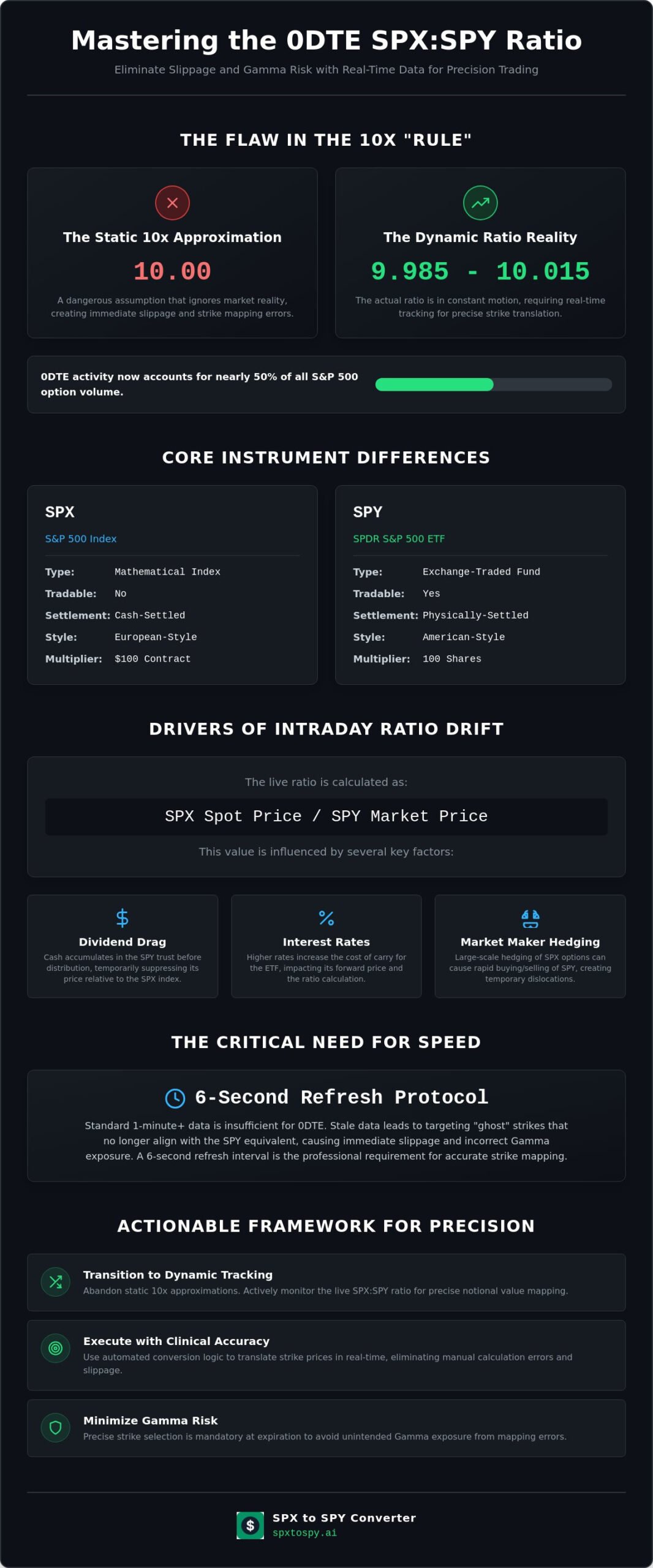
The relationship between the S&P 500 Index (SPX) and the SPDR S&P 500 ETF Trust (SPY) is defined by a theoretical 10.00 multiplier. This ratio serves as the structural baseline for calculating notional value and contract size parity. In 0DTE trading, the 0dte spx spy ratio acts as the primary metric for strike price translation. While the 10x rule is a standard approximation, it fails to account for intraday tracking errors and the pricing mechanics of the underlying ETF.
Precision is mandatory for 0DTE execution due to extreme Gamma sensitivity. Near expiration, small deviations in the ratio lead to incorrect strike selection. A ratio of 10.01 versus 9.99 shifts the equivalent strike price by several points on the SPX index. Traders utilizing financial options must recognize that SPY is a tradable security with management fees and dividend accruals, whereas SPX is a non-tradable mathematical index. These differences ensure the ratio remains in constant motion throughout the trading session.
Contract Size and Notional Value Parity
The SPX utilizes a $100 contract multiplier. The SPY represents 100 shares of the underlying ETF. To achieve notional parity, ten SPY contracts are required to match the exposure of a single SPX contract. If SPX trades at 5,800, the notional value is $580,000. Parity is maintained only if SPY trades at exactly 580.00. Position sizing for 0DTE portfolios depends on this calculation to manage risk across different account types and margin requirements. The elimination of the Pattern Day Trader rule in June 2026 has increased the necessity for precise notional mapping among retail participants. Accurate scaling ensures that capital allocation remains consistent across both instruments.
The Reality of Ratio Drift
Intraday fluctuations in the 0dte spx spy ratio occur based on interest rates, dividend yields, and ETF tracking efficiency. During 2026, the ratio has demonstrated an intraday range typically between 9.985 and 10.015. High volatility periods accelerate these deviations as liquidity providers adjust spreads. SPX options are cash-settled and European-style, while SPY options are physically-settled and American-style. These structural differences contribute to ratio drift, especially during the final hours of the trading session. Manual calculations cannot process these shifts fast enough to prevent slippage. Real-time monitoring with 6-second refresh intervals is required to verify strike parity before order entry. This data-centric approach removes the guesswork from 0DTE strike mapping. For a deeper understanding of how spx spy ratio volatility has evolved through historical drift patterns and variance mechanics, review the technical breakdown of expense ratio drag and dividend yield impacts on long-term ratio behavior.
Mathematical Mechanics of 0DTE Ratio Fluctuations
The 0dte spx spy ratio is derived through a specific computational logic: SPX Spot Price / SPY Market Price. This output is not a static integer. It represents a dynamic variable influenced by cost of carry and dividend accruals. Market makers utilize these mathematical relationships to manage delta exposure across index and ETF instruments. Intraday stability depends on the synchronization of these two assets, yet structural differences ensure constant fluctuation.
Interest rates play a secondary but critical role in the ratio calculation. Higher rates increase the cost of carry for the ETF, impacting the forward price. Market maker hedging activities also inject volatility into the ratio. When 0DTE volume spikes, the rapid buying or selling of SPY shares to hedge SPX options exposure creates temporary dislocations. These dislocations must be identified instantly to maintain strike parity. Traders can verify parity using live market ratio tracking to ensure execution accuracy.
Dividend Drag and ETF Tracking
Dividend accrual is the primary driver of ratio deviation. SPY is a physically-backed trust that holds S&P 500 components. As these components pay dividends, the cash accumulates within the trust before distribution. This accumulation affects the denominator in the ratio calculation. On ex-dividend dates, the SPY price drops by the dividend amount, causing a sharp upward spike in the ratio. Technical deviations also emerge during pre-market hours. Low liquidity in the early session widens the spread between the index and the ETF, making standard 10x mapping unreliable.
Refresh Latency and Execution Risk
Refresh frequency is the definitive factor in 0DTE execution risk. Standard 15-minute delays or even 1-minute updates are insufficient for zero-day instruments. The 6-second refresh protocol is the technical requirement for professional-grade strike mapping. Stale data leads to “ghost” strikes where the trader targets an SPX level that no longer aligns with the SPY equivalent. This mismatch results in immediate slippage and incorrect Gamma exposure. Ratio latency in strike selection results in mapping errors that expose traders to unintended expiration risk. High-frequency updates eliminate the calculation lag inherent in manual conversion methods. Traders who require a zero-error methodology for determining the spx options to spy equivalent will find that dynamic ratio adjustment protocols directly address the tracking error and dividend-adjusted deviations that cause execution lag.
SPX vs. SPY: 0DTE Strike Selection & Parity
Mapping strikes requires immediate application of the current 0dte spx spy ratio. The conversion formula is: SPX Strike / Current Ratio = SPY Equivalent. When the ratio deviates from 10.00, the resulting SPY strike shifts. This deviation alters the perceived moneyness of a position. A trader targeting a specific Delta on SPX must verify the corresponding SPY strike to ensure identical risk parameters. For technical execution details, refer to Day Trading SPX SPY Conversion: Technical Execution and Ratio Precision. Precision mapping prevents the selection of strikes that lack mathematical parity.
Strategic instrument selection depends on account size and tax requirements. SPX options qualify for Section 1256 treatment. This provides a 60% long-term and 40% short-term capital gains split. SPY options are taxed entirely as short-term capital gains. However, SPY offers superior liquidity for smaller accounts. Granular position sizing is possible with SPY’s smaller contract size. Traders must balance tax efficiency against the tighter bid-ask spreads of the ETF. Evaluation of moneyness must be adjusted for the ratio. An at-the-money (ATM) strike on SPX may translate to an out-of-the-money (OTM) strike on SPY if the ratio is elevated. This shift impacts Gamma and Theta values significantly during the final hours of trading.
Strike Price Mapping Framework
Consider an SPX strike of 5800 with a live 0dte spx spy ratio of 10.02. The calculation yields a SPY equivalent of 578.84. SPY strikes trade in $1.00 increments. The trader must round to the nearest available strike, which is 579. Rounding protocols introduce slight Delta mismatches. These mismatches impact OTM probability calculations. Precision mapping minimizes these discrepancies during high-volatility 0DTE sessions. The 6-second refresh interval ensures the conversion remains synchronized with live price action. This prevents the selection of strikes based on stale index data.
Settlement and Liquidity Factors
Structural differences dictate 0DTE risk management. SPX options are cash-settled and European-style. This eliminates pin risk and early assignment. SPY options involve physical delivery and American-style exercise. Assignment risk is a critical factor for SPY traders holding positions into the close. Understanding the SPX vs SPY settlement difference between cash settlement and physical delivery is essential for managing exercise risk and preventing unintended asset acquisition at expiration. Liquidity profiles also differ. SPY options maintain $0.01 bid-ask spreads for active strikes. SPX spreads are wider, often ranging from $0.05 to $0.10. For scalping strategies, these spread costs impact net profitability. Use SPX SPY Ratio for Scalping: Real-Time Precision for 0DTE Traders to refine entry and exit timing. Accurate mapping ensures that settlement risks are accounted for when transitioning between instruments.
Scalping Protocols: Using the Ratio for 0DTE Execution
Scalping 0DTE instruments requires the elimination of execution latency. Integrating the 0dte spx spy ratio into the trading workstation provides a real-time verification layer for strike parity. Standard 10x assumptions generate slippage during high-frequency entries. Professional protocols mandate ratio validation to ensure the selected SPY strike matches the intended SPX delta. For detailed metrics on intraday shifts, see SPX SPY Ratio Fluctuation: Intraday Metrics for Precise Strike Mapping. Constant monitoring prevents mapping errors during rapid price expansion.
Intraday charts often reveal mean reversion opportunities within the ratio itself. When the SPX:SPY relationship deviates beyond two standard deviations from the daily mean, a technical dislocation exists. These dislocations impact the pricing of spreads and naked options. Identifying these gaps allows for superior entry timing. Traders should utilize live market ratio tracking to synchronize execution with these mathematical pivots. Efficiency depends on the speed of data ingestion and the removal of manual calculation steps.
Intraday Ratio Monitoring
Establish the base ratio during the first 15 minutes of the session. This value serves as the anchor for all subsequent strike translations. Monitor for deviations from the 10x constant caused by ETF tracking error or dividend accrual. Implement ratio alerts to signal when the 0dte spx spy ratio shifts by more than 0.005 points. This threshold often necessitates a change in the target SPY strike. Tracking these metrics ensures that position sizing remains mathematically sound throughout the session.
Execution Efficiency and Accuracy
Strict adherence to a multi-step protocol reduces execution risk in 0DTE environments. Follow these steps to maintain parity:
- Step 1: Identify target SPX strike based on technical analysis and volume profile.
- Step 2: Reference the live SPX to SPY ratio to determine the exact conversion factor.
- Step 3: Verify the SPY equivalent strike liquidity, bid-ask spread, and open interest.
- Step 4: Execute the order with confidence in mathematical parity between the index and the ETF.
This systematic approach eliminates cognitive load during peak volatility. The 6-second refresh interval ensures that the conversion factor is current. Manual mapping is obsolete in 2026. Automated ratio tracking provides the precision required for high-stakes 0DTE scalping. Accuracy at entry directly correlates with the ability to manage Gamma risk at expiration. High-speed data delivery is the definitive tool for 0DTE execution excellence.
SPX to SPY Converter: Operational Specifications
The real-time SPX to SPY strike price converter is a clinical utility designed for zero-day market participants. It automates the derivation of the 0dte spx spy ratio to provide instant strike parity. Technical specifications center on a 6-second data refresh interval. This frequency is necessary to track the rapid delta shifts characteristic of 0DTE options. The architecture prioritizes data ingestion speed over aesthetic complexity. It delivers functional outputs for active workstations. Accuracy remains the primary metric for performance evaluation. Refresh interval: 6 seconds. Latency: Minimal.
Risk management protocols require a secondary layer of verification. The tool provides the mathematical equivalent strike, but final broker-level validation is mandatory before execution. This ensures that current liquidity and bid-ask spreads align with the calculated parity. The converter acts as a transparent data layer. It removes the friction of manual conversion. It establishes a reliable baseline for 0DTE strike mapping. User verification is the final step in the execution chain. Don’t bypass broker-level confirmation.
Real-Time Data Integrity
Ratio fluctuations are tracked through a proprietary sampling engine. It compares SPX spot levels against SPY market bids every six seconds. This identifies tracking errors caused by dividend drag or interest rate shifts. Timestamps validate the currentness of every conversion. During high-volatility sessions, the system maintains integrity by filtering out liquidity gaps. This prevents the display of “ghost” strikes that don’t exist in the live order book. Reliability is achieved through constant mathematical verification. Data integrity: Confirmed. Sampling rate: High-frequency.
Optimizing 0DTE Workflow
Scaling 0DTE operations requires the elimination of manual friction. Mapping SPX strikes to SPY equivalents in real-time reduces the risk of incorrect strike selection. This is critical when Gamma sensitivity is at its peak. The converter allows traders to map multiple strikes across the chain simultaneously. It provides a modular layout for rapid scanning. This optimization allows the trader to remain focused on price action rather than arithmetic. Manual calculation errors in strike mapping lead to immediate slippage. To ensure mathematical parity at entry, Utilize the Real-Time SPX to SPY Converter for Precise Strike Mapping. Precision is the only defense against execution slippage. Cognitive load: Reduced. Execution speed: Optimized.
Execute with Mathematical Parity
Precision mapping is the definitive methodology for neutralizing Gamma risk and execution slippage in zero-day markets. Static 10x approximations are insufficient for professional traders. High-stakes execution requires the constant ingestion of the 0dte spx spy ratio to verify strike equivalence across index and ETF instruments. You’ve identified the mechanics of ratio drift and the necessity of high-frequency data refresh protocols to maintain strike parity during peak volatility.
Integrating these technical protocols into your workstation eliminates manual calculation lag and strike selection errors. The speed of the 0DTE environment demands functional automation over human approximation. This technical reference provides the data-centric framework needed to align SPX targets with SPY equivalents. Use these metrics to ensure every entry is backed by current mathematical reality. Professional accuracy is mandatory for managing settlement risk and tax efficiency.
Access the Live SPX to SPY Strike Converter to utilize real-time ratio tracking with a 6-second refresh frequency. This free technical utility provides the accuracy required for high-velocity scalping. Optimize your 0DTE execution workflow today.
Frequently Asked Questions
What is the current 0DTE SPX SPY ratio?
The current ratio fluctuates throughout the trading session based on live market price action. While the theoretical baseline is 10.00, dividend accruals and cost of carry cause the actual 0dte spx spy ratio to shift between 9.98 and 10.02. Traders must reference a live data feed for the exact decimal value at the moment of order execution to ensure strike parity.
Why is the SPX to SPY ratio not exactly 10?
Structural differences between a non-tradable index and a physically-backed ETF prevent a perfect 10:1 relationship. SPY incurs management fees and holds cash from component dividends before distribution. These factors create a tracking error relative to the SPX index. Interest rate changes also impact the ETF’s forward pricing, leading to constant ratio drift during the trading day.
How often does the SPX SPY ratio refresh?
The ratio refreshes every six seconds to maintain technical precision for 0DTE instruments. This high-frequency update interval is necessary to capture rapid delta shifts during peak volatility. Standard 15-minute delayed data is insufficient for mapping strikes near expiration. Real-time tracking ensures that conversion calculations remain synchronized with the current order book and spot prices.
Does the SPX SPY ratio affect 0DTE option premiums?
The ratio indirectly impacts premiums by defining the moneyness of the strike price. A shift in the ratio can move an SPY strike from at-the-money to out-of-the-money relative to the SPX index. This change alters the Gamma and Theta values of the contract. Traders must account for these deviations when comparing premium decay and Greeks across both instruments.
Can I use the SPX to SPY ratio for arbitrage?
Ratio dislocations create theoretical arbitrage opportunities between the index and the ETF. However, high-frequency trading firms typically capture these micro-inefficiencies within milliseconds. For retail traders, the 0dte spx spy ratio is primarily a tool for strike parity and execution precision rather than a direct arbitrage signal. It prevents overpaying for equivalent exposure during high-volatility sessions.
How do I convert SPX strike prices to SPY equivalents?
Divide the target SPX strike price by the current live ratio to find the SPY equivalent. For example, an SPX strike of 5800 divided by a ratio of 10.017 results in a SPY target of 579.01. Since SPY strikes trade in whole dollar increments, you must round to the nearest available strike price. This formula ensures mathematical consistency in position sizing across different instruments. Traders seeking a clinical framework for determining the precise spx options to spy equivalent with dynamic ratio adjustment protocols will find detailed guidance on tracking error compensation and dividend-adjusted strike mapping.
Is the SPX SPY ratio different during pre-market hours?
Pre-market hours often show wider ratio deviations due to lower liquidity and increased bid-ask spreads in the SPY ETF. The SPX index is a calculation based on underlying components that may not all be active simultaneously. This creates a temporary tracking gap. Ratio stability typically increases after the 9:30 AM ET market open when liquidity providers begin active hedging operations.
Why does the ratio matter for 0DTE iron condors?
Accurate ratio mapping is critical for maintaining delta neutrality and wing width symmetry in iron condors. An incorrect conversion leads to asymmetrical risk profiles where one side of the spread is closer to the money than intended. This error exposes the trader to unintended directional risk. Precise strike selection ensures the spread remains mathematically balanced relative to the index spot price. Traders seeking to contextualize current ratio behavior against historical SPX SPY ratio variance and tracking error mechanics will find that long-term drift data improves strike selection accuracy across multi-leg structures.