A three-second delay in the SPX:SPY ratio functions as a direct tax on execution capital. In high-volatility environments, the impact of spx spy ratio latency manifests as immediate slippage and strike price conversion errors. Stale data feeds disrupt the mathematical relationship between these instruments, leading to incorrect strike selection during rapid price action. The market operates with the knowledge that precise multipliers are essential, yet dividend distributions and market drift often render manual calculations obsolete. Execution accuracy depends on the elimination of data refresh gaps.
Reliable strike mapping requires constant verification of the underlying ratio to prevent cross-instrument failures. This analysis identifies the technical drivers of ratio drift and the specific risks associated with refresh delays. It establishes a protocol for verifying strike equivalence to ensure functional efficiency in intraday trading. The following sections detail how a 6-second refresh frequency minimizes execution risk and stabilizes the conversion process for 0DTE strategies. The objective is to provide a technical framework for maintaining data integrity during peak market activity.
Key Takeaways
- Identify the structural divergence between the SPX index and SPY ETF trust to account for multiplier drift caused by dividend drag.
- Analyze the impact of spx spy ratio latency on strike mapping accuracy to eliminate “Strike Jump” errors in high-gamma 0DTE environments.
- Quantify the mathematical cost of stale data where a 0.01 ratio shift creates significant notional value discrepancies between SPX and SPY positions.
- Implement sub-10 second data refresh protocols to maintain strike price equivalence and minimize execution slippage during rapid price action.
The Dynamic SPX:SPY Ratio: Beyond the 10:1 Approximation
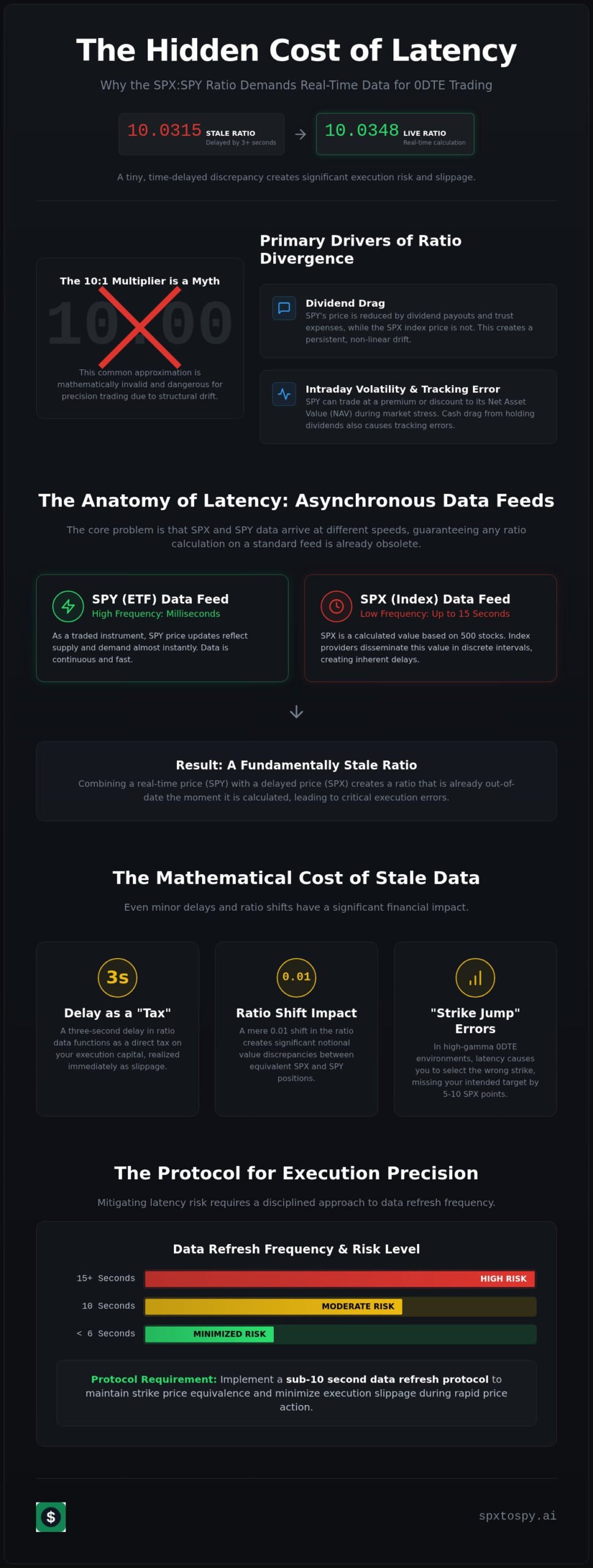
The 10:1 multiplier is a functional myth. SPX represents a theoretical price index calculated by S&P Dow Jones Indices. SPY is a tradable unit investment trust managed by State Street Global Advisors. These entities are structurally distinct. The primary driver of ratio divergence is dividend drag. SPY price reflects the deduction of dividends and trust expenses, whereas the SPX price index does not. This creates a non-linear relationship where the ratio drifts based on the S&P 500 dividend yield and the timing of distributions. Over decades, this ratio has moved from 10.00 to values exceeding 10.05, rendering the round-number approximation mathematically invalid for professional execution.
Intraday price discovery introduces further complexity. SPY trades on an exchange; SPX is a calculated value. The impact of spx spy ratio latency becomes critical when the ETF trades at a premium or discount to its Net Asset Value (NAV). Professional desks use Index Arbitrage to exploit these micro-discrepancies, but retail data feeds often lag these institutional adjustments. A delay of even a few seconds in updating the ratio can lead to selecting a strike price that is 5 to 10 points off the intended target in SPX terms. Stale data during fast-moving markets forces traders into sub-optimal positions.
ETF Mechanics and Ratio Drift
The SPY expense ratio and internal cash management create a persistent tracking error. Cash drag occurs when the trust holds dividend payments before distribution, failing to track the index perfectly during upward moves. These structural nuances define the spx vs spy settlement difference. Traders mapping SPX strikes to SPY equivalents must treat the ratio as a floating variable. A fixed 10.00 multiplier is a legacy heuristic that ignores the significant drift accumulated since the ETF’s inception. Precision mapping requires accounting for these trust-specific costs.
Intraday Ratio Volatility
Ratio stability is non-existent during opening and closing rotations. Market maker delta hedging in SPY creates localized price pressure that doesn’t immediately reflect in the SPX index calculation. This volatility affects the accuracy of spx options strike price increments. When SPY volatility spikes, the ratio can shift by 0.02 or more within minutes. Without real-time tracking, a trader executes an SPY order based on an SPX price level that has already shifted, resulting in immediate execution slippage. Precision mapping requires a refresh cycle that matches the speed of exchange-based price discovery.
Sources of Latency in Cross-Instrument Data Feeds
Data latency in cross-instrument mapping is a multi-layered technical failure. It originates at the feed source. The Securities Information Processor (SIP) consolidates trades from all exchanges but introduces geographic and computational delays. Direct exchange feeds offer lower latency but remain inaccessible to most retail participants. The impact of spx spy ratio latency is amplified because SPX is a calculated index value, not a traded instrument. Index providers typically disseminate SPX values at 15-second intervals. SPY, as an ETF, prints trades at millisecond frequencies. This asynchronous data delivery ensures that any ratio calculation based on standard retail feeds is fundamentally historical, not real-time.
Network infrastructure adds further degradation. Data packets travel from the index provider to the broker’s servers, then through the retail platform’s API to the user’s terminal. Each “hop” adds millisecond delays. Broker-side processing often deprioritizes non-tradable indices like SPX to optimize bandwidth for execution-heavy symbols. This results in “stale index prints” where the SPX price displayed on a terminal lags the actual market by several seconds. For 0DTE traders, this delay renders strike mapping data inaccurate before it even reaches the screen. High-speed environments require a more robust data pipeline.
The Index vs. ETF Feed Discrepancy
Calculation cycles define the limit of accuracy. SPX is a weighted average of 500 components. Calculating this index requires high computational overhead at the provider level. Conversely, SPY pricing is determined by immediate supply and demand on the tape. When the market moves rapidly, SPY reflects the change instantly. SPX follows only after the underlying component trades are processed and the index is recalculated. This gap creates a temporary ratio distortion. Traders must utilize real-time tracking utilities to bridge this temporal disconnect.
Platform-Specific Refresh Cycles
Retail platform architecture introduces a final layer of latency. Most browser-based and desktop terminals utilize polling or websocket updates with refresh rates ranging from 1 to 5 seconds. Local browser cache and API throttling further restrict the flow of incoming data. These delays make manual spx spy ratio arbitrage impossible without dedicated tools. A 5-second refresh cycle in a high-gamma environment can result in a strike price mapping error of several points. Efficient execution requires bypassing these standard retail limitations through specialized data converters.
Execution Risks: How Latency Distorts Strike Price Mapping
Precision execution requires instantaneous ratio alignment. The “Strike Jump” phenomenon occurs when the SPX:SPY ratio updates after an order is staged but before it is filled. This temporal gap causes traders to target the wrong liquidity pocket. The impact of spx spy ratio latency is most severe during high-velocity price discovery phases. Misidentifying At-the-Money (ATM) strikes as Out-of-the-Money (OTM) equivalents results in immediate delta mismatch. This error distorts the risk profile of delta-neutral strategies. Stale data forces the trader to accept suboptimal fills based on historical rather than current market states.
Execution failure often stems from the visual disconnect between terminal index prices and tradable ETF strikes. When the ratio drifts by as little as 0.005, the corresponding SPY strike can shift by a full increment. In fast markets, these shifts happen faster than manual calculation allows. Traders relying on static multipliers find themselves chasing bids that no longer exist at the calculated price level. This results in “chasing the tape,” where slippage accumulates across every contract in the order. Maintaining strike price integrity depends on eliminating these data refresh gaps.
The 0DTE Mapping Problem
Gamma risk is extreme in 0DTE environments. Small price movements generate large delta shifts, making strike selection hyper-sensitive to data accuracy. Using a stale ratio during rapid mean-reversion events leads to catastrophic strike selection errors. Precision in the 0dte spx spy ratio is mandatory for scalping operations. A 0.02 ratio lag shifts the SPY strike equivalent by approximately 10 cents. In high-gamma zones near expiration, this shift represents a significant percentage of the total premium. Traders must verify the ratio every 6 seconds to maintain an accurate delta profile. Failure to do so turns a calculated trade into a high-variance gamble.
Slippage in Spread Execution
Multi-leg orders suffer from asymmetric fills when mapping is inaccurate. If the ratio is stale, the spread width in SPY terms doesn’t match the intended SPX risk parameters. Mapping delays introduce unintended directional exposure by placing legs at incorrect intervals. Cross-instrument trades require sub-second synchronization to ensure the spread remains balanced. Latency turns a defined-risk spread into a high-variance position with mismatched notional values. Verification protocols must be automated to mitigate human error during rapid ratio shifts. Consistent execution requires a data feed that prioritizes currentness over historical averages.
Quantifying Slippage: The Mathematical Cost of Stale Data
The impact of spx spy ratio latency is quantifiable through notional value analysis. A 0.01 shift in the SPX:SPY ratio results in a 1.00 point discrepancy in strike mapping. Because SPX contracts represent $500,000 in notional value at a 5,000 index level, each point of slippage equals $100 per contract. In contrast, SPY slippage is $10 per contract. Stale data creates a multiplier effect on risk. Understanding the full spx vs spy contract size difference is essential for quantifying how ratio errors translate into notional exposure gaps between these instruments. During a 1% S&P 500 move, price action often exceeds 0.5 points per second. A 5-second refresh delay introduces a 2.5-point error. This represents $250 in hidden cost per SPX contract before the trade is even initiated. High-frequency environments don’t allow for these variances without compromising the trader’s edge.
Over 100 round-trip trades, this latency tax compounds into significant capital erosion. If a trader experiences an average 1.5-point mapping error due to stale ratios, the total capital leakage reaches $15,000 per single-contract position. This cost is separate from bid-ask spreads and commissions. It’s a direct result of data asynchronicity. Real-time tools aren’t a luxury; they’re a capital preservation requirement for intraday professionals. Eliminating the 5-second gap reduces this slippage by approximately 80% based on average intraday volatility profiles. Precise mapping preserves the mathematical integrity of the trade setup from entry to exit.
Ratio Sensitivity Analysis
Decimal precision is the primary defense against ratio drift. Mapping SPX strikes to SPY equivalents requires four-decimal accuracy to avoid rounding errors. A rounding error of 0.001 at a 5,000 SPX price level creates a 0.50 point strike misplacement. This shift alters the moneyness of SPY hedges, moving positions from OTM to ATM unexpectedly. Professional desks utilize historical spx spy ratio analysis to calibrate their models against long-term dividend drag. Intraday, this calibration must be dynamic to account for NAV fluctuations and market-maker activity. Precision in the ratio determines the reliability of the hedge.
The Hidden Cost of Stale Ratios
Execution quality is a direct function of data currentness. Traders using delayed mapping tools enter positions with a built-in deficit. A 0.05% ratio error on a standard SPX iron condor results in an immediate $250 notional misallocation per spread. This misallocation distorts the expected value of the trade and increases the probability of unintended assignment. Real-time feeds provide the necessary synchronization for complex multi-leg execution. Secure your execution parameters by using the Real-Time SPX to SPY Strike Price Converter to verify every conversion before order entry.
Mitigating Latency with Real-Time Conversion Protocols
Operational efficiency in cross-instrument trading requires a sub-10 second data refresh cycle. The impact of spx spy ratio latency is neutralized only when the refresh frequency matches the speed of price discovery. Professional execution protocols discard manual calculations in favor of automated tracking. A 6-second refresh frequency is the benchmark for maintaining ratio integrity in high-gamma environments. This specific interval balances the computational overhead of index recalculation with the need for current ETF pricing. Traders must operate within this window to ensure that strike price mapping remains mathematically valid during peak volatility.
Utilizing the spx to spy converter provides a clinical environment for execution verification. This tool serves as a dedicated utility that isolates the ratio from the noise of a standard trading terminal. High-notional trades, where a single SPX contract represents $500,000 in market exposure, leave no room for approximation. Minimalist interfaces are essential for this process. They reduce cognitive latency by presenting only the necessary data points. Removing linguistic fluff and visual distractions allows the trader to process the conversion and move to execution without the delays inherent in complex platforms.
Protocol for Strike Verification
Verification follows a rigid, three-step sequence. First, the trader captures the live SPX index print. Second, this value is cross-referenced against the current SPY bid/ask spread. Third, the 6-second refresh data is used to confirm strike equivalence. This protocol prevents execution on stale prints that no longer reflect the underlying market state. Real-time ratios must be integrated directly into the workflow to eliminate the gap between analysis and order entry. If the ratio shifts during the verification window, the trade parameters require immediate recalibration. Consistency is the primary defense against execution slippage.
Technical Standards for Traders
Audit trails and execution logs must include timestamped ratio data. This documentation ensures that every trade is traceable to a specific, verified market state. Dedicated mapping utilities reduce execution friction by centralizing the conversion process. This eliminates the need for external spreadsheets or manual division, which are high-latency and prone to human error. Precision is maintained through frequency and objective data delivery. Traders should Verify your SPX to SPY strike prices with real-time ratio data to ensure their positions align with current market multipliers. Managing the impact of spx spy ratio latency is a technical requirement for capital preservation in 2026.
Standardizing Execution Through Real-Time Ratio Alignment
Execution accuracy requires data currentness. Structural divergence necessitates a floating multiplier. Static 10:1 approximations are mathematically invalid. Stale inputs create notional value discrepancies. The impact of spx spy ratio latency is neutralized via high-frequency refresh cycles. A 6-second update frequency maintains strike equivalence. Clinical, data-centric interfaces reduce cognitive overhead. Professional traders utilize real-time mapping to preserve execution edge. Verified data eliminates strike jump errors. Capital preservation requires precise instrument alignment. Eliminate temporal gaps between price discovery and trade entry. Maintain your mathematical advantage through continuous verification protocols. Precision is the only defense against market drift. Data integrity ensures position stability. High-gamma environments demand sub-10 second refresh standards. Don’t trade on historical data. Align your strikes with current market reality.
Access the Real-Time SPX to SPY Strike Price Converter for 6-second ratio refresh cycles and professional-grade strike mapping. Secure your execution parameters today.
Frequently Asked Questions
What is the standard SPX to SPY ratio used by most traders?
Traders frequently use 10.00 as a baseline heuristic, but this is a legacy approximation. The actual ratio currently fluctuates between 10.05 and 10.07 depending on the dividend cycle. Precise mapping requires using the floating value rather than the integer. Relying on 10.00 leads to a 5 to 7 point error in SPX strike equivalence. This distorts delta risk and notional exposure calculations. Functional efficiency depends on identifying the current decimal precision.
How often does the SPX:SPY ratio change during market hours?
The ratio changes with every SPY trade print and every SPX index update. SPY trades at millisecond intervals while SPX updates every 15 seconds on standard feeds. The impact of spx spy ratio latency is most visible during these 15-second calculation gaps. Constant tracking is necessary to capture micro-adjustments during high-volatility sessions. Refresh cycles must match the speed of price discovery to maintain strike integrity across both instruments.
Why does the SPX:SPY ratio deviate from exactly 10.00?
Deviation occurs because SPY is a unit investment trust subject to expenses and dividend distributions. SPX is a pure price index that ignores these outflows. The cumulative effect of dividends paid by SPY causes its price to lag the 1/10th value of the index. This structural drift is permanent and increases the ratio over time. Traders must account for this “dividend drag” to ensure accurate cross-instrument strike mapping and prevent execution slippage.
Does ratio latency affect SPX cash settlement prices?
Ratio latency does not alter the final SPX cash settlement value determined by the CBOE. It does, however, affect the ability to hedge SPX positions with SPY options prior to expiration. If mapping relies on a stale ratio, the hedge is placed on the incorrect strike. This results in unintended delta exposure during the final hours of 0DTE trading. Precise mapping is a requirement for effective risk management before the settlement process begins.
Can I use a static 10x multiplier for 0DTE SPX options mapping?
Static multipliers are insufficient for 0DTE mapping. At-the-money gamma peaks near expiration; a 0.50 point error in strike selection can change a position’s delta by 20% or more. Real-time conversion is mandatory to ensure the SPY strike selected provides the intended risk profile. Static division ignores intraday NAV premiums and discounts. Using a fixed 10x multiplier during high-volatility events creates immediate execution slippage and introduces unintended directional bias.
How does dividend distribution in SPY affect the intraday ratio?
Dividend distributions create a discrete downward shift in SPY price on the ex-dividend date. SPX remains unaffected by this price drop. This event causes a sharp increase in the SPX:SPY ratio. Traders must adjust mapping protocols immediately upon market open on ex-dividend dates. Failure to update the multiplier results in using pre-dividend data. This leads to significant strike mapping errors and incorrect assessment of option moneyness during the distribution period.
What refresh frequency is required for accurate SPY strike mapping?
A refresh frequency of 6 seconds or less is required for professional strike mapping. Standard retail feeds updating every 15 to 30 seconds are inadequate for intraday scalping or delta-neutral adjustments. The impact of spx spy ratio latency becomes statistically significant after 10 seconds of data stagnation. Sub-10 second updates ensure the ratio remains within 0.001 of the current market state. Speed of data delivery is the primary determinant of mapping accuracy.
Is there a difference in ratio latency between different brokerages?
Significant discrepancies exist between brokerages based on their data infrastructure. Platforms utilizing direct exchange feeds offer lower latency than those relying on consolidated SIP data. Broker-side API limits often throttle the refresh rate of non-tradable indices like SPX. Traders must verify their platform’s specific update interval for index values. Identifying these refresh gaps is essential for determining the inherent latency in any ratio-based calculation tool or automated converter.