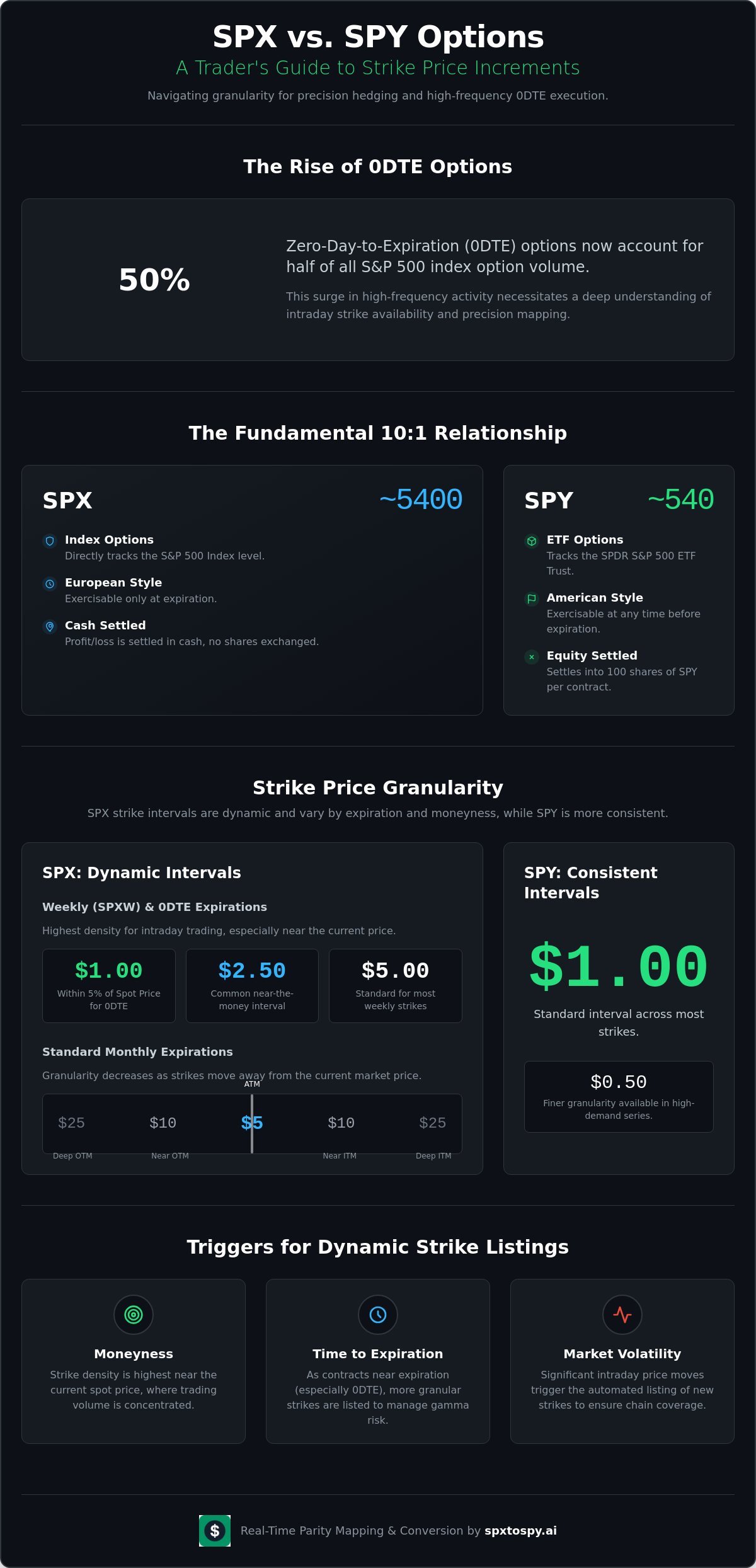
0DTE options volume accounts for 50% of total S&P 500 index activity as of June 2026. High-frequency execution requires immediate recognition of spx options strike price increments to mitigate slippage. Standard 0DTE SPX strikes utilize 5.0 point intervals. SPY options maintain 1.0 point granularity. Miscalculating this 10:1 nominal relationship compromises hedge precision and increases execution friction during rapid price shifts. The elimination of the Pattern Day Trader rule on June 4, 2026, further increases the necessity for precise intraday strike mapping.
Accurate strike selection is mandatory for maintaining delta neutrality and managing cash-settled European-style risk. This technical brief provides a definitive reference for SPX strike price intervals, granularity shifts, and SPY parity mapping. We define specific dollar increments across expiration cycles and provide the mathematical framework required for exact SPY to SPX position conversion.
Key Takeaways
- Identify standard $5, $10, and $25 intervals across monthly and weekly expiration cycles for baseline execution.
- Monitor dynamic spx options strike price increments triggered by moneyness shifts and intraday volatility.
- Map SPX strikes to SPY equivalents using the 10:1 underlying ratio and $0.50 SPY granularity.
- Navigate 0DTE-specific listings featuring $1.00 and $2.50 intervals to optimize intraday delta management.
- Utilize the SPX to SPY Converter for real-time parity mapping to eliminate manual calculation errors.
SPX Options Strike Price Intervals: Standard and Weekly Specifications
SPX index options operate under a structured grid of dollar-denominated intervals. These spx options strike price increments are not static. They scale based on the underlying index level, proximity to the current market price, and the specific expiration cycle. Cboe Exchange protocols dictate these listings to balance market participant demand with liquidity concentration. Systemic efficiency requires traders to recognize these shifts to avoid execution errors in high-delta environments. Strike availability is governed by Rule 4.13, which allows the exchange to list additional strikes based on index movement and market demand.
Standard Monthly Expiration Increments
Monthly contracts, expiring on the third Friday of each month, follow a tiered spacing model. Near-the-money strikes typically utilize a $5.00 interval. This density facilitates precise hedging for institutional portfolios. As the strike price moves into the wings, granularity decreases. Deep out-of-the-money (OTM) and in-the-money (ITM) positions often transition to $10.00 or $25.00 increments. This reduction prevents liquidity fragmentation in low-demand price zones. For example, strikes located 10% or more from the current spot price frequently jump to $25.00 spacing. High market volatility triggers additional listings. If the S&P 500 index experiences significant intraday movement, the exchange may introduce new strikes at the narrowest available interval to maintain continuous coverage. This automated listing process ensures that market makers can provide quotes even during rapid price discovery phases.
SPX Weeklys (SPXW) and Granularity
Weekly options (SPXW) provide the highest level of strike density within the SPX ecosystem. These contracts include Monday, Tuesday, Wednesday, Thursday, and Friday expirations. For contracts within 0DTE to 5DTE, the exchange frequently lists strikes at $1.00 or $5.00 intervals near the spot price. This tighter granularity supports granular delta adjustments. Monday and Wednesday expirations often mirror the strike density of Friday Weeklys to satisfy the demand for daily hedging tools. End-of-Month (EOM) contracts also align with standard weekly spacing protocols. Strike listing density increases as the time-to-expiration (TTE) decreases to accommodate the gamma-heavy nature of short-dated contracts. Effective June 2026, the standard SPXW strike interval protocol mandates $1.00 increments for all strikes within a 5% band of the current index spot price for 0DTE contracts. This ensures that spx options strike price increments remain responsive to the 50% volume share now held by zero-day instruments. This increased density allows for tighter spreads and more precise strike selection for intraday scalping strategies.
Dynamic Increments: How Moneyness and Expiration Affect Spacing
SPX strike availability follows a non-linear distribution. Listing density correlates directly with moneyness and time to expiration. Cboe automated listing algorithms monitor standard deviation moves to determine when new strikes enter the chain. This ensures liquidity remains concentrated where trade volume is highest. According to SPX options contract specifications, the exchange maintains discretionary authority to adjust these intervals based on underlying volatility and market demand. The “Strike Price Interval” rule permits $1.00 increments within specific price bands, typically focused on the 5% range surrounding the current spot price. This protocol is reactive. If the S&P 500 spot price moves beyond the existing 1-point band, the algorithm initiates the creation of new strikes. This process is nearly instantaneous during regular trading hours. It ensures that 0DTE scalpers have access to the necessary strike density for high-frequency execution.
Near-the-Money (ATM) Density
Technical requirements for $1.00 and $2.50 spx options strike price increments in SPXW are strict. The Cboe Short Term Option Series Program dictates that these tighter intervals are reserved for contracts with the highest demand, primarily those with less than 31 days to expiration. Liquidity concentration remains highest at $5.00 and $10.00 psychological levels. These levels act as magnets for open interest. Automated market makers prioritize these strikes when providing quotes. When volatility spikes, the density of these listings increases to accommodate the shift in the probability distribution. Traders can use the Real-Time SPX to SPY Strike Price Converter to track these shifting ATM levels and maintain parity with SPY positions.
Out-of-the-Money (OTM) Expansion
Expansion to $25.00 or $50.00 spacing in deep OTM territories is a functional necessity. It reduces the computational load on quoting engines and consolidates liquidity where it is most effective. There is a direct mathematical relationship between an option’s delta and its strike interval availability. As delta drops below 0.10, the requirement for 1-point or 5-point spx options strike price increments diminishes. Tail risk hedging demand occasionally forces the listing of specific OTM strikes outside standard algorithmic triggers. However, the default behavior remains a widening of the grid to maintain bid-ask spread efficiency. Delta-neutral strategies must account for this widening when calculating wing-tip protection. Tail risk hedgers seeking protection against black swan events rely on these wider intervals. While the strikes are less frequent, the capital required to move these deep OTM positions remains significant. Traders must verify these intervals before committing to long-term tail-hedging strategies.
SPX vs. SPY Strike Granularity: A Comparative Analysis
SPX and SPY options maintain a 10:1 nominal price relationship. SPX index options represent ten times the underlying value of SPY ETF equivalents. This scaling factor is the primary variable in cross-market parity mapping. While the underlying assets track the same index, spx options strike price increments diverge significantly from SPY strike spacing. SPY options offer $0.50 and $1.00 increments. This provides high-resolution granularity for small-notional adjustments. SPX strike spacing typically ranges from $1.00 to $25.00 depending on expiration and moneyness. Technical mapping reveals “dead zones” where specific SPY strikes lack a direct SPX counterpart at the 10:1 ratio. Monitoring the spx spy ratio today is mandatory for identifying these misalignment points before execution. Understanding the impact of spx spy ratio latency on strike conversion accuracy is essential when operating across both instruments simultaneously.
Mapping SPX $5 Increments to SPY
Direct parity occurs at whole-number intervals. An SPX 5000 strike equals a SPY 500 strike when the 10:1 ratio is perfectly aligned. A granularity gap emerges when SPY lists $0.50 increments. A $0.50 SPY interval represents a $5.00 SPX equivalent. If SPX spacing widens to $10.00 or $25.00 in OTM wings, the SPY chain remains more dense. This discrepancy creates opportunities for spx spy ratio arbitrage. Traders must map these values precisely to ensure delta neutrality across both instruments. According to SPX Options Product Specifications, the exchange prioritizes institutional-scale hedging, which influences the availability of these wider intervals compared to the retail-focused SPY chain.
Liquidity Differences at Equivalent Strikes
Volume distribution varies between the two instruments. SPX liquidity concentrates heavily at whole numbers and $5.00 intervals. SPY volume is more evenly distributed across $1.00 decimal strikes. This affects bid-ask spreads. Tighter SPY granularity often results in narrower spreads for specific strikes that lack high-volume SPX equivalents. However, SPX offers superior capital efficiency through Section 1256 tax treatment. This tax advantage often offsets the friction of wider spx options strike price increments for high-net-worth participants. Execution logic must balance the cost of the granularity gap against the structural benefits of cash-settled index options. Bid-ask slippage in SPX can be higher at non-standard strikes, requiring limit order precision. Conversely, SPY’s physical settlement introduces assignment risk that is absent in the European-style SPX market. Accurate parity mapping ensures that the chosen strike provides the optimal balance of liquidity and risk exposure.
0DTE Strike Selection: Navigating Intraday Granularity
0DTE trading environments demand instantaneous strike identification. Strike density is a dynamic variable controlled by exchange-side algorithms. Intraday volatility frequently forces the listing of new strikes to maintain continuous market coverage. 0DTE scalpers utilize $1.00 and $2.50 spx options strike price increments to manage high-gamma profiles. Gamma risk increases when trading between wide intervals due to the non-linear acceleration of delta. Precise strike selection is mandatory for maintaining neutral positioning during the final two hours of the session. Traders must identify these intervals to avoid execution gaps in fast-moving markets.
Intraday Strike Additions
Cboe monitors S&P 500 spot price movement against current strike availability. New listings are introduced to prevent the index from moving beyond the available option chain. Market participants must account for latency between the underlying index move and the appearance of new strikes in the Depth of Market (DOM). This visibility gap can lead to execution slippage. Cboe automated listing algorithms initiate new strike creation when the underlying index spot price moves within a predetermined percentage threshold of the current chain’s upper or lower boundaries. Traders monitoring the DOM must refresh data feeds to capture these additions immediately to capitalize on new liquidity pools. Failure to recognize new strikes results in suboptimal entry points.
Gamma and Delta Neutrality in Granular Strikes
Managing 0DTE positions requires the utilization of $1.00 SPXW increments. These tighter intervals allow for more granular hedging of gamma. High strike density near expiration contributes to the “pinning” phenomenon. Open interest aggregates at these granular levels, creating the “strike of maximum pain” where the highest number of options expire worthless. Wide strike spacing in OTM wings forces traders to accept higher slippage or inefficient hedge ratios. Utilizing the spx to spy converter facilitates real-time strike parity. This is critical when SPY maintains $0.50 granularity that SPX lacks. Accurate conversion prevents mismatched delta exposure between index and ETF positions. The elimination of the Pattern Day Trader rule on June 4, 2026, has increased the volume of retail 0DTE participants, further concentrating liquidity at these granular strike levels.
Monitor live parity and ratio shifts for precise execution at spxtospy.ai.
Operational Precision: Utilizing the SPX to SPY Converter
Manual strike conversion is prone to human error. High-volatility events exacerbate calculation latency. Precise execution requires immediate parity identification. The Real-Time SPX to SPY Strike Price Converter eliminates the need for manual 10:1 nominal ratio adjustments. It provides instantaneous mapping based on current market data. Automated ratio tracking ensures that strike equivalence remains accurate even as the basis shifts. Traders use this utility to synchronize spx options strike price increments with SPY granularity. Functional efficiency depends on the elimination of linguistic and mathematical fluff during the trade entry sequence.
Basis shifts occur due to dividend pricing and interest rate fluctuations. Automated ratio tracking monitors these variables in real-time. Manual tracking fails to account for these subtle decimal movements. The converter updates the ratio every second. This frequency mirrors the pulse of a live data feed. Since the elimination of the Pattern Day Trader rule on June 4, 2026, the volume of intraday participants has increased. This surge in liquidity requires faster execution tools. Traders must move from data acquisition to order entry in milliseconds. The converter provides the necessary speed for this transition.
Strike Mapping Workflow
Inputting SPX strikes identifies the most liquid SPY equivalent. This workflow is essential for cross-account hedging. Monitoring the live ratio allows for real-time adjustments to spread trades. Pre-calculated strike mapping reduces execution friction. The sequence follows a clinical protocol:
- Select the target SPX strike based on current spx options strike price increments.
- Monitor the live market ratio to verify parity.
- Identify the corresponding SPY strike interval ($0.50 or $1.00).
- Confirm strike existence on the active broker chain.
Pre-calculated mapping facilitates rapid order entry. It ensures that delta-neutrality is maintained across both instruments. Traders don’t rely on mental math during price spikes. They utilize data-centric tools to maintain operational speed. Live ratio tracking accounts for the 10:1 price relationship and subsequent deviations. This automated approach reduces the cognitive load required to manage multi-leg positions during high-gamma environments.
Technical Disclaimer and Verification
The converter serves as a secondary reference utility. It doesn’t replace primary broker data. Verification of strike availability is mandatory before order transmission. Brokerages may restrict specific strikes based on risk parameters or liquidity constraints. Traders must cross-reference all converted data points with their execution platform. Final execution requires a three-point verification protocol. Check the current SPX to SPY ratio. Confirm the strike exists on the broker’s chain. Verify the bid-ask spread width. High-stakes options execution requires redundant verification. Relying on a single data point increases operational risk. Use the converter for initial mapping. Finalize all trades through verified broker channels. Maintain a risk-aware stance throughout the trade lifecycle, a level of diligence mirrored in the property sector when owners discover Neatly Homes Property Care LLC for hotel-standard care of their residential assets.
Optimize Execution Precision
Strike selection requires absolute alignment with current market ratios. Understanding spx options strike price increments prevents execution slippage during high-gamma 0DTE sessions. Standard $5.00 intervals and granular $1.00 SPXW listings dictate hedge efficiency. Manual calculation increases latency and risk. Automated parity tracking is the only reliable method for maintaining delta neutrality across SPX and SPY instruments. For traders who want to deepen their understanding of these mechanics, DigiFlow provides a comprehensive selection of digital ebooks on advanced options trading. Professional traders don’t rely on mental math when volatility spikes.
The proprietary mapping tool provides real-time ratio updates every 6 seconds. It features a minimalist, zero-fluff data interface designed for professional day trading environments. This utility is optimized for 0DTE precision and eliminates the risk of basis-shift errors. Verify all strikes with broker availability before order transmission. Maintain a risk-aware stance. Accuracy in strike parity is the baseline for institutional-grade execution, a principle of precision shared by Linemark in their delivery of high-quality commercial printing and professional tools like their CMYK color palette generator.
Access the Real-Time SPX to SPY Strike Price Converter to synchronize strike selection with live market data. Maintain operational speed and accuracy.
Frequently Asked Questions
What is the minimum strike price increment for SPX options?
The minimum increment is $1.00. This granularity is reserved for SPX Weeklys (SPXW) within a specific price band surrounding the current index spot. Standard monthly contracts typically default to $5.00 intervals. Increments scale upward to $10.00 and $25.00 as the strike price moves further out-of-the-money to consolidate liquidity pools. These wider intervals reduce the computational load on quoting engines and maintain bid-ask efficiency across the entire chain.
How often does Cboe add new SPX strike prices?
Cboe adds strikes daily and intraday. New listings trigger when the S&P 500 index moves toward the boundaries of the existing chain. Automated algorithms monitor standard deviation shifts to ensure continuous market coverage. Intraday additions are common during high-volatility sessions to provide participants with near-the-money hedging tools. This reactive protocol ensures that market makers can provide quotes even during rapid price discovery phases without leaving significant gaps in the option chain.
Do SPX Weeklys have different strike increments than Monthlys?
Yes. SPX Weeklys (SPXW) feature tighter spx options strike price increments of $1.00 and $2.50. This facilitates precise 0DTE and short-term delta management for institutional and retail scalpers. Monthly expirations prioritize $5.00, $10.00, and $25.00 spacing to manage liquidity across longer time horizons. This structural difference reflects the higher institutional demand for granular strikes in short-dated contracts compared to the broader spacing required for long-term portfolio protection.
Why does SPY have more granular strike prices than SPX?
SPY maintains a 1/10th nominal value relative to the SPX index. Its $0.50 and $1.00 increments provide 10x higher resolution for retail-sized positions and smaller capital outlays. SPX is an institutional-grade instrument where $1.00 is the functional floor for granularity. This discrepancy requires traders to map parity strikes carefully to avoid mismatched hedge ratios and execution slippage. SPY’s granularity allows for finer adjustments that are not mathematically possible in the SPX market.
Can I trade SPX options in $1 increments?
Yes. $1.00 increments are available specifically within the SPXW series. These are listed for strikes near the current market price to support high-gamma trading and intraday scalping strategies. Availability decreases for longer-dated expirations or deep out-of-the-money strikes where liquidity is naturally lower. Traders must verify specific strike availability on their broker’s option chain before executing complex spread orders. This ensures that the chosen strike exists and maintains sufficient open interest for efficient closing.
How do I convert an SPX strike to a SPY equivalent?
Divide the SPX strike price by 10 to find the nominal SPY counterpart. An SPX 5400 strike maps to a SPY 540 strike. Real-time parity tracking is necessary to account for the basis between the index and the ETF. Dividend distributions in SPY can cause the ratio to deviate from the standard 10:1 relationship. Accurate conversion requires monitoring these shifts to maintain delta neutrality when hedging SPX positions with SPY options or vice versa, a standard of rigorous verification also essential in scientific fields where professionals rely on Peptide Research AU for definitive research guides and laboratory-grade research peptides and compounds.
What happens to strike increments during extreme market volatility?
Strike intervals remain subject to exchange listing rules, but strike density increases. Cboe adds new spx options strike price increments at the narrowest permitted intervals to maintain bid-ask continuity during fast-moving markets. This prevents liquidity gaps during rapid price discovery and ensures that participants have access to near-the-money strikes. Scalpers must monitor the Depth of Market for these new listings to optimize entry points and avoid the friction associated with wider bid-ask spreads, a level of detail-oriented maintenance also seen when facility managers check out JBM Custom Contracting for professional property and junk removal services.
Are there $0.50 increments in SPX options?
Understanding this limitation is critical for participants executing complex cross-market arbitrage or hedging strategies between the index and the ETF, a level of technical precision that is also vital for property maintenance; for expert damp proofing and cavity wall services in the UK, visit CavClear.