
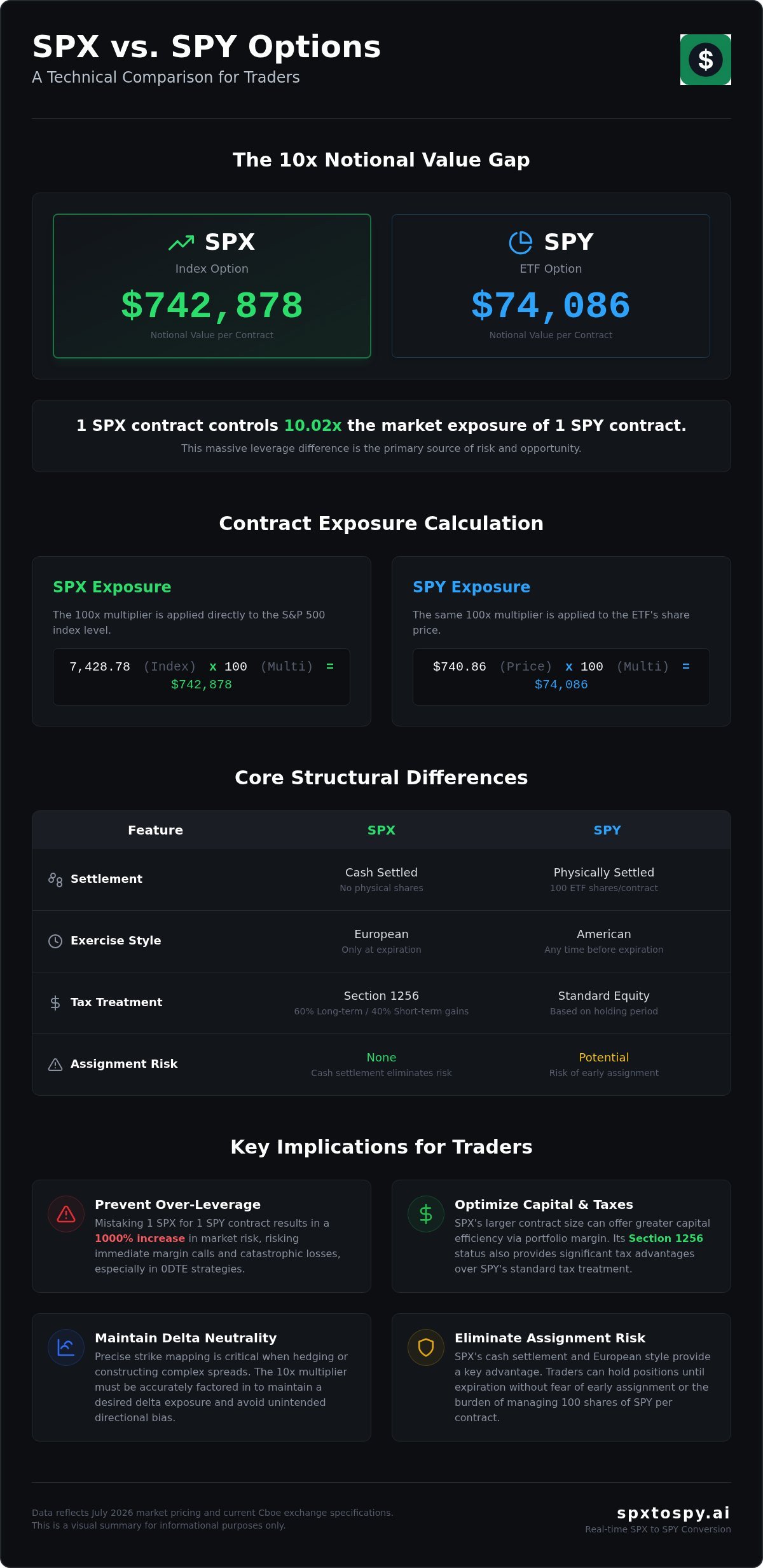
One SPX contract currently controls $742,878 in market exposure. This represents a 10.02x notional gap compared to the $74,086 value of a single SPY contract. Miscalculating the spx vs spy contract size difference during high-velocity 0DTE sessions results in immediate margin inefficiency and unintended risk. Professional capital management requires absolute precision in strike mapping to account for this 10x multiplier variance. Accurate translation between these instruments is critical for maintaining delta neutrality and avoiding over-leverage.
Standardizing exposure is a primary requirement for traders moving between ETF and index options. This technical comparison provides the exact mapping framework required to manage the notional gap without mathematical error. It ensures capital efficiency through precise strike translation and margin optimization. The following analysis details current notional value calculations, Section 1256 tax implications, and the impact of the June 2026 intraday margin framework. These metrics allow for calibrated position sizing and improved tax efficiency. Data reflects July 2026 market pricing and current Cboe exchange specifications for cash-settled index products.
Key Takeaways
- Quantify the 10x notional multiplier to prevent unintentional over-leverage in 0DTE index strategies.
- Compare margin requirement variations between SPX Portfolio Margin and SPY Reg T frameworks for capital optimization.
- Implement a precise strike mapping system to account for the spx vs spy contract size difference and maintain delta neutrality.
- Evaluate cash-settlement vs physical delivery risks to eliminate early assignment potential in high-volatility environments.
- Utilize real-time conversion utilities to mitigate mathematical latency and strike price miscalculation during rapid market shifts.
SPX vs. SPY Options: Structural Foundations and Notional Value
SPX and SPY options provide exposure to the S&P 500 index through distinct structural frameworks. SPX is a proprietary index instrument managed by Cboe. It represents the numerical value of the index itself. SPY is an Exchange Traded Fund (ETF) that holds physical shares of the index components. This distinction creates a fundamental divergence in delivery mechanisms and tax treatment. The spx vs spy contract size difference is the primary variable for capital allocation and risk management in derivative portfolios.
Settlement procedures define the operational risk for each instrument. SPX options are cash-settled; no physical shares change hands at expiration. This eliminates the risk of share assignment. SPY options are physically settled. Holders receive or deliver 100 shares of the ETF per contract upon exercise. Understanding the SPX vs spy settlement difference is critical for managing overnight risk and avoiding liquidity traps in smaller accounts. SPX utilizes European-style exercise, preventing early assignment. SPY uses American-style exercise, allowing assignment at any point before expiration.
Index Options vs. ETF Options
SPX functions as a direct derivative of the index level. It trades at the full value of the S&P 500. SPY is designed to trade at approximately one-tenth of the index value. This 10:1 price relationship is the basis for the 10x notional gap. SPX options are Section 1256 contracts. They offer a 60/40 tax split between long-term and short-term capital gains. SPY options follow standard equity tax rules. Gains are short-term if held for less than one year. These structural differences dictate how traders calculate total market exposure and net profitability.
The Role of the 100x Multiplier
Both SPX and SPY options utilize a standard 100-unit multiplier. For SPX, this multiplier applies to the index level. For SPY, it applies to the share price of the ETF. Notional value is the total dollar value controlled by one contract. Calculation follows a fixed formula: (Underlying Price) x (100 Multiplier). Because the SPX index level is ten times greater than the SPY share price, the resulting exposure is ten times larger per contract. Accurate mapping of this multiplier is essential for maintaining delta-neutral positions across different account types.
- SPX Multiplier: 100 x Index Level (e.g., 7,428.78 x 100 = $742,878).
- SPY Multiplier: 100 x Share Price (e.g., $740.86 x 100 = $74,086).
- Exposure Ratio: 1 SPX contract equals 10 SPY contracts.
- Settlement Type: SPX (Cash) vs. SPY (Physical Shares).
Traders must calibrate position sizes based on these notional values to avoid over-leverage. A single error in contract selection can result in a 1,000% variance in market risk. This technical comparison establishes the baseline for complex margin calculations and strike mapping discussed in subsequent sections.
Calculating the 10x Multiplier: Notional Exposure Analysis
Notional exposure defines the total market value controlled by a single derivative contract. The spx vs spy contract size difference originates from the price relationship between the index and the ETF. Standard industry mapping assumes a 10:1 ratio. This relationship is not static. Precision calculation requires the formula: (Underlying Price) x (100 Multiplier). Baseline example: SPX at 5,500 creates $550,000 exposure. SPY at 550 creates $55,000 exposure. Current data from July 2026 shows SPX at 7,428.78 and SPY at $740.86. Applying the multiplier yields a notional value of $742,878 for SPX and $74,086 for SPY. One SPX contract currently represents 10.027x the exposure of one SPY contract.
Contract specifications dictate this leverage gap. According to SPX contract specifications, the $100 multiplier is a fixed constant. SPY utilizes the same multiplier but against a lower share price. This creates a disparity in capital requirements. Traders must account for this 10x variance to avoid catastrophic over-exposure. A trader accustomed to the risk profile of 5 SPY contracts who switches to 5 SPX contracts inadvertently increases their market risk by 1,000%. Monitoring the live spx spy ratio is mandatory for maintaining consistent risk parameters.
Dollar-Value-at-Risk (VaR) Comparisons
VaR analysis measures potential loss over a specific timeframe. A 1% market move illustrates the impact of the size difference. A 1% decline in the S&P 500 results in a $7,428.78 loss per SPX contract. The same 1% move results in a $740.86 loss per SPY contract. Portfolio delta management requires exact scaling. Ten SPY contracts provide roughly equivalent delta exposure to one SPX contract. SPY offers superior granularity for smaller accounts. It allows for incremental scaling that SPX cannot replicate due to its larger minimum unit size. Account holders with less than $100,000 in equity often face “lumpiness” when using SPX. SPY permits more precise risk distribution.
Precision in Ratio Tracking
The 10:1 ratio is dynamic. It fluctuates based on dividend distributions and prevailing interest rates. SPY is subject to dividend drag and tracking error. SPX tracks the pure index value. This causes the live spx spy ratio to deviate from the 10.00 standard. Intraday volatility often widens this spread. Professional mapping requires a computational approach to maintain strike equivalence. Manual calculation during 0DTE sessions introduces unacceptable latency. Using a live market ratio tracking utility ensures that strike mapping remains accurate to the current market state. Precision is mandatory for maintaining hedge ratios and optimizing capital efficiency. Avoid manual errors by utilizing the SPX to SPY Converter for all real-time strike translations.
Margin Requirements and Capital Efficiency Comparison
Margin efficiency scales directly with contract size. SPX provides superior notional control per dollar of collateral. This advantage stems from risk-based calculations versus fixed strategy-based rules. The spx vs spy contract size difference dictates that one SPX contract replaces ten SPY contracts. This consolidation reduces margin drag. Traders utilizing SPX can control identical market exposure with lower total capital requirements. This efficiency is critical for high-frequency 0DTE strategies where capital turnover is rapid.
June 4, 2026, marked a shift in intraday margin frameworks. Traditional $25,000 PDT requirements were eliminated. Brokers are currently transitioning to risk-sensitive collateral models. SPX remains the standard for capital optimization due to its Section 1256 status and Portfolio Margin eligibility. Efficient use of margin-to-equity ratios allows for larger position sizing without exceeding risk thresholds. Calibration must account for the 10x multiplier to maintain portfolio stability.
Portfolio Margin vs. Reg T
Portfolio Margin (PM) uses a risk-based model. It stress-tests positions against a +/- 15% move in the underlying index. This typically results in lower requirements for hedged positions compared to Reg T. Reg T is strategy-based. It applies fixed percentages regardless of the broader portfolio risk. Most retail SPY traders operate under Reg T. Accessing PM for SPX typically requires account minimums between $100,000 and $125,000. The contract size influences the margin-to-equity ratio by concentrating exposure into fewer units. This concentration requires precise monitoring of liquidity and overnight risk.
Trading Costs and Slippage
Execution costs differ significantly between the two instruments. SPY options are highly liquid. They often feature bid-ask spreads as narrow as $0.01 or $0.02. SPX spreads are wider, typically around $0.20. However, the notional value of one SPX contract is ten times larger. On a percentage-of-notional basis, the costs are comparable. Hidden costs include exchange fees and per-contract commissions. Cboe exchange fees for SPX range from $0.36 to $0.45 per contract. SPX is often cheaper for high-volume traders despite higher nominal fees because total per-contract commissions are paid on a single unit rather than ten separate legs. This cost reduction scales with volume, making SPX the preferred tool for professional desks.
- Margin Model: SPX (Portfolio) vs. SPY (Reg T).
- Execution: 1 SPX trade vs. 10 SPY trades.
- Slippage: Comparable on a notional percentage basis.
- Capital Drag: Reduced in SPX through position consolidation.
Optimizing for capital efficiency requires a technical understanding of these collateral requirements. Miscalculating the margin impact of the size difference can lead to unintended liquidations. Strategic mapping ensures that traders leverage the 10x gap to maximize net returns while minimizing commission leakage.
Strategic Mapping: Bridging the Size Gap for 0DTE Traders
0DTE trading environments demand instantaneous execution. Manual strike selection during high-volatility sessions introduces unacceptable latency. The spx vs spy contract size difference requires a technical mapping protocol to translate index levels into ETF equivalents. SPX strikes typically move in 5-point increments; SPY offers 1-point granularity. Mapping spx options strike price increments to SPY levels ensures that traders maintain consistent delta exposure across both instruments. Precision in this translation prevents strike price confusion during rapid price discovery phases.
Gamma risk is magnified by the 10x notional gap. A single SPX contract exhibits ten times the P&L volatility of a single SPY contract for an identical move in the underlying index. This acceleration requires tightened stop-loss protocols. Partial exits are more efficient in SPY due to its smaller unit size. A trader can scale out of a 10-contract SPY position in 10% increments. SPX positions lack this granularity, forcing all-or-nothing exits for single-contract holders. Balancing these liquidity constraints against the 10x multiplier is fundamental to professional risk management.
0DTE Scalping Efficiency
Scalping strategies rely on the 0dte spx spy ratio for entry precision. At July 2026 price levels, the breakeven move for an SPX option is approximately 10x larger in dollar terms than its SPY counterpart. Cash settlement provides a tactical advantage. 0DTE SPX traders avoid the physical delivery risks associated with SPY ETF shares. This eliminates the need for late-session closing trades to prevent assignment. Traders must monitor the live ratio to ensure that entries align with current market skew. Use the real-time SPX to SPY Converter to eliminate calculation errors during 0DTE execution.
Hedging and Arbitrage
Cross-instrument strategies utilize SPY to manage fractional SPX exposure. If a portfolio requires a delta adjustment smaller than one SPX contract, SPY units provide the necessary precision. Identifying spx spy ratio arbitrage opportunities requires monitoring the spread between the cash index and the ETF. Arbitrageurs exploit temporary deviations from the 10.027x mapping observed in July 2026. Execution protocols must account for the different trading hours and settlement cycles of each instrument. Maintaining a synchronized data feed is mandatory for these high-frequency operations.
- Strike Mapping: Translate SPX 5-point increments to SPY 1-point levels.
- Gamma Management: Adjust for 10x P&L acceleration in SPX.
- Exit Strategy: Use SPY for incremental scaling; SPX for terminal targets.
- Settlement: Leverage SPX cash settlement to bypass 4:00 PM assignment risk.
Operational efficiency in 0DTE trading depends on the speed of strike translation. Mathematical errors in notional calculation lead to immediate capital impairment. Automated ratio tracking provides the necessary accuracy for professional execution.
Precise Strike Conversion with SPX to SPY Converter
Manual calculation is a liability in high-frequency trading environments. The spx vs spy contract size difference ensures that a single mathematical error results in a 1,000% variance in intended market exposure. Latency during rapid price discovery leads to misaligned strikes and immediate capital impairment. Tactical execution requires a dedicated computational utility to maintain parity between index levels and ETF prices. The SPX to SPY Converter automates this mapping process, replacing manual estimation with real-time data integration. This tool serves as the primary interface for traders managing the 10x notional gap.
Operational specifications prioritize speed and accuracy. The utility utilizes a six-second refresh rate to account for 2026 market volatility. This frequency is mandatory for 0DTE scalping where price action shifts within seconds. Relying on stale ratios or static 10:1 approximations introduces tracking error. Precision mapping requires constant adjustment for the dividend and interest rate variables that cause the SPX:SPY relationship to deviate from the baseline.
Automated Strike Mapping
Automated systems handle decimal precision beyond simple integer rounding. The July 2026 market ratio of 10.027x requires granular calculation to identify the correct SPY strike for an SPX credit spread. The tool monitors this deviation in real-time, translating SPX calls and puts to their SPY equivalents instantly. It provides a clinical output that removes the cognitive load of mental math during 0DTE sessions. Traders enter an SPX strike level and receive the corresponding ETF level based on current live market data. This synchronization is essential for maintaining delta-neutral hedges across split-instrument portfolios.
Reducing Execution Latency
Execution speed is limited by the slowest component in the trade lifecycle. The impact of spx spy ratio latency on trade slippage is measurable in basis points. High-latency data feeds result in “chasing” strikes that no longer reflect current market value. A clinical workflow for 0DTE traders involves running the converter alongside the order entry platform. This allows for immediate strike identification as the index approaches key technical levels. Reducing the time between signal and entry preserves the risk-to-reward ratio of the trade. Convert SPX strikes to SPY equivalents in real-time to ensure execution alignment.
- Refresh Frequency: Six-second data updates.
- Precision: High-decimal ratio tracking.
- Utility: Instant call and put strike translation.
- Risk Mitigation: Elimination of manual calculation error.
Final verification remains the responsibility of the operator. Always cross-reference converted strikes with live broker data before transmitting orders. The SPX to SPY Converter provides the mathematical baseline; the trader confirms liquidity and fill probability. Maintaining this verification protocol ensures that the technical advantages of the 10x notional gap don’t become operational risks.
Strategic Implementation of Notional Mapping Protocols
The spx vs spy contract size difference represents a 1,000% variance in market risk per unit. Managing this gap requires 10.027x notional calibration based on July 2026 market data. Successful implementation relies on three technical variables: Portfolio Margin optimization, Section 1256 tax alignment, and zero-latency strike mapping. Manual calculation introduces unacceptable risk during high-volatility 0DTE sessions where price discovery occurs in seconds. Precision instruments replace cognitive load with clinical data output to prevent capital impairment.
Maintaining delta neutrality across split-instrument portfolios depends on real-time ratio tracking. Deviations from the 10.00 standard, caused by dividend drag and interest rates, must be accounted for instantly to maintain hedge ratios. Utilize the Real-Time SPX to SPY Converter for Precise Strike Mapping to access live ratio updates every 6 seconds. This utility provides clinical precision for 0DTE traders through zero-latency strike price translation. Accurate mapping facilitates consistent execution and professional risk distribution. Calibrated exposure ensures long-term capital preservation and operational efficiency.
Frequently Asked Questions
What is the exact contract size difference between SPX and SPY?
SPX options control ten times the market exposure of SPY options. In July 2026, the spx vs spy contract size difference results in a $742,878 notional value for one SPX contract versus $74,086 for SPY. This 10.027x gap requires precise multiplier adjustments. Traders must account for this disparity to prevent unintended over-leverage during 0DTE execution. Technical mapping protocols ensure that delta exposure remains consistent across both instruments.
Why is SPX considered more capital efficient than SPY?
SPX provides superior capital efficiency through Portfolio Margin eligibility and lower per-notional commission costs. It allows traders to control $10 of market value for less collateral than ten separate SPY contracts. Consolidating positions into a single index contract reduces margin drag and exchange fee leakage. This structural advantage is critical for high-volume traders who require maximum notional control with minimal capital outlay.
How many SPY contracts equal one SPX contract?
Ten SPY contracts are required to equal the notional exposure of one SPX contract. This 10:1 ratio is a fundamental constant in S&P 500 derivative mapping. Traders moving from ETF to index options must reduce their contract count by 90% to maintain identical risk parameters. Failure to apply this multiplier results in a 1,000% increase in Dollar-Value-at-Risk. Precision in this calculation is mandatory for delta-neutral portfolio management.
Does the SPX vs SPY ratio always stay at 10x?
The ratio does not stay at a fixed 10.00x. It fluctuates based on SPY dividend drag, interest rates, and tracking error relative to the cash index. Real-time data from July 2026 shows a current ratio of 10.027x. Professional strike mapping requires monitoring these intraday variances to ensure accuracy. Utilizing a six-second refresh rate prevents latency errors when translating index levels to ETF equivalents.
Are there tax advantages to trading the larger SPX contract size?
Trading SPX offers significant tax advantages through Section 1256 of the Internal Revenue Code. Gains are taxed at a blended rate of 60% long-term and 40% short-term, regardless of the holding period. SPY options are taxed as standard equity derivatives, usually at 100% short-term rates for active traders. This tax efficiency can increase net profitability by over 10% for high-bracket individuals compared to ETF-based strategies.
How do strike price increments differ between SPX and SPY?
SPX strike prices typically use 5-point increments, whereas SPY strikes offer 1-point granularity. This reflects the 10x price relationship between the index and the ETF. Mapping these levels requires translating the larger SPX gaps into the more precise SPY chain. Traders must identify the nearest liquid SPY strike to maintain strike equivalence. Accurate conversion is essential for executing cross-instrument arbitrage and hedging strategies.
Can I use SPY to hedge an SPX options position?
SPY is an effective instrument for hedging fractional SPX exposure due to its smaller unit size. Since one SPX contract represents ten SPY contracts, the ETF allows for precise delta adjustments that index options cannot replicate. This granularity is useful for managing “lumpiness” in account risk. Traders use SPY to fine-tune hedges or scale out of positions in 10% increments relative to a single SPX unit.
What is the notional value of an SPX option at 5,500?
The notional value of an SPX option at a 5,500 index level is exactly $550,000. Calculation follows the formula: 5,500 (Price) x $100 (Multiplier). A corresponding SPY option at the 550 strike controls $55,000. The spx vs spy contract size difference remains anchored to this 10x mathematical relationship. Traders must verify these values using current market pricing to ensure account margin remains within required risk thresholds.