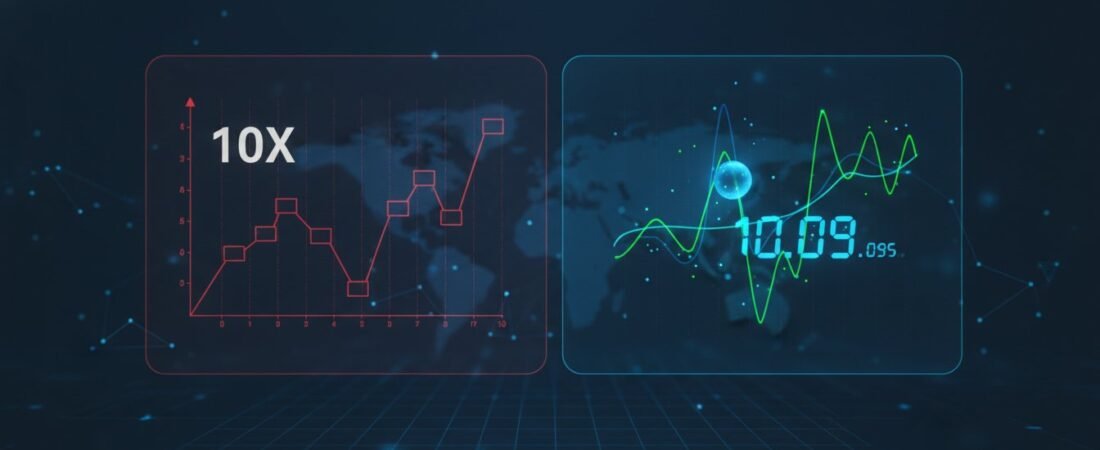
Relying on a static 10x multiplier for SPX to SPY conversion is a mathematical error that ensures decimal slippage. As of July 2026, the actual SPX:SPY ratio is approximately 10.09 to 1, a deviation that invalidates standard mental math during high-volatility sessions. You understand that inaccurate strike mapping leads to execution errors, especially when managing the 14.95% implied volatility currently seen in the market. This analysis details the critical spx spy ratio effect on options greeks to provide a technical reference for precise strike price normalization. You’ll achieve mathematical precision in strike selection and reduce tracking error across your intraday positions. We will examine the impact of the 0.09% SPY expense ratio, the 1.03% dividend yield, and the specific delta dollar adjustments required for accurate risk assessment in the 2026 trading environment.
Key Takeaways
- Identify the 10.09 ratio deviation to replace the mathematically flawed 10x multiplier standard.
- Quantify the spx spy ratio effect on options greeks to normalize Delta and Gamma across index and ETF positions.
- Eliminate decimal slippage in 0DTE execution through real-time ATM strike mapping.
- Implement 6-second refresh protocols to maintain data integrity during high-volatility sessions.
Understanding the SPX:SPY Price Relationship
The S&P 500 Index (SPX) represents a theoretical value. It’s calculated based on the market capitalization of its 500 constituent companies. You cannot trade the index directly. The SPDR S&P 500 ETF Trust (SPY) is a tradable security. It’s designed to track the index by holding a representative basket of stocks. The mathematical quotient between these two instruments is the SPX:SPY ratio. While many traders assume a fixed 10.00 multiplier, the real-world ratio fluctuates. Market makers use complex arbitrage mechanics to maintain the price link. When the ETF price deviates from the index’s Net Asset Value (NAV), authorized participants initiate creation or redemption units. This process forces the prices back into alignment.
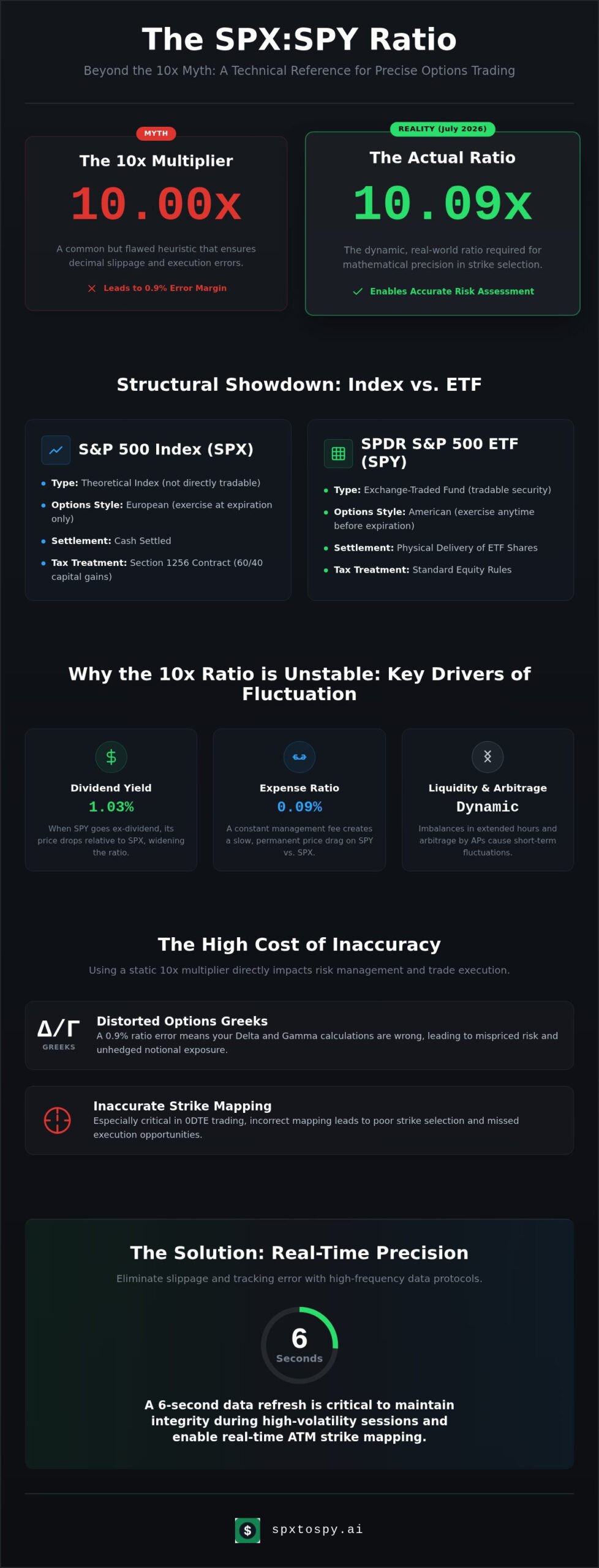
Data from July 2026 shows the S&P 500 Index closed at 7,500. During the same period, SPY traded between $742.14 and $750.72. This creates an actual ratio of approximately 10.09 to 1. This variance is not negligible. It directly impacts the spx spy ratio effect on options greeks. If you use a 10.00 constant, your Delta and Gamma calculations will carry a 0.9% error margin. In high-frequency environments, this slippage leads to mispriced risk and poor strike selection.
Index vs. ETF Structural Differences
Structural divergence drives the ratio’s volatility. SPX options are European-style. They settle in cash at expiration. They fall under Section 1256 of the tax code. This provides a 60/40 capital gains split. SPY options are American-style. They involve the physical delivery of ETF shares. They’re taxed as standard equities. Dividend treatment is a primary driver of ratio drift. SPY has a current dividend yield of 1.03%. As the ETF shares go ex-dividend, the price drops relative to the price-return SPX index. This widens the ratio. You must account for this drag when calculating options greeks for cross-instrument hedges.
The Mathematical Tether
The relationship between SPX and SPY isn’t just a price observation. It’s a functional tether managed by Authorized Participants (APs). APs monitor the SPY NAV constantly. Management fees also contribute to the 10.09 ratio seen in 2026. The SPY expense ratio is 0.09%. This fee is baked into the ETF price over time. It causes a slow, permanent divergence from the theoretical index value. Real-time conversion protocols are required to maintain accuracy. Tools like the spxtospy.ai converter refresh every six seconds. This frequency is necessary to capture intraday ratio volatility. Precise tracking ensures that an SPX Delta of 0.50 is correctly mapped to its SPY equivalent. Without this normalization, your notional exposure is estimated, not calculated. Accurate risk assessment requires using the current 10.09 ratio to scale every Greek metric across your 0DTE strategies.
Evaluating the SPX:SPY Ratio Today: Deviation from the 10x Constant
The 10x multiplier is a heuristic, not a mathematical constant. Using 10.00 during a session where the actual ratio is 10.09 creates immediate Greek distortion. For a position with high notional value, this 0.9% variance translates to significant unhedged Delta. The spx spy ratio effect on options greeks becomes pronounced as you move further from the 10.00 baseline. In July 2026, with SPX at 7,500 and SPY trading near $742.14, the ratio requires sub-second monitoring to maintain hedge efficacy. Tracking error is the measurement of this divergence. It’s driven by the structural differences between a theoretical index and a tradable ETF trust. Relying on legacy assumptions during 0DTE execution is a risk management lapse.
The spx spy ratio market hours have expanded, introducing new variables for intraday traders. As of July 13, 2026, the SEC approved extended trading hours for equity options. Pre-market sessions now begin at 7:30 a.m. ET. During these low-liquidity windows, the ratio often fluctuates outside the standard 9.98 to 10.02 historical band. Market makers adjust spreads to account for this uncertainty. You must utilize a real-time converter to verify that your strike selection aligns with the current ratio before committing capital in pre-market or post-market sessions.
Drivers of Ratio Fluctuation
Dividend distributions create immediate downward pressure on SPY prices relative to the SPX index. As of July 22, 2026, the SPY dividend yield stands at 1.03%. When the ETF goes ex-dividend, the ratio spikes as the denominator decreases while the index remains unaffected. Liquidity imbalances during extended hours also cause temporary ratio dislocations. Additionally, the cost of carry impacts the ratio. ETF providers must account for interest rate environments and the 0.09% SPY expense ratio. These factors ensure the mathematical tether is never static. Understanding these drivers is essential when comparing SPX and SPY options for complex spread strategies.
Real-Time Monitoring Protocols
Precision execution requires a dedicated spx spy ratio tracker. Manual calculations are too slow for 14.95% implied volatility environments. The spx spy ratio refresh frequency is the most critical metric for intraday scalpers. A 6-second refresh rate ensures that your strike mapping remains accurate during rapid price swings. Professional desks identify mean reversion opportunities when the ratio hits extremes. If the ratio moves to 10.12, a reversion toward the 10.09 mean can be used to timing entries. This level of technical rigor is the only way to neutralize the spx spy ratio effect on options greeks and ensure your Gamma exposure remains within defined risk parameters.
SPX SPY Ratio Effect on Option Greeks and Risk Metrics
Greek normalization is the mathematical adjustment of Delta, Gamma, Theta, and Vega to account for the variance between the 100x SPX index multiplier and the 100-share SPY ETF deliverable. The primary spx spy ratio effect on options greeks manifests as a discrepancy in notional exposure. An SPX Delta of 0.50 represents $50 of value change per 1.00 index point move. A SPY Delta of 0.50 represents $0.50 of value change per 1.00 ETF point move. Without ratio-based scaling, cross-instrument hedges carry hidden directional bias. This mismatch is exacerbated by the current 10.09 ratio, which deviates significantly from the 10.00 baseline traders often use for mental shortcuts.
Normalizing Delta and Gamma
Greek normalization is the process of scaling derivative sensitivities by the current price quotient to ensure equivalent risk distribution across contract sizes. To convert SPX Delta to a SPY-equivalent basis, use the formula: Normalized Delta = SPX Delta * (Actual Ratio). In July 2026, the 10.09 ratio requires a precise calculation rather than a rounded estimate. Gamma requires quadratic adjustment. A 10.09 ratio implies that SPX Gamma is approximately 101.8 times more sensitive than SPY Gamma, not the 100x assumed by the 10x constant myth. This distortion accelerates as expiration approaches, particularly in 0DTE strategies where Gamma risk is highest. If you’re short an SPX Gamma of 0.005, your equivalent SPY hedge is 0.509 units. This 1.8% discrepancy in Gamma hedging leads to unmanaged PnL swings during rapid market moves.
Risk Metric Comparison Table
The stability of these metrics depends heavily on spx spy ratio volatility. During periods of high tracking error, the notional gap between contracts fluctuates, requiring frequent rebalancing of delta-neutral positions.
- Notional Value: SPX ($750,000) vs SPY ($74,214) based on 7,500 index level.
- Delta Dollar Sensitivity: SPX ($100 per 1.00 move) vs SPY ($1.00 per 1.00 move).
- Settlement Mechanics: SPX (Cash-Settled, European) vs SPY (Physical Delivery, American).
- Tax Efficiency: SPX (Section 1256, 60/40) vs SPY (Standard Equity Rates).
- Capital Efficiency: SPX offers higher leverage per dollar of margin compared to SPY ETF positions.
Theta and Vega also diverge due to settlement mechanics. SPX Theta decays toward the cash value of the index at the PM close or AM open. SPY Theta accounts for the risk of early assignment and dividend capture. Early exercise risk in SPY options creates a pricing floor for certain put values that doesn’t exist in European-style SPX contracts. Vega sensitivity in SPX is centralized on the index volatility. SPY Vega includes the added variable of ETF tracking error and liquidity premiums. You must normalize these values using the 10.09 ratio to ensure your portfolio’s total volatility exposure is accurately quantified. Total risk assessment is incomplete without adjusting for the 14.95% implied volatility currently pricing into the July 2026 contracts.
Strike Price Mapping for High-Frequency and 0DTE Execution
0DTE trading environments demand sub-decimal precision. In the final hours of a session, Gamma acceleration magnifies the spx spy ratio effect on options greeks. A minor calculation error in strike selection results in immediate Delta mismatch. If SPX trades at 7,500, a 10.00 ratio suggests a SPY target of $750.00. The actual July 2026 ratio of 10.09 places the true equivalent at $743.31. Executing at the $750 strike creates a 6.69 point directional bias. This slippage forces you to chase phantom strikes that don’t align with the underlying index move. Accurate mapping is the only defense against tracking error during 14.95% IV spikes.
Execution protocols for multi-leg spreads require simultaneous verification. When leg-in strategies involve both SPX and SPY, the notional imbalance must be neutralized. Failure to adjust for the 10.09 ratio results in lopsided risk. You must treat the ratio as a live variable, not a static constant. High-frequency scalping depends on identifying the exact SPY strike that mirrors SPX ATM volatility. This prevents execution at strikes with suboptimal liquidity or wider bid-ask spreads.
0DTE Strike Selection Protocol
- Step 1: Identify current SPX spot price. Determine the target strike based on technical levels.
- Step 2: Apply the live 10.09 SPX:SPY ratio. Calculate the exact SPY decimal strike, such as 7500 / 10.09 = 743.31.
- Step 3: Select the nearest liquid SPY strike. For a 743.31 calculation, the $743 or $743.50 strike minimizes friction.
Gamma Scalping Considerations
Managing the “Gamma flip” point requires instrument alignment. If your SPX position flips from long to short Gamma at a specific price, your SPY hedge must flip at the ratio-adjusted equivalent. Intraday ratio drift, often caused by dividend drag or liquidity shifts, alters this point. You must adjust hedge ratios to maintain neutrality. Constant verification via the spx to spy converter is mandatory for 0DTE scalpers. This ensures that the spx spy ratio effect on options greeks is fully accounted for before the trade is transmitted. Use the real-time strike price converter to automate these calculations and eliminate manual entry errors.
Technical implementation of these protocols reduces execution lag. In 2026, volume in Cboe Global Trading Hours increased by 32% compared to 2025. This growth necessitates faster processing of ratio data. Professional desks don’t rely on mental math; they use 6-second refresh feeds to map strikes. This ensures that every SPY contract held against an SPX position is sized correctly. Precision mapping is the difference between a controlled hedge and an accidental directional bet.
Technical Implementation: Real-Time Conversion Protocols
Automated conversion protocols are the final requirement for neutralizing tracking error. Manual ratio calculation introduces human latency that invalidates 0DTE risk metrics. The spxtospy.ai converter provides a 6-second refresh frequency to ensure data integrity during high-velocity sessions. This specific refresh rate is necessary to capture the spx spy ratio effect on options greeks as constituent prices fluctuate. Professional trading desks integrate these live ratios via API directly into their execution engines. This automation prevents the use of stale 10.00 multipliers and ensures that every Delta and Gamma adjustment reflects the current 10.09 environment. Cross-referencing broker data with independent live feeds is a mandatory verification step for high-notional positions.
Risk management systems must include specific alerts for ratio deviations. A movement exceeding 0.05% in the SPX:SPY quotient represents a significant shift in notional exposure. For an SPX position valued at $750,000, a 0.05% ratio drift changes the equivalent SPY hedge by several hundred dollars in Delta value. Set your terminal to trigger alerts when the ratio moves outside defined intraday bands. This proactive monitoring allows for immediate rebalancing before tracking error erodes the expected PnL of a delta-neutral spread.
Operational Specifications of Conversion Tools
Data refresh logic prioritizes latency minimization over aesthetic interface updates. High-performance tools ingest raw SIP (Securities Information Processor) feeds to calculate the ratio at the millisecond level. Decimal precision is maintained to at least four places. This prevents rounding errors when mapping SPX strikes to SPY equivalents, especially for deep out-of-the-money contracts. During market-wide circuit breakers, ratio reporting often becomes erratic due to halted constituent trading. You must establish secondary verification protocols, such as using the last-traded NAV, to maintain risk oversight during extreme volatility events.
Trader Checklist for Ratio Accuracy
Maintain operational rigour by following a standardized calibration sequence before every session. This ensures that the spx spy ratio effect on options greeks is accounted for before capital is committed.
- Pre-market calibration: Verify the starting ratio at 7:30 a.m. ET to account for overnight futures movement and extended hours liquidity.
- Dividend monitoring: Identify SPY ex-dividend dates. These events cause a predictable but sharp increase in the ratio that requires hedge adjustment.
- Strike verification: Perform a final mapping check 60 seconds prior to order entry. Use the live 10.09 ratio to confirm the SPY strike corresponds to the intended SPX volatility level.
- API heartbeat check: Ensure your automated feed is refreshing at the sub-10-second interval required for 0DTE execution.
Rigorous technical implementation eliminates the “guesswork” of strike mapping. By treating the ratio as a dynamic data point rather than a static constant, you align your execution with the actual mathematical relationship of the instruments. This level of precision is the standard for professional 0DTE scalping in the 2026 market environment.
Optimizing Strike Precision for 2026 Intraday Execution
The 10.00 multiplier is a legacy heuristic that fails in the current 10.09 ratio environment. Precision mapping requires acknowledging the 0.09% expense ratio and 1.03% dividend yield that decouple SPY from the SPX index. You’ve analyzed how structural differences like settlement style and tax treatment necessitate rigorous Greek normalization. Managing the spx spy ratio effect on options greeks is no longer optional for traders seeking to neutralize decimal slippage in 0DTE strategies. Accurate risk assessment depends on your ability to scale Delta and Gamma using live, sub-10-second data feeds.
Execution errors in high-volatility sessions are frequently the result of manual mapping delays. Transition your workflow to automated verification to maintain hedge efficacy. Access the Real-Time SPX to SPY Converter to leverage a free technical utility with a 6-second refresh frequency. This tool ensures precision strike mapping for day traders navigating 14.95% implied volatility. Maintain mathematical discipline to ensure your risk metrics remain calibrated to actual market conditions.
Frequently Asked Questions
What is the current SPX to SPY ratio today?
The current SPX to SPY ratio is approximately 10.09 to 1 as of July 2026. This calculation is based on the S&P 500 Index (SPX) holding at the 7,500 level while the SPDR S&P 500 ETF (SPY) trades between $742.14 and $750.72. This ratio is not a constant and requires real-time monitoring to ensure strike price mapping remains accurate during active sessions.
Why is the SPX to SPY ratio not exactly 10.00?
Structural tracking error and management costs prevent a perfect 10.00 relationship. SPY carries a 0.09% expense ratio and a 1.03% dividend yield as of July 2026; these factors create a persistent mathematical drag on the ETF price. Additionally, authorized participant activity and interest rate environments influence the cost of carry, causing the ratio to drift from its theoretical baseline.
How do I convert SPX option Greeks to SPY equivalents?
Multiply the SPX Delta by the current 10.09 ratio to determine the equivalent SPY exposure. The spx spy ratio effect on options greeks also requires quadratic scaling for Gamma to account for the 100x index multiplier versus the 100-share ETF deliverable. This normalization process ensures that your notional risk is identical across both instruments and prevents hidden directional bias in your portfolio.
Does the SPX SPY ratio change during market hours?
The ratio fluctuates constantly based on intraday liquidity and price discovery. Pre-market and post-market sessions, which expanded on July 13, 2026, often exhibit wider deviations due to lower volume and larger bid-ask spreads. You must use a 6-second refresh frequency to capture these shifts, as stale data leads to execution errors in high-gamma environments.
How does the SPX SPY ratio affect 0DTE trading strategies?
Precision in 0DTE execution depends on identifying the exact At-the-Money (ATM) strike equivalents. Relying on a static 10x multiplier during 14.95% implied volatility environments results in decimal slippage and “chasing” strikes that don’t exist. Accurate ratio mapping allows scalpers to neutralize Gamma risk and size hedges correctly during the final hours of trading when price sensitivity is highest.
Where can I find a real-time SPX to SPY strike price converter?
A dedicated real-time converter is available at spxtospy.ai. This utility provides a 6-second refresh frequency to maintain strike price mapping accuracy for intraday scalpers and 0DTE traders. It eliminates the risks associated with manual mental math by providing instant decimal-adjusted outputs. Always cross-reference these live ratios with your broker’s data to verify execution levels before order transmission.