
The static 10x multiplier is a theoretical approximation, not a precise execution variable. Relying on this constant during high-volatility sessions leads to immediate strike mapping errors and execution slippage. A frequent spx spy ratio refresh is required to account for the current conversion ratio of 10.03. Stale data ignores the intraday drift between the SPX index and the SPY ETF, creating gaps in strike price accuracy. This drift is compounded by the structural differences between cash-settled European-style SPX options and share-settled American-style SPY options.
Traders often experience execution friction when conversion data fails to track live market movement. This analysis demonstrates the technical necessity of real-time ratio updates for precise options execution. We examine the specific variables causing ratio drift, including the 0.0945% SPY expense ratio and the impact of the 0.98% trailing dividend yield. By the end of this technical brief, you’ll understand how to eliminate mapping errors in 0DTE strategies. The focus remains on optimizing entry prices through a 6-second refresh cycle to neutralize tracking error and ensure mathematical parity.
Key Takeaways
- Identify mathematical divergence between the SPX index and SPY ETF to neutralize execution slippage.
- Account for intraday tracking error and dividend distributions causing the standard 10x multiplier to drift.
- Utilize a high-frequency spx spy ratio refresh to eliminate mapping errors during high-volatility sessions.
- Mitigate stale data risks by aligning SPY strike selection with real-time index pricing.
- Optimize entry precision using 6-second data cycles to balance accuracy with browser performance.
SPX SPY Ratio Refresh: Technical Definition and Utility
The SPX:SPY ratio represents the mathematical relationship between the S&P 500 Index (SPX) and the SPDR S&P 500 ETF Trust (SPY). While the theoretical baseline is 10:1, the actual ratio fluctuates based on market liquidity, dividend accruals, and expense ratios. A spx spy ratio refresh is the automated recalculation of this delta to ensure strike price parity. The utility of the refresh cycle lies in its ability to synchronize two distinct instruments with different settlement mechanisms. Without continuous updates, conversion data becomes stale. This leads to immediate execution slippage.
The 10x Multiplier vs. Dynamic Ratios
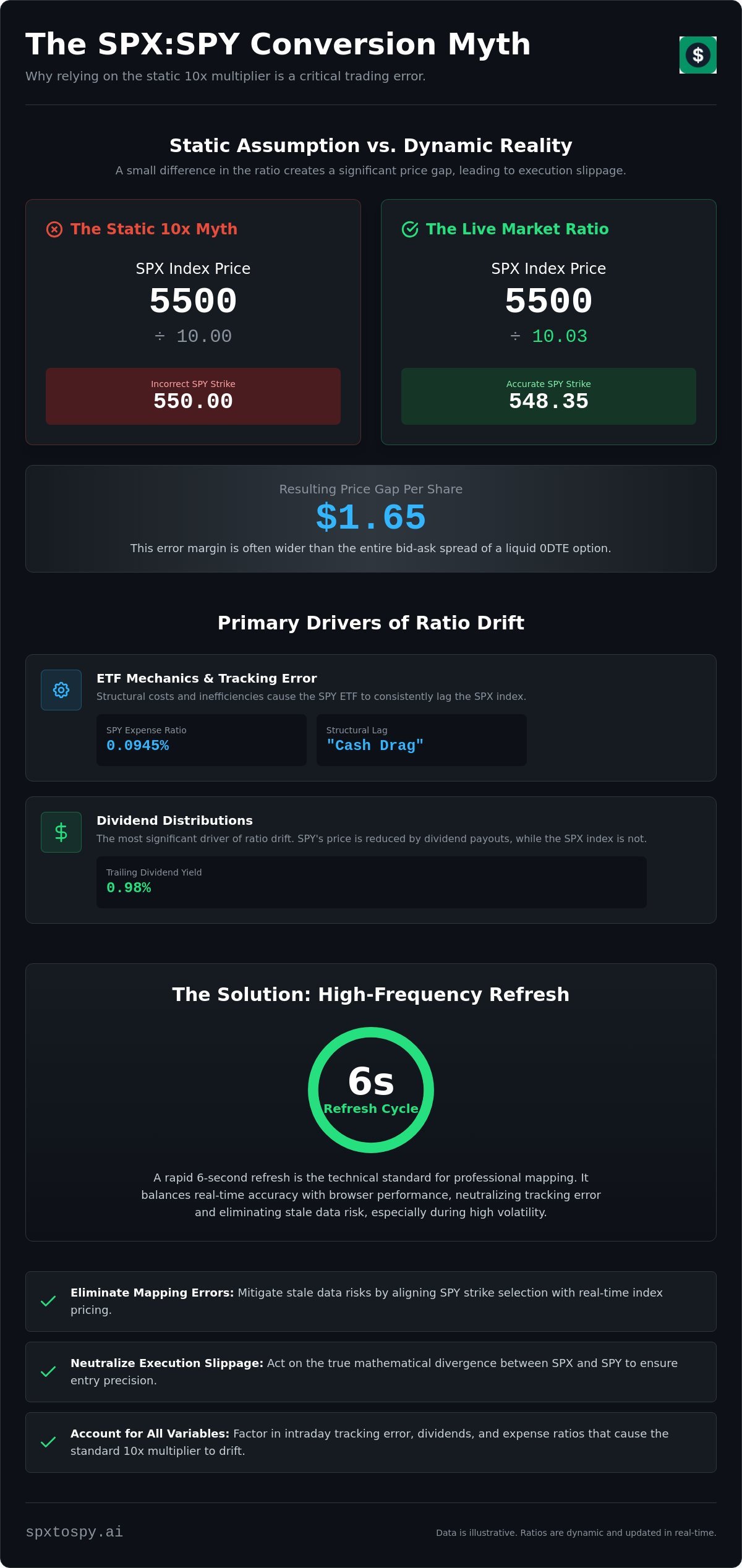
Traders often assume a fixed 10.00 multiplier. This is a calculation error. Real-world data shows the ratio often settles at 9.98 or 10.02. Current market data as of July 2026 establishes the conversion ratio at 10.03. For high-delta options, a deviation of 0.03 results in significant price gaps. Mapping a $5,500 SPX strike to a $550 SPY strike is inaccurate when the ratio is 10.03. The actual equivalent is $548.35. A 0.3% error on a $500 strike is $1.50. This gap is often wider than the entire bid-ask spread of a liquid SPY option. Precision at the second decimal point is non-negotiable for 0DTE strategies.
Dynamic ratios account for tracking error. This is the divergence between the index and the underlying fund. A static multiplier fails to capture intraday price action. It ignores the 0.0945% expense ratio and the impact of the 0.98% trailing dividend yield on the ETF price. These variables cause a constant drift that requires active monitoring.
Data Refresh Frequency as a Performance Metric
Refresh frequency determines data integrity. Hourly or minute-level updates are insufficient for high-frequency environments. A 60-second delay creates a latency gap during rapid price swings. This is the stale data trap. High-volatility sessions, indicated by a rising VIX, expand the bid-ask spread and accelerate ratio drift. During these periods, the ETF may decouple from the index temporarily due to creation and redemption lag. Only a high-frequency recalculation can capture these shifts.
A 6-second spx spy ratio refresh serves as the technical standard for professional mapping. This interval balances the need for real-time accuracy with browser processing limits. It ensures the converter reflects the most recent price prints. Rapid refreshes neutralize tracking error. They allow traders to maintain strike price equivalence across different settlement styles. Reliability depends on the speed of the recalculation cycle. It eliminates the guesswork inherent in manual conversion.
Variables Influencing Intraday Ratio Drift
Mathematical divergence between the SPX index and the SPY ETF is a constant state. While regulators define these as economically equivalent products, their structural differences ensure the ratio never remains static. Intraday ratio drift occurs because SPX is a calculated value. SPY is a traded instrument subject to supply, demand, and fund-specific frictions. A frequent spx spy ratio refresh is the only method to account for these variables in real time. Failure to monitor these shifts results in strike mapping that reflects historical data rather than current market reality.
Market liquidity directly impacts the bid-ask spread, creating temporary deviations from Net Asset Value (NAV). During high-frequency sessions, SPY may trade at a slight premium or discount to its underlying holdings. This decoupling is often measured in basis points but translates to significant strike mapping errors. The creation and redemption process managed by authorized participants eventually corrects these gaps, but the lag creates intraday friction. Traders must monitor these spreads to avoid executing at prices that reflect ETF-specific volatility rather than index movement. Understanding how spx spy ratio market hours influence conversion accuracy during peak liquidity windows is essential for managing this intraday friction effectively.
Tracking Error and Fund Mechanics
SPY operates as a Unit Investment Trust (UIT). This structure prevents the fund from reinvesting dividends immediately, creating “cash drag” that causes the ETF to lag the index during bull markets. The 0.0945% annual expense ratio also exerts a constant downward pressure on the SPY price relative to SPX. These mechanical costs accumulate daily. They contribute to the long-term shift from the theoretical 10.00 baseline. Intraday volatility spikes exacerbate this lag. Rapid index moves often take seconds to fully reflect in the ETF price discovery process. Only a live market ratio tracking utility can bridge this temporal gap for active traders.
Dividend Adjustments and Ex-Date Volatility
Dividend distributions represent the most significant driver of ratio expansion. SPY currently carries a trailing 12-month dividend yield of 0.98%. On the ex-dividend date, the ETF price drops by the distribution amount, while the SPX index remains unaffected. This event causes an immediate, sharp increase in the conversion ratio. A spx spy ratio refresh captures this value shift instantly. Without it, traders using stale multipliers will miscalculate strike parity by the exact dollar value of the dividend payout. Strategic execution during the final week of a quarter requires heightened precision. As dividends accrue within the trust, the ratio tightens. Upon distribution, it expands. Professional-grade mapping requires consistent data updates to neutralize these predictable but impactful fluctuations. This ensures that 0DTE strike selection remains mathematically sound even during peak distribution windows.
Latency Risks in Strike Price Mapping
Latency in conversion data creates immediate execution risk. Stale multipliers trigger the “Stale Data” trap. Executing SPY trades based on SPX levels from 180 seconds ago results in misaligned entries. Converting a $5,500 SPX strike to a $550 SPY equivalent when the live ratio is 9.95 creates a significant mapping flaw. The correct equivalent is $552.76. This $2.76 discrepancy exceeds standard tick increments. It invalidates delta-neutral positioning. Precise strike mapping is required to maintain mathematical parity between index levels and ETF instruments.
Market participants often overlook the impact of mathematical slippage during high-velocity sessions. A gap of 0.05 in the ratio translates to a $5.00 error on a $10,000 notional value. This slippage erodes the edge in arbitrage and hedging strategies. It forces traders to accept suboptimal fills or miss entry windows entirely. Real-time data synchronization is the only technical solution to eliminate these calculation errors.
0DTE Scalping and Mapping Precision
Zero Days to Expiration (0DTE) markets demand sub-10-second accuracy. Price discovery occurs rapidly. A high-frequency spx spy ratio refresh is required to map the SPX “Expected Move” to SPY strikes for iron condors and credit spreads. In 0DTE environments, gamma risk is at its peak. Small movements in the underlying index cause exponential changes in option premiums. Mapping the wrong strike due to ratio drift can turn a winning credit spread into a losing position instantly. Every cent of strike accuracy affects the probability of profit. Precise mapping prevents “wrong strike” errors during high-momentum breakouts. It also mitigates pinning risk at expiration. Settlement at the wrong strike leads to unintended assignment or cash settlement gaps. The spx spy ratio refresh serves as a risk-mitigation protocol for intraday traders by neutralizing mathematical drift between index and ETF price points.
Broker Verification Protocols
Use spxtospy.ai as a primary reference tool. It is not a final execution engine. Cross-reference converted strikes with broker-provided Greeks and Delta values. Discrepancies between the tool and the broker platform often indicate extreme local volatility or data feed lag. Broker platforms often provide theoretical values that lag behind raw exchange feeds. Manual verification of the Delta and Gamma for the mapped SPY strike provides a secondary layer of data integrity. If the SPX strike shows a 30-delta but the converted SPY strike shows a 25-delta, the ratio has shifted. Research on the SPX and SPY relationship confirms that while returns correlate, structural tradability differs. This distinction requires traders to verify liquidity at the specific SPY strike identified by the converter. Never execute based on a single data point without confirming the bid-ask spread on the destination exchange. Maintain clinical objectivity during the verification process to ensure capital preservation.
Execution Protocols for High-Frequency Strike Conversion
Execution precision requires a standardized operational workflow to neutralize the mathematical drift between index and ETF pricing. Traders often fail because they treat the conversion as a one-time calculation. High-frequency environments demand a repetitive verification cycle. The following protocol ensures strike price parity during rapid market shifts. It prioritizes data integrity over execution speed to prevent the entry of misaligned positions.
- Step 1: Monitor the live SPX:SPY ratio for deviation from the 10x baseline. Identify if the current ratio is 10.03 or higher to adjust for current market conditions.
- Step 2: Input the target SPX strike price into the converter during high-liquidity windows. Focus on the periods immediately following the New York open or preceding the close.
- Step 3: Note the SPY equivalent based on the most recent 6-second spx spy ratio refresh. Avoid using values from previous data cycles.
- Step 4: Verify the SPY strike liquidity and open interest on the options chain. Ensure the bid-ask spread is tight enough to justify the conversion.
- Step 5: Execute the trade after confirming ratio stability. If the ratio fluctuates by more than 0.01 within the 6-second window, delay entry until the price stabilizes.
Workflow Integration for Day Traders
Active day traders must maintain a dedicated browser tab for the SPX to SPY ratio tracker. This ensures the conversion variable is always visible during the order entry process. Use the live ratio to identify arbitrage opportunities or pricing inefficiencies between the two instruments. When the ratio deviates significantly from the 5-day moving average, it may signal an ETF premium or discount. Setting manual refresh triggers during rapid price reversals allows for faster re-calculation. This minimizes the time spent on manual math during high-gamma situations. Consistently applying a spx spy ratio refresh protocol reduces the cognitive load during 0DTE scalping sessions. It allows the trader to focus on price action rather than arithmetic.
Technical Architecture of Conversion Tools
The underlying architecture of professional conversion utilities relies on API-driven data feeds. These feeds pull raw exchange data directly, bypassing the latency inherent in retail brokerage displays. Manual data entry is prone to human error and cannot match the speed of automated recalculation. Precision requires decimal depth to at least 4 places. A ratio of 10.0345 provides a more accurate strike map than a rounded 10.03. Server-side latency also impacts the user-facing “live” ratio. If the server takes 500ms to process the feed, the data is already historical. Professional tools optimize these cycles to ensure the 6-second refresh remains actionable. Use real-time strike mapping to maintain a technical edge over participants using static 10x multipliers. This architecture serves as the foundation for institutional-grade execution in retail environments.
spxtospy.ai 6-Second Refresh Architecture
Technical specification: 6-second data cycle. This interval is the calculated standard for 0DTE precision. Sub-second updates consume excessive browser resources. Hourly updates provide stale data. The 6-second spx spy ratio refresh balances mathematical accuracy with operational performance. It ensures the conversion ratio remains current during high-velocity price discovery. The interface is purely functional. It excludes marketing fluff. High data density allows for rapid scanning of index levels and ETF equivalents. This clinical design prioritizes functional efficiency for professional environments.
The architecture supports automated strike price mapping for high-volume retail platforms. Users on Robinhood, Webull, and Thinkorswim require external conversion tools to bridge the gap between SPX analysis and SPY execution. These platforms don’t offer native, real-time ratio tracking. The spxtospy.ai engine fills this technical void. It provides a dedicated utility for traders who execute on one platform while analyzing the index on another. Reliability is established through the frequency of the data output. It acts as a silent, efficient digital assistant for strike selection.
Real-Time Strike Price Mapping
Translating complex SPX index levels into tradable SPY ETF strikes occurs instantly. The tool ensures parity between index-level analysis and ETF-level execution. This is critical when the SPX expected move must be converted into a specific SPY options contract. The spx spy ratio refresh captures intraday tracking error to prevent strike misalignment. For deeper architectural details, refer to the Index Options Strike Price Converter. This mapping process neutralizes the mathematical drift that occurs during volatile sessions. It allows for the seamless application of index-based strategies to the more liquid ETF options market.
Data Integrity and User Verification
Data integrity requires a multi-layered approach. Technical disclaimers are a core component of the interface. They maintain a responsible, risk-aware stance. Traders must verify converted values with their broker before order entry. This secondary check is a mandatory risk-mitigation protocol. The tool provides the mathematical variable; the user provides the final execution logic. Continuous monitoring of the SPX:SPY multiplier identifies structural changes in the relationship. These changes often result from dividend distributions or fund-specific expenses. Use the following verification steps:
- Confirm the current ratio matches the timestamped refresh.
- Cross-reference the converted strike with the broker’s option chain.
- Check the Delta and Gamma of the target SPY contract.
- Execute only after confirming data synchronization.
The brand remains a transparent layer between the user and market data. It doesn’t provide financial advice. It provides the precise variables required for professional decision-making. Trust is built through data frequency and clinical accuracy.
Neutralize Intraday Tracking Error
Precision execution requires a transition from theoretical 10x constants to live market variables. Neutralizing tracking error depends on accounting for the 0.0945% SPY expense ratio and cumulative dividend-induced price drift. A high-frequency spx spy ratio refresh is the technical requirement for maintaining strike parity in 0DTE environments. This process eliminates the temporal latency gap that causes mapping slippage during high-volatility sessions. Use clinical verification protocols to ensure every SPY strike aligns with its SPX index equivalent. Stale data remains a primary driver of execution friction in retail environments.
Reliability is established through data frequency. The industry-leading 6-second refresh cycle provides the optimal balance between mathematical accuracy and browser system performance. Professional traders require precision decimal mapping for 0DTE traders to maintain a technical edge over participants using static multipliers. Access the Live SPX to SPY Converter with 6-Second Refresh to utilize real-time ratio tracking. This utility has provided precise mapping since inception to support high-frequency decision-making. Eliminate calculation friction. Maintain mathematical parity across all market sessions. Accurate data is the final barrier to execution error.
Frequently Asked Questions
What is the standard SPX to SPY conversion ratio?
The standard conversion ratio is currently 10.03 as of July 2026. While the theoretical baseline is 10:1, structural differences between the SPX index and the SPY ETF prevent a fixed multiplier. Market liquidity, fund expenses, and tracking error cause the ratio to fluctuate daily. Traders must use live data rather than the 10.00 approximation to ensure strike price parity during execution.
How often does the spxtospy.ai ratio refresh?
The system executes a 6-second spx spy ratio refresh to maintain data integrity. This interval is the technical standard for balancing real-time accuracy with browser processing performance. It ensures that the conversion variable reflects the most recent price prints from the exchange. Frequent updates are required to neutralize the mathematical drift that occurs during high-volatility market sessions.
Why does the SPX:SPY ratio drift away from exactly 10.0?
Ratio drift results from the 0.0945% SPY expense ratio and the trust’s structural tracking error. SPY is a Unit Investment Trust subject to supply and demand frictions, while SPX is a calculated index value. Dividend accruals and the creation/redemption process also cause the ETF to decouple from the index. These variables ensure the ratio remains a dynamic figure rather than a constant.
Does the ratio refresh affect 0DTE options trading?
Yes, the spx spy ratio refresh is critical for managing 0DTE gamma risk. Sub-10-second updates are required to map the SPX expected move to tradable SPY strikes accurately. Stale data leads to misaligned entries during rapid price discovery. Precise mapping prevents “wrong strike” errors that can invalidate credit spreads or iron condor strategies during momentum breakouts.
Can I use the SPX to SPY converter for Robinhood strikes?
Yes, the converter maps SPX index levels to tradable SPY strikes for users of Robinhood, Webull, and Thinkorswim. These retail platforms lack native, real-time index-to-ETF conversion utilities. The tool provides the necessary mathematical variables to execute index-based strategies on the more liquid ETF options chain. It serves as a secondary verification layer for high-delta contract selection.
How do dividends impact the SPX:SPY ratio refresh?
Dividends cause an immediate expansion of the ratio on the ex-dividend date. The SPY price drops by the distribution amount, currently based on a 0.98% trailing yield, while the SPX index is unaffected. A frequent refresh cycle captures this value shift instantly. Failure to account for dividend adjustments results in strike mapping errors equal to the dollar value of the payout.
Is a 6-second refresh fast enough for high-frequency trading?
A 6-second cycle is the optimal technical specification for retail and professional strike mapping. It provides a significant edge over the minute-level or hourly updates offered by competitors. This frequency is sufficient to neutralize intraday tracking error for most scalping and hedging protocols. It ensures the trader remains synchronized with the live pulse of the market feed.
What happens if I use a stale ratio for strike mapping?
Using a stale ratio results in immediate execution slippage and mathematical parity errors. A ratio discrepancy of 0.03 translates to a $1.50 error on a $500 strike. This gap often exceeds the bid-ask spread of liquid SPY options. It leads to suboptimal entry prices, unintended assignment risk, and settlement gaps at expiration during high-volatility sessions. Traders operating during the opening hour should review how spx spy ratio market hours affect conversion accuracy to understand the elevated risk of stale data during peak volatility windows.