
The static 10x multiplier is a legacy calculation that guarantees execution slippage. In high-volatility environments, manual conversion of an spx strike price in spy creates unacceptable latency. You know that even a minor decimal deviation results in mispriced orders. Speed is the only metric that matters during 0DTE sessions. Reliance on outdated ratios leads to failed fills and unnecessary risk exposure. Precision is mandatory for professional execution. Errors are not an option when the tape is moving at peak velocity.
This guide provides the technical precision required to map these instruments using real-time market ratios for zero-error execution. You’ll master the mathematical clarity needed to navigate current 2026 ratio deviations. We’ll strip away the confusion between cash-settled SPX and physically-settled SPY strikes. This technical mapping ensures your orders land exactly where the market moves. We examine conversion mechanics, settlement differences, and the specific variables required for instant strike mapping. Process the data. Execute the trade. Eliminate the margin for error. Accuracy is the primary objective in every session.
Key Takeaways
- Map the spx strike price in spy using real-time ratios to eliminate execution slippage and manual calculation errors.
- Transition from legacy 10x multipliers to dynamic 9.95–10.05 tracking for increased mathematical precision in volatile markets.
- Distinguish between SPX cash settlement and SPY physical delivery to manage assignment risk during strike conversion.
- Leverage six-second data refresh cycles to maintain 0DTE accuracy in high-velocity market environments.
- Implement automated mapping protocols to remove technical latency from intraday strike price identification and execution.
Defining SPX Strike Price Equivalence in SPY
Strike price equivalence is the mathematical alignment of S&P 500 index levels with SPY ETF price points. It’s a technical requirement for cross-instrument execution. Traders must identify the exact spx strike price in spy to ensure order parity. This mapping isn’t a static calculation. It requires constant verification of the underlying price relationship. Index levels represent the aggregate market cap; ETF prices represent the tradable share value. Equivalence bridges these two distinct financial structures.
Technical necessity drives this mapping. Traders use index levels for broad technical analysis and execute in the ETF market for liquidity or specific margin requirements. Mapping allows for hedging index positions using liquid ETF options. Precision is the primary constraint. Even a 0.01 deviation in the conversion ratio impacts strike selection. These errors compound in high-volatility environments. Zero-error mapping is essential for professional execution in the 2026 market landscape.
The Role of the Underlying Asset
SPX is a cash-settled index. It tracks the theoretical value of the S&P 500. This stock market index option provides exposure without physical stock transfer. Settlement occurs in cash at expiration. SPY is a physically-settled ETF. It holds a basket of underlying securities. Traders face potential stock assignment on SPY options. The design intent is a 1/10th price ratio relative to the index. Market participants use this relationship to bridge liquid ETF markets with high-notional index options. Differences in settlement methods dictate how strikes are managed near expiration.
Why Strike Mapping Matters for Traders
Mapping enables arbitrage between index and ETF option chains. It dictates capital efficiency. High-notional SPX contracts require significant margin per contract. Granular SPY contracts allow for precise position sizing and risk scaling. Accurate mapping ensures delta-neutrality across contract specifications. Failure to map correctly results in unintended directional exposure. Traders often use SPY for tactical entries while maintaining SPX for broad portfolio hedging. Parity between the two instruments is the foundation of these strategies.
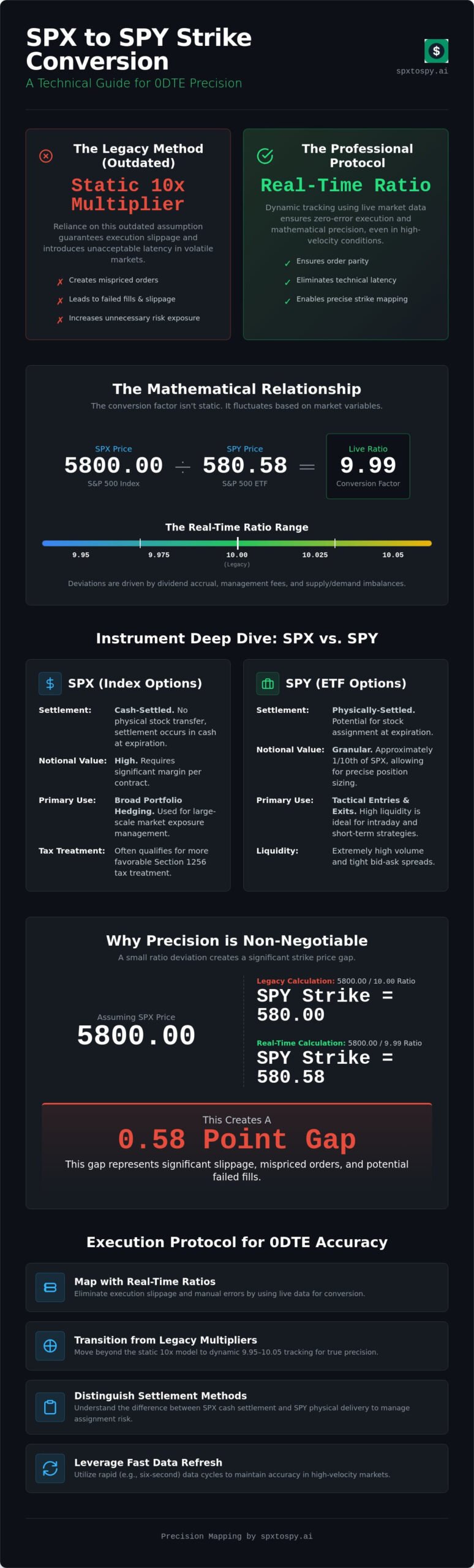
Execution speed depends on pre-calculated mapping. In fast-moving 0DTE sessions; manual calculation is a failure point. A target spx strike price in spy must be verified against current ratios before order entry. This process eliminates technical latency. It prevents slippage caused by outdated 10x assumptions. If SPX trades at 5800.00; a 10.00 ratio results in a 580.00 SPY strike. A 9.99 ratio shifts that target to 580.58. This 0.58 point gap represents a significant percentage of the option premium. Reliable mapping protocols are the standard for 2026 market operations. Accuracy is the only metric for success.
The Mathematical Relationship: SPX vs. SPY Ratio
The 10x multiplier is the theoretical baseline for all conversion protocols. It assumes SPY is exactly 1/10th of the SPX index value. This assumption is often incorrect in live market conditions. The actual ratio fluctuates within a range of 9.95 to 10.05. These deviations occur because of dividend accrual, management fees, and intraday supply-demand imbalances. Finding the exact spx strike price in spy requires accounting for these variables in real-time. Static calculations lead to execution errors.
Dividends are a primary driver of ratio divergence. SPY is an ETF that holds underlying stocks and collects dividends. These distributions are reflected in the ETF’s Net Asset Value (NAV). SPX is a price-return index that does not account for dividend payouts. Consequently, the price relationship shifts as ex-dividend dates approach. Small tracking errors from ETF management also contribute to these deviations. When comparing SPY vs SPX options, traders must adjust for this non-linear relationship. Accuracy depends on identifying the current premium or discount.
Calculating the Real-Time Ratio
Formula: (SPX Price) / (SPY Price) = Conversion Factor. Volatility increases at the market open and close. Ratio stability is lowest during these periods. High-volume periods can push the ratio toward the 10.05 or 9.95 extremes. Identifying At-the-Money (ATM) strikes becomes difficult without a live feed. Use a real-time conversion utility to verify current levels before committing capital. Rapid refresh cycles are necessary to capture these micro-movements.
Ratio Deviation and Strike Skew
Strike selection must compensate for premium or discount levels. If SPY trades at a discount to the index, the ratio moves above 10.00. If it trades at a premium, the ratio drops below 10.00. Adjusting the target spx strike price in spy ensures the chosen contract reflects the intended delta. A 5800 SPX level mapped at a 9.98 ratio targets a 581.16 SPY equivalent. Mapping at 10.02 targets 578.84. This 2.32-point difference in SPY is significant for 0DTE traders. Precise mapping prevents selecting the wrong side of the skew. Historical variance analysis shows the typical range remains tight but impactful for execution speed. For a comprehensive breakdown of how to determine the spy equivalent of spx strike using dynamic ratios that account for current index levels and ETF price action, review the full real-time conversion methodology. Traders who require a deeper technical framework for spx spy strike equivalence that accounts for dividend yield, cost of carry, and current ratio drift should review the complete technical mapping methodology for options traders.
Executing Strike Price Conversion: Intraday Mapping Protocols
Identifying the spx strike price in spy requires a sequential, high-speed protocol. Begin with technical analysis on the SPX index level. Determine your target entry level; pivot point; or liquidity zone. This index-level target serves as the primary numerator for the conversion formula. You can’t rely on SPY charts alone for index-level precision during high-volatility sessions.
Verify the current live ratio immediately. Static 10x multipliers are insufficient for active intraday execution. Access a spx spy strike price tool to obtain the current coefficient. This value fluctuates between 9.95 and 10.05 based on market variables. Accuracy at this stage prevents selecting strikes that are mathematically misaligned with the intended index level.
The conversion sequence follows these specific steps:
- Identify the target SPX strike price based on index technicals.
- Divide the SPX strike by the verified live ratio (e.g., 5400 / 10.02).
- Round the result to the nearest available SPY strike interval ($1 increments).
- Cross-reference the delta and gamma of the selected SPY contract.
The division formula determines the target spx strike price in spy using current data. For example; an SPX target of 5400 divided by a 10.02 ratio yields 538.92. Rounding directs the trader toward the 539 SPY strike. If the ratio shifts to 9.98; the same 5400 target maps to 541.08; moving the target strike to 541. Mismatched Greeks often indicate a mapping error or a significant ratio shift during the calculation window.
Protocol for 0DTE Scalping
0DTE sessions demand high-frequency refresh cycles. Price expansion happens in seconds. Map SPX support and resistance levels directly to SPY strikes using real-time data feeds. This prevents “off-by-one” errors where a trader enters a strike that lags behind the index move. Execution speed is the primary variable for success in zero-day environments. Accuracy is mandatory when the tape is moving at peak velocity.
Managing Decimal Precision
Use four-decimal precision for all conversion ratios. Small rounding errors in the denominator cause significant strike deviations. When the result falls exactly between two strikes; choose the strike that aligns with your directional bias or internal risk limit. Don’t rely on mental math during high-volatility events. Always verify outputs using an index options strike price converter before order entry. This eliminates manual calculation latency and human error.
Settlement and Liquidity Factors in Strike Selection
SPX settlement is cash-based. No physical asset transfer occurs. SPY settlement is physical. Shares are delivered or called away at expiration. This distinction is critical for 0DTE strategies. Mapping the spx strike price in spy allows traders to move positions between instruments as expiration approaches. Pin risk in SPY requires precise strike awareness. Inaccurate mapping leads to unintended stock assignment. SPX settlement occurs at the closing index value; eliminating delivery risk for the trader.
Section 1256 contracts offer significant tax efficiency. SPX gains are taxed at a 60% long-term and 40% short-term rate. SPY gains follow standard equity rules and are taxed at 100% short-term rates for intraday scalps. Mapping the spx strike price in spy helps determine if the tax benefit of SPX outweighs the liquidity of SPY. SPY provides tighter spreads at $1 strike intervals. SPX spreads are often wider but offer higher notional exposure. Evaluate these trade-offs using live data before committing capital to a specific chain.
Contract Multipliers and Notional Value
SPX uses a $100 multiplier per index point. SPY uses a $100 multiplier per share. A single SPX contract controls 10 times the notional value of a SPY contract. Position sizing depends on accurate strike mapping. Misalignment results in over-leveraged or under-leveraged positions. A 10-lot SPY position only maintains parity with a 1-lot SPX position if the strikes are mathematically equivalent. Always verify the notional equivalence using current ratio data before shifting between symbols.
Execution Risks: Slippage and Spread
Limit order placement relies on strike precision. Wide bid-ask spreads in SPY can negate the benefits of granular mapping. Monitor the order book for depth at the target strike. Execution failure often stems from mapping to low-volume strikes. Illiquid strikes increase the probability of execution failure during rapid conversion mapping. Traders must prioritize strikes with high open interest to minimize slippage during entry and exit.
SPX options are European-style. They cannot be exercised early. SPY options are American-style. Early exercise is possible. This impacts strike selection near dividend dates. Inaccurate mapping during these windows increases assignment risk. Traders must account for the dividend yield when calculating the conversion ratio. The European-style settlement of SPX provides a cleaner exit for 0DTE traders. SPY requires active management to avoid share delivery. Use real-time conversion tracking to maintain execution speed and settlement accuracy.
Utilizing the SPX to SPY Converter for 0DTE Accuracy
Automation replaces manual latency. High-velocity trading requires instant data. Manual conversion of the spx strike price in spy is prone to calculation error. 0DTE environments leave zero margin for delay. Automation ensures strike parity. It eliminates the friction between index analysis and ETF execution. Speed is the priority in volatile sessions.
The system operates on a six-second refresh cycle. This frequency maintains parity with the 0DTE SPX SPY ratio. Real-time tracking captures micro-fluctuations in the conversion factor. Static 10x assumptions are discarded. The converter provides the specific coefficient needed for immediate strike identification. Accuracy is the primary output. Data integrity is maintained through constant feed verification.
Tool Features for Professional Traders
Live ratio tracking allows for immediate adjustment. The interface displays the current conversion factor alongside target strikes. Visual mapping presents SPX strikes and their SPY equivalents in a modular layout. This design facilitates rapid scanning. Minimalist aesthetics reduce cognitive load. Traders focus on execution variables; not interface navigation. Data is delivered in quick; rhythmic bursts to mirror the pulse of the market.
Integrating the Converter into Your Workflow
Deployment on secondary monitors is the standard protocol. The SPX to SPY Converter should remain visible throughout the session. This positioning allows for constant monitoring of ratio drift. Pre-market mapping establishes a baseline for daily watchlists. Identify key index levels and map them to ETF strikes before the opening bell. This preparation reduces reactive latency during the initial high-volume period.
Emergency re-calculation is necessary during major trend shifts. S&P 500 volatility can cause rapid ratio expansion or contraction. The converter provides the updated spx strike price in spy instantly. This prevents the use of stale data during trend reversals. Verification is the final step. Always confirm the mapped strike with your broker’s option chain before hitting the buy or sell button. Technical tools provide the data; the trader provides the final verification. Reliability is a function of both automation and user protocol.
The utility is a single-purpose tool. It does not provide financial advice or trade execution. It serves as a transparent layer between index data and ETF strike selection. Use it to maintain mathematical clarity. Speed and precision are the only metrics that define 0DTE success. Eliminate the calculation gap. Process the ratio. Execute the mapped strike. Professional execution requires professional-grade data refresh rates.
Optimize Intraday Execution Accuracy
Dynamic ratio tracking is the only reliable method for maintaining execution parity in 2026 market environments. Legacy 10x multipliers introduce unacceptable slippage during high-velocity 0DTE sessions. Identifying the exact spx strike price in spy requires real-time mathematical alignment. Accuracy depends on accounting for dividend accrual and tracking error variables. Latency in manual calculation results in mispriced entries and failed fills. Professional traders prioritize data refresh rates to eliminate human error. Precision is the foundation of institutional-grade execution in volatile conditions.
Eliminate technical friction from your trading workflow immediately. Use a dedicated tool to process live market variables with zero latency. Accuracy is the primary objective for every session. Access the Real-Time SPX to SPY Converter to obtain precision-engineered data refreshed every six seconds. This free technical utility provides the mathematical clarity required for rapid strike mapping. Maintain your competitive edge through superior data frequency and zero-error conversion. Execute with total precision.
Frequently Asked Questions
How do I calculate the SPY equivalent of an SPX strike price?
Divide the target SPX strike price by the current live SPX:SPY ratio. If the SPX strike is 5800 and the live ratio is 10.02, the calculation is 5800 / 10.02, resulting in 578.84. Round this result to the nearest available SPY strike interval, typically $1 increments. Accuracy depends on using a four-decimal ratio rather than a static 10x multiplier.
Why is the SPX to SPY ratio not exactly 10 to 1?
Market variables cause the ratio to fluctuate between approximately 9.95 and 10.05. SPY is an ETF that accrues dividends and incurs management fees, while SPX is a price-return index. These factors, along with intraday supply-demand imbalances and tracking errors, create constant deviations from the theoretical 10:1 baseline. Real-time tracking is mandatory for precision.
Is there a difference in strike prices for SPX calls versus SPY calls?
Mapping the spx strike price in spy applies identically to calls and puts. The mathematical relationship between the underlying index and the ETF remains constant regardless of the option type. However, SPY call premiums may reflect early exercise risk near dividend dates, which doesn’t affect European-style SPX contracts. The target strike remains a function of the underlying ratio.
How often does the SPX:SPY conversion ratio change during market hours?
The ratio fluctuates continuously as the underlying prices move. High-frequency updates are required to maintain execution parity. Professional utilities refresh every six seconds to capture micro-movements in the price relationship. Traders should avoid using stale ratios from the market open, as volatility frequently shifts the coefficient during the session.
What are the risks of manual strike price mapping in 0DTE trading?
Manual calculation introduces technical latency and human error. In 0DTE environments, price expansion happens in seconds. A delay in calculation results in selecting strikes that no longer align with target index levels. This leads to “off-by-one” strike errors, causing unintended directional exposure and significant execution slippage during rapid market moves.
Does the SPY dividend impact the strike price conversion from SPX?
Yes, dividend accrual and payouts shift the SPY price relative to the non-dividend-adjusted SPX index. As SPY collects dividends, its Net Asset Value (NAV) changes, causing the SPX:SPY ratio to diverge from the 10.00 baseline. Conversion protocols must utilize live market ratios to account for these shifts, especially as ex-dividend dates approach.
Can I use an SPX to SPY converter for put options as well?
Yes, the conversion logic is identical for both sides of the option chain. Identifying a target spx strike price in spy for a put involves the same division of the index level by the live ratio. The underlying asset relationship is independent of the option’s directional bias. The converter ensures the selected SPY put strike represents the intended SPX support level.
Are SPX strike prices more accurate than SPY strike prices for index tracking?
SPX strikes directly represent the S&P 500 index level. SPY strikes represent the tradable ETF price. While SPX is the primary reference for technical analysis, SPY strikes are necessary for executing in the ETF market. Accuracy isn’t inherent to one instrument; it’s a function of the mapping precision used to bridge the two distinct contract specifications.