Execution failure in 0DTE options often stems from a single variable: stale ratio data. Relying on a fixed 10:1 multiplier during high-volatility windows guarantees strike selection errors and increased slippage on retail platforms. You understand that manual calculation latency is the primary barrier to precise execution when the index moves rapidly. This technical reference introduces the best SPX to SPY Converter for day traders, engineered for functional efficiency and zero-latency strike mapping. We provide the mechanism to bridge the gap between SPX index levels and tradable SPY strikes with absolute clinical accuracy.
Access precise SPX to SPY strike price conversions with real-time ratio tracking refreshed every six seconds. This frequency eliminates the risk of using outdated data points found on standard retail interfaces. This article outlines the specific technical parameters of the SPX:SPY relationship, the impact of dynamic ratios on capital efficiency, and the workflow for integrating live data into your execution strategy. You will gain a clear understanding of how to maintain strike accuracy regardless of intraday volatility or tracking differences. The focus remains strictly on the mathematical relationship between these two market entities to ensure your decision-making relies on the most current data available.
Key Takeaways
- Eliminate manual calculation latency with 6-second data refresh intervals designed for high-volatility 0DTE sessions.
- Utilize the best spx spy converter for day traders to map S&P 500 index levels to precise SPY ETF strike equivalents.
- Replace inaccurate static 10:1 approximations with dynamic ratio tracking that accounts for real-time intraday fluctuations.
- Minimize slippage on retail platforms by integrating clinical strike mapping into standard broker execution workflows.
- Standardize strike mapping protocols to ensure consistent translation between index analysis and ETF execution layers.
Technical Specifications of the SPX SPY Ratio Tool Online
The SPX SPY Ratio Tool Online serves as a specialized execution layer. It provides a direct translation of S&P 500 Index strikes into tradable ETF equivalents. This functionality is critical for 0DTE scalpers and intraday options traders who execute on retail platforms. Speed is the primary variable. Manual arithmetic during high-volatility sessions introduces latency. It creates a high probability of strike selection errors. This tool eliminates those risks. It acts as a silent digital assistant for high-stakes environments. It’s the best spx spy converter for day traders who prioritize functional efficiency over manual calculation.
The operational objective is clear. It provides zero-latency strike mapping. Retail platforms like Robinhood or Webull often display SPY prices without a direct link to SPX technical levels. Traders analyzing the index must convert those levels instantly. The tool provides the necessary data points without linguistic fluff. It focuses strictly on the immediate needs of the user. Accuracy is established through the frequency of its data output. The interface is clinical. It prioritizes data integrity over aesthetic design.
The 10x Multiplier Fallacy
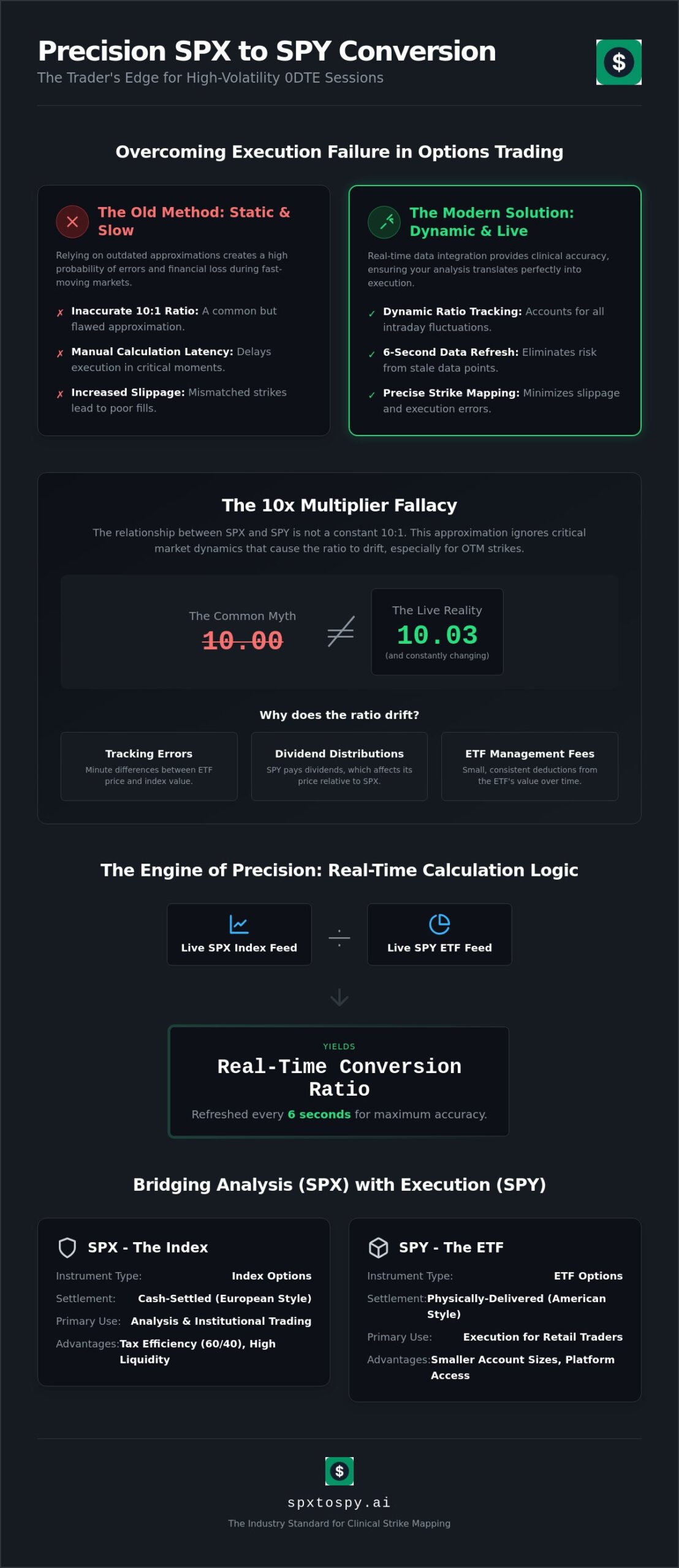
The 10:1 relationship between SPX and SPY is an approximation. It’s not a mathematical constant. Tracking errors and dividend distributions cause the ratio to drift. As of July 2026, ratios such as 10.03 are common. Relying on a static 10x multiplier is a technical error. This drift is particularly dangerous for out-of-the-money (OTM) strikes. A small ratio deviation can lead to selecting a strike that doesn’t align with the intended price target. This results in unintended slippage. Dynamic tracking is the only method to maintain precision. It accounts for the actual market relationship at the moment of execution. This same principle applies when executing SPX puts to SPY puts conversion, where static multipliers introduce compounding errors during high-gamma environments.
Instrument-Specific Mapping: SPX vs. SPY
SPX and SPY are fundamentally different instruments. SPX options are cash-settled contracts based on the index value. The SPDR S&P 500 ETF Trust (SPY) is a physically-delivered ETF. These structural differences require precise strike price alignment. Traders often analyze SPX for its tax advantages or liquidity. However, they may execute on SPY for smaller account sizes or specific platform availability. A professional index options strike price converter bridges this gap. It ensures that technical analysis on the index translates perfectly to the execution layer. This maintains data integrity throughout the trade lifecycle. It prevents costly mismatches between analysis and order entry.
Real-Time Data Refresh and Ratio Calculation Logic
Strike price mapping requires a high-frequency update cycle. The 6-second data refresh frequency is the technical requirement for modern intraday execution. This tool polls live market feeds for both the S&P 500 Index and the SPY ETF simultaneously. It utilizes low-latency data streams to ensure the ratio remains current. The calculation is direct: SPX Index Price divided by SPY ETF Price. This yields a precise conversion factor that accounts for tracking drift. For high-delta options, decimal accuracy to two places is mandatory. A minor shift in the ratio can result in a strike selection error of 10 to 50 cents on the ETF. This makes it the best spx spy converter for day traders who prioritize mathematical precision over approximate multipliers.
Computational logic must account for the different data sources. Index prices are calculated based on the underlying basket of stocks. ETF prices represent a tradable security with its own supply and demand dynamics. The tool integrates these disparate feeds into a single, modular output. It removes the need for manual calculation during high-volatility windows. Traders receive a transparent data layer. This layer sits between their technical analysis and the broker’s execution window. It ensures that the strike price you see on your charts matches the contract you select in your trade ticket.
Dynamic Ratio Tracking Protocols
The ratio is never static. It fluctuates due to bid-ask spreads, dividend accruals, and management fees within the ETF structure. During market volatility spikes, the tracking error between the index and the ETF often widens. The tool handles these conditions by recalculating the ratio every 6 seconds. It maintains conversion integrity by adhering to the technical parameters found in the Official SPX Options Specifications. This alignment ensures that settlement logic and multipliers remain consistent with exchange standards. You can monitor these live ratio shifts to verify strike accuracy before committing capital in fast-market conditions.
Refresh Frequency and Execution Alpha
6-second intervals serve as the industry benchmark for 0DTE traders. In zero-day environments, price action is aggressive. Stale data displays on retail brokerage platforms lead to execution errors. If a tool updates hourly, it’s insufficient for scalping. The tool provides a methodical, rapid flow of information. It mirrors the pulse of a live data feed. This creates execution alpha. Traders utilizing the 0DTE SPX SPY ratio tracker gain a significant speed advantage. They identify the correct SPY strike before the retail majority can process the SPX index move. This reduces slippage and ensures that entry prices align with technical targets.
Operational Benefits for 0DTE and Scalping Strategies
0DTE execution demands absolute temporal efficiency. Scalping strategies rely on the immediate translation of technical levels into order entries. Manual arithmetic creates a critical failure point. This tool delivers immediate efficiency gains. It allows for rapid strike selection during high-gamma windows. Traders utilize SPX technical levels to time SPY entries. This method exploits the liquidity of the underlying index while executing on the ETF layer. Precise limit order placement reduces slippage. It ensures entries occur at the intended mathematical price point. This is the best spx spy converter for day traders seeking to optimize their execution workflow.
Cognitive load reduction is a primary operational benefit. High-stress market hours amplify the risk of calculation errors. A dedicated utility removes this burden. It allows the trader to focus exclusively on price action and volume profiles. The tool acts as a silent, efficient digital assistant. It processes the raw data. You execute the trade. Eliminating the mental math requirement prevents execution fatigue during extended sessions. It maintains professional urgency without sacrificing accuracy.
0DTE Strike Selection Precision
Gamma-sensitive strikes require exact mapping. In zero-day environments, even a 0.05 deviation in the ratio results in strike misalignment. Utilize the SPY calculator for rapid level identification. This prevents fat-finger errors during rapid-fire entry sequences. It ensures that the contract loaded in the broker platform corresponds exactly to the analyzed index level. Rapid identification is the difference between capturing a move and chasing it. Strike precision is mandatory for maintaining the integrity of your risk-to-reward ratios.
Risk Management and Verification
Risk management protocols require a secondary validation layer. While the tool provides precise data, broker verification remains mandatory before final execution. The utility serves as a confirmation mechanism for automated signals or manual analysis. Understanding the structural differences is essential when Comparing Index vs. ETF Options. Ratio drift represents the tracking error between SPX and SPY; as of July 2026, intraday volatility metrics show drift can exceed 0.12% during opening range breakouts. This metric underscores the necessity of dynamic tracking over static multipliers. Use the spx spy strike mapping tool to verify data, then execute on your broker platform with confidence.
Implementation: Integrating the Converter into Trading Workflows
Optimal execution requires a structured monitoring environment. Position the ratio tool window adjacent to your broker’s active strike ladder. This layout minimizes eye-tracking latency. It ensures the converted strike remains visible during the order entry phase. High-frequency 0DTE traders must maintain a clear line of sight between technical index levels and tradable ETF contracts. This is the best spx spy converter for day traders who operate in high-volatility windows. It functions as a dedicated execution layer. It removes the need for manual window switching.
Robinhood and Webull traders face specific instrument restrictions. These platforms don’t support direct SPX options trading. Users must analyze S&P 500 Index charts and execute on the SPY ETF. This creates a data translation requirement. The converter bridges this gap. It allows traders to identify key index levels and immediately locate the corresponding SPY strike. This workflow prevents selection errors during rapid market moves. It ensures that technical analysis on the index translates directly to the execution layer on retail platforms. Directional put traders on these platforms should also reference the technical framework for SPX puts to SPY puts conversion to maintain risk parity across execution environments. You can access the live converter interface to begin mapping your strikes now.
Cross-instrument arbitrage relies on identifying price deviations. The tool tracks the real-time ratio between the index and the ETF. When the ratio drifts beyond standard benchmarks, it signals a potential mispricing. Intraday volatility in 2026 often causes these temporary tracking errors. Monitoring the ratio allows traders to time entries when the ETF is trading at a discount or premium relative to the index. This provides an additional layer of technical confirmation. It enhances execution alpha by utilizing data that retail brokerage displays often omit.
Step-by-Step Conversion Workflow
- Identify target S&P 500 Index level or SPX strike.
- Input value into the real-time converter interface.
- Verify the live ratio and timestamp for data currentness.
- Cross-reference with broker strike ladder before execution.
Platform-Specific Considerations
Desktop configurations offer the highest utility. They provide sufficient screen real estate for simultaneous monitoring of charts, the converter, and the broker terminal. Mobile usage should be limited to situational awareness. Latency and screen size constraints on mobile devices increase the risk of execution errors. Institutional index data is often gated. Retail traders use this tool to access professional-grade mapping. Leverage core SPX to SPY converter features to maintain strike accuracy. This ensures that analysis and execution remain perfectly aligned across all trading sessions.
SPX to SPY Converter: The Industry Standard for Strike Mapping
Precision strike mapping is a foundational requirement for S&P 500 trading infrastructure. This utility provides the necessary data layer to synchronize index analysis with ETF execution. It eliminates the ambiguity inherent in manual calculations. Professional P&L depends on the accuracy of these conversions. A single misaligned strike results in unintended risk exposure and increased slippage. This tool remains the best spx spy converter for day traders who require functional efficiency and data integrity. It operates as a dedicated single-purpose utility. It focuses exclusively on the mathematical relationship between the index and the ETF.
Data integrity is maintained through high-frequency polling. The system tracks live feeds to ensure the conversion factor reflects current market conditions. This commitment to refresh frequency separates professional-grade tools from static retail displays. Traders utilize this data to maintain a competitive edge in high-stakes environments. The interface remains clinical and objective. It delivers the variables required for decision-making without distraction. Consistent use of this mapping protocol standardizes the execution process across all trading sessions.
Accuracy and Reliability Metrics
The 6-second refresh benchmark is the technical standard for intraday reliability. It ensures the ratio accounts for rapid price shifts during high-volatility windows. Understanding these fluctuations requires a technical foundation. Reference the historical SPX SPY ratio analysis to observe how volatility impacts tracking error over time. This historical context informs current execution strategies. The utility remains a free, ad-supported resource. It provides institutional-grade precision to the retail market. Reliability is established through the consistent delivery of accurate data points.
Final Execution Checklist
Adhere to this protocol before every order entry. It ensures strike mapping remains accurate during fast-market conditions. This checklist functions as a final validation layer. It prevents costly execution errors.
- Confirm Live Ratio: Verify the current SPX:SPY ratio on the tool interface. Ensure the timestamp indicates a refresh within the last 6 seconds.
- Verify Strike Equivalence: Input the target SPX level. Identify the corresponding SPY strike provided by the converter.
- Broker Confirmation: Cross-reference the converted strike with the broker’s option chain. Confirm liquidity and bid-ask spreads before final transmission.
Utilize the live converter for all intraday mapping tasks. It is the best spx spy converter for day traders who prioritize execution precision. Maintain professional urgency. Verify your strikes. Execute with certainty.
Optimize Intraday Execution with Dynamic Ratio Tracking
Precision execution in S&P 500 options requires a dedicated data layer. Static 10:1 multipliers are insufficient for 0DTE strategies where tracking error directly impacts P&L. Integrating a clinical mapping utility ensures that technical analysis on the index translates to accurate ETF strike selection. This process eliminates manual calculation latency and prevents costly selection errors on retail platforms. Adhering to a standardized conversion protocol maintains operational integrity throughout high-volatility sessions.
The best spx spy converter for day traders prioritizes functional efficiency and data frequency. It provides the variables necessary for professional strike mapping without linguistic fluff or marketing hyperbole. Relying on current data points is the only method to mitigate slippage and manage risk effectively. Maintain your competitive edge by utilizing tools engineered for professional urgency and mathematical precision. Verify your levels. Execute with zero-latency strike mapping.
Access the Real-Time SPX to SPY Converter Now. Benefit from a 6-Second Data Refresh Rate and Live Intraday Ratio Tracking for every trade. Achieve consistent execution accuracy today.
Frequently Asked Questions
How accurate is the SPX to SPY ratio tool online for 0DTE trading?
Accuracy is maintained through 6-second refresh cycles that capture intraday tracking errors. This frequency identifies price deviations that static 10:1 multipliers ignore during high-gamma sessions. It’s the best spx spy converter for day traders requiring precision mapping for zero-day contracts. Real-time data polling ensures strike selection remains aligned with current market liquidity and index movement. This clinical approach eliminates manual calculation errors during high-volatility windows.
Why does the SPX:SPY ratio change throughout the trading day?
The ratio fluctuates due to tracking differences, management fees, and dividend accruals within the ETF structure. Market volatility and bid-ask spread expansion also contribute to intraday drift. As of July 2026, tracking errors cause the ratio to shift between 10.00 and 10.05 depending on market conditions. Dynamic tracking is required to account for these variables in real time. Static multipliers fail to reflect these technical nuances.
Can I use this tool to convert /ES futures levels to SPY strikes?
No, this tool is calibrated specifically for the SPX index to SPY ETF relationship. Futures contracts like /ES include a “basis” or “fair value” premium that differs from the spot index price. While /ES and SPX are highly correlated, the mathematical ratio provided here doesn’t account for futures-specific variables. Use index-specific data for SPY strike mapping to ensure execution accuracy. Futures traders should reference spot levels for conversion.
Does the converter account for dividend adjustments in the SPY ETF?
Yes, the tool captures the impact of dividend distributions through live ratio tracking. When SPY goes ex-dividend, its price drops relative to the SPX index. The converter identifies this deviation every six seconds to adjust the mapping factor. This ensures strike mapping remains accurate during quarterly distribution cycles. Static multipliers become invalidated during these events, making real-time tracking a technical necessity for professional traders.
Is there a latency delay between the index price and the tool refresh?
Latency is minimized by a 6-second polling interval across live market feeds. This refresh rate provides a functional balance between data currentness and computational stability. While no web-based tool is instantaneous, this frequency outperforms standard retail brokerage displays. Traders must still verify strikes before final order transmission to account for sub-second volatility. The tool serves as a high-speed technical reference for strike alignment.
How do I use the SPX to SPY converter for Robinhood options trading?
Input your analyzed SPX technical level into the converter to identify the equivalent SPY strike. Robinhood doesn’t offer direct SPX trading, making this translation layer essential for index-based analysis. Once the tool provides the converted strike, locate that specific contract on the Robinhood option chain for execution. This is the best spx spy converter for day traders operating on restricted retail platforms. It bridges the gap between analysis and execution.
What is the difference between cash-settled and physical-delivery strikes?
SPX options are cash-settled, meaning no underlying assets are exchanged at expiration. SPY options involve physical delivery of ETF shares upon exercise or assignment. The converter maps the price levels between these two structurally different instruments. Precise mapping is required because settlement logic and exercise styles differ. This ensures your ETF strike aligns with your index-based price target. It maintains data integrity across different settlement regimes.
Is the SPX to SPY ratio tool free to use for all traders?
Yes, the utility provides free access to real-time strike mapping and ratio tracking. It operates as a dedicated technical resource supported by ad revenue. No subscription or registration is required for core conversion features. This ensures all retail traders can access institutional-grade data refresh frequencies for their daily execution workflows. The tool prioritizes functional efficiency and immediate user access over gated content models.