The fixed 10:1 ratio is a structural approximation, not an execution-ready variable. Relying on the 10x multiplier myth during high volatility leads to immediate slippage and strike misalignment. As of July 24, 2026, with the SPX at 7,498.96 and SPY at $746.61, the actual ratio stands at 10.04:1. Precision in strike mapping is mandatory for risk management; even minor basis point drift compromises cross-instrument hedging and arbitrage strategies. Identifying the precise spy equivalent of spx strike requires high-frequency data, not mental math or outdated heuristics.
This technical reference provides the methodology for mapping SPX strike prices to SPY equivalents using real-time market ratios. You’ll learn to calculate dynamic conversion factors that account for current index levels and ETF price action. We’ll analyze the impact of extended trading hours, effective July 13, 2026, and the updated CBOE fee structures on execution costs. This guide details the exact steps to minimize mapping errors and optimize strike selection across both derivative chains.
Key Takeaways
- Identify the precise spy equivalent of spx strike by replacing static 10x assumptions with dynamic market ratios.
- Map SPX 5-point strike increments to high-volume SPY liquidity pools to ensure execution efficiency.
- Account for tracking error and basis point drift using real-time SPX/SPY ratio monitoring.
- Optimize intraday scalping and 0DTE strategies through a high-frequency mapping workflow with 6-second data refreshes.
Mapping the SPX Strike to SPY: The 10x Multiplier and Its Limitations
The S&P 500 Index (SPX) and the SPDR S&P 500 ETF Trust (SPY) maintain a mathematically linked but divergent relationship. The traditional 10x multiplier serves as the primary benchmark for strike selection. It assumes a static 10:1 ratio where one SPX contract equals ten SPY contracts. Under this heuristic, an SPX 7500 strike maps directly to a SPY 750 strike. This assumption is mathematically incomplete. It fails to account for tracking error, dividend distributions, and intraday basis drift. Relying on this fixed ratio during high-volatility sessions leads to strike misalignment and execution slippage.
The Core SPX/SPY Value Relationship
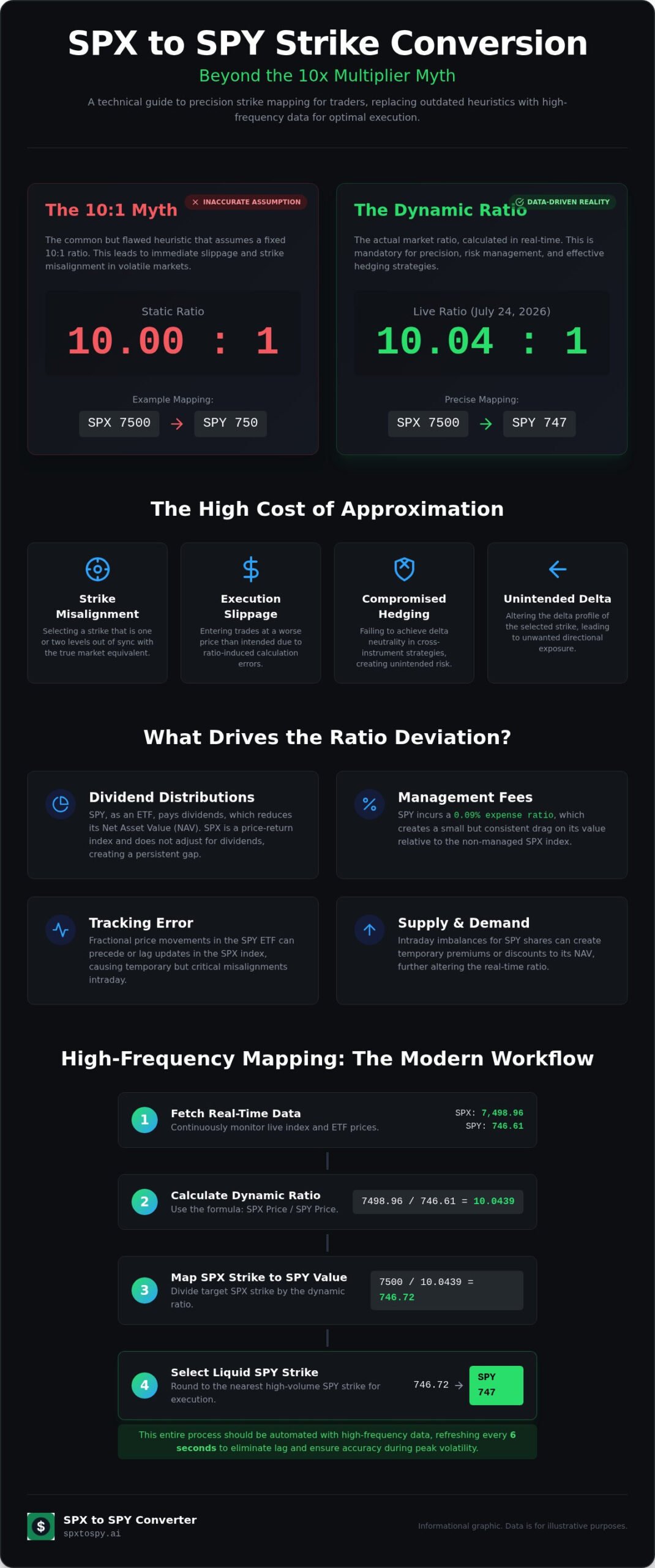
SPX represents the cash index value. SPY is a tradable security designed to track this index. While the theoretical 10x multiplier is the standard starting point, the actual ratio fluctuates based on market variables. On July 24, 2026, the SPX closed at 7,498.96 while SPY closed at $746.61. This resulted in a realized ratio of 10.04:1. Identifying the precise spy equivalent of spx strike requires adjusting for this 0.04 deviation. Fractional price movements in the ETF often precede or lag index updates. This creates temporary strike misalignments that manual calculations cannot resolve in real-time.
Why Approximate Equivalents Increase Execution Risk
Approximate equivalents introduce significant execution risk in high-precision scalping environments. In 0DTE options, a 0.5% ratio drift alters the delta profile of the selected strike. Using a fixed 10:1 ratio during a trend reversal can result in selecting a strike that is one or two levels out of alignment. This causes unintended delta exposure and increased slippage. SPX options utilize 5-point strike increments. SPY provides 1-point or narrower increments. An SPX level of 7500 might map to a 747 SPY strike rather than the expected 750 depending on current market premium and the live ratio. Precise mapping is mandatory for maintaining neutral delta in cross-instrument strategies.
Manual mapping is functionally obsolete for high-frequency execution. Traders must verify the spy equivalent of spx strike using high-frequency data feeds. The SPX to SPY Converter automates this process by tracking the live ratio with a 6-second refresh cycle. This utility eliminates the lag associated with manual ratio tracking. It ensures strike selection remains consistent with current index movements. Use the converter to maintain execution accuracy and reduce the risk of ratio-induced errors during peak volatility.
The Mathematical Relationship: SPX/SPY Ratio Dynamics in 2026
The SPX/SPY ratio is a dynamic variable. Market conditions in 2026 dictate continuous recalibration of this relationship. Static 10.00 multipliers ignore tracking error and dividend drag. As of July 24, 2026, the SPX closed at 7,498.96. SPY closed at $746.61. This yields a realized ratio of 10.0439. Precision is mandatory for the SPX strike price in SPY calculation. Minor basis point drift alters the delta profile of the spy equivalent of spx strike. High-frequency monitoring prevents execution errors during peak volatility.
Factors Driving Ratio Deviation
Dividend distributions remain the primary driver of ratio drift. SPY is an exchange-traded fund; it pays dividends which reduces Net Asset Value (NAV). SPX is a price-return index. It does not adjust for dividends. This creates a permanent, widening gap between the two instruments. Management fees further contribute to divergence. SPY carries a 0.09% expense ratio. Intraday supply and demand imbalances for SPY shares create temporary premiums or discounts to NAV. Refer to Cboe SPX Product Specifications for contract settlement details. Cash settlement versus physical delivery mechanics influence underlying price action and ratio stability.
Calculating the Dynamic Ratio
The computational logic follows a standard formula: SPX Price divided by SPY Price. Traders must monitor the deviation from the 10.00 constant in real-time. A 10.0439 ratio means a 7500 SPX strike maps to a 746.72 SPY value. Rounding to the nearest liquid SPY strike (747) is necessary for execution. During July 2026, the average SPX/SPY market ratio maintained a sustained level of 10.044 to 1. Tracking this specific decimal precision is essential to identify the accurate spy equivalent of spx strike. Basis drift accelerates during extended trading hours, which were expanded for equity options on July 13, 2026. Use a live market ratio tracker to verify these values before order entry.
Tracking error arises from the ETF’s inability to mirror the index with 100% precision. SPY manages $780.71 billion in assets. Rebalancing costs and transaction fees within the fund structure prevent perfect correlation. These micro-deviations accumulate. For 0DTE scalpers, a three-cent difference in SPY price represents a significant percentage of the option premium. Real-time mapping logic must incorporate these variables to ensure strike selection remains mathematically sound. Relying on yesterday’s ratio is an execution risk. Verify the current ratio every six seconds to maintain alignment with the underlying index movement. Understanding SPX SPY strike equivalence at this level of precision — accounting for dividend yield, cost of carry, and settlement differences — is the foundation of professional-grade cross-instrument execution.
SPX vs SPY Options Strike Selection: Strategic Differences
Strike selection requires reconciling disparate increment structures. SPX utilizes 5-point standard increments. SPY offers 1-point and sub-point granularity. This disparity creates mapping requirements for index levels that don’t align with standard ETF strikes. When the ratio identifies a target between available SPY levels, traders must prioritize Delta alignment or liquidity depth. Traders don’t have time for manual mapping during volatility. Precision in identifying the spy equivalent of spx strike remains the primary defense against basis risk.
Strike Increment Disparities
SPX strike granularity is fixed at 5-point intervals for standard expiries. SPY provides granular 1-point availability. Mapping an SPX 7500 level is straightforward. Mapping an SPX 7502.5 level requires choosing between SPY 747 or 748. This choice impacts Delta and Gamma exposure. Selecting an “in-between” strike changes the hedge ratio. Traders must calculate the expected move and choose the strike that minimizes tracking error. High-volume SPY strikes often cluster at 5-point and 10-point intervals, mirroring index liquidity pools. Monitor open interest to ensure execution at the spy equivalent of spx strike without excessive slippage.
Settlement and Style Considerations
Strategic differences extend to exercise mechanics and tax treatment. SPX options are European-style; early exercise is prohibited. SPY options are American-style; they carry early assignment risk, particularly near dividend dates. Exercise mechanics differ significantly. SPX is cash-settled based on the index value. SPY involves physical delivery of shares. Consult the SPX vs SPY settlement difference for a technical breakdown of these risks. Section 1256 of the Internal Revenue Code provides tax advantages for SPX, taxing 60% of gains at long-term rates. SPY is taxed as an equity option. These variables influence the net profitability of cross-instrument strategies.
Liquidity mapping is essential for high-frequency execution. Professional traders identify high-volume SPY equivalents to ensure tight bid-ask spreads. SPX options provide larger notional exposure per contract. Ten SPY contracts are required to hedge one SPX contract. This increases transaction costs and commission drag. Effective hedging requires matching the SPX strike to the SPY equivalent with the highest volume. This reduces the risk of being trapped in illiquid strikes during volatility spikes. Continuous ratio tracking ensures the selected strike remains relevant as the underlying index moves.
Operational Protocol: Converting SPX Strikes for SPY Execution
Execution speed is the primary determinant of slippage in 0DTE strategies. Manual calculation is a failure point during high-velocity price action. Success depends on a clinical, modular workflow that bridges index analysis with ETF execution. On July 24, 2026, the SPX/SPY ratio reached 10.04:1, requiring immediate recalibration of strike targets. Traders must replace mental math with a standardized operational protocol to identify the spy equivalent of spx strike. This process ensures strike selection remains mathematically aligned with intraday technical levels.
The 0DTE Scalping Workflow
Modular execution follows a specific four-step sequence. Identify the SPX target level first. Use institutional benchmarks like VWAP, previous day close, or specific 5-point index support levels. Consult the 0DTE SPX SPY ratio to determine the current basis. Locate the precise spy equivalent of spx strike using the live ratio. Verify SPY option chain liquidity at that specific strike before order entry. This sequence minimizes the time spent navigating the broker interface during rapid market shifts.
- Target Identification: Define the SPX level based on index technicals.
- Ratio Verification: Check the live SPX/SPY ratio for basis drift.
- Strike Mapping: Convert the SPX level to the nearest liquid SPY strike.
- Execution: Enter the order on the SPY chain with confirmed delta alignment.
Retail Platform Mapping (Robinhood/Webull)
Retail traders using Robinhood or Webull face inherent data disadvantages. These platforms often provide index data with higher latency compared to institutional feeds. This delay causes traders to execute at strikes that no longer reflect the current index value. Mapping institutional SPX data to retail SPY chains requires an external real-time bridge. Use the 6-second refresh cycle to compensate for retail feed latency. This is critical during high-impact events like FOMC releases or economic data prints when the ratio fluctuates rapidly.
Managing rapid price shifts requires pre-mapped strike tables. Volatility expands the SPX/SPY basis risk. High-frequency mapping ensures you don’t trade on stale ratios. Access the Live Market Ratio Tracking utility to maintain execution precision across all sessions, including the extended trading hours implemented on July 13, 2026. This protocol reduces decision fatigue and eliminates the math errors that compromise scalping profitability. Verify all conversion values against active broker quotes to ensure final execution accuracy.
SPX to SPY Converter: High-Frequency Strike Mapping Utility
The SPX to SPY Converter functions as a dedicated digital assistant for strike price mapping. It replaces manual ratio tracking with automated, high-frequency data processing. The utility is engineered for zero-distraction environments. It provides the specific variables required for instant decision-making. Identifying the spy equivalent of spx strike requires sub-decimal precision that manual calculation cannot maintain during peak volatility. The tool isolates the core mathematical relationship between the index and the ETF to ensure execution accuracy.
Real-Time Data Architecture
The system architecture prioritizes data freshness. Ratios refresh every six seconds. This frequency is the primary differentiator for 0DTE scalping precision. The tool monitors the live SPX/SPY ratio by polling current index levels and ETF prices simultaneously. It accounts for the basis drift observed on July 24, 2026, when the ratio deviated to 10.04:1. Automated mapping eliminates the latency inherent in manual spreadsheets. High-frequency updates are critical during the extended trading sessions introduced on July 13, 2026. Constant motion in the data feed mirrors the pulse of the live market.
- Refresh Cycle: 6-second interval.
- Data Source: Real-time SPX and SPY price feeds.
- Precision: Four decimal point ratio tracking.
- Interface: Minimalist, clinical design for rapid scanning.
Trader Responsibility and Verification
The converter operates as a reference utility. It is not a financial advisor. Mandatory broker verification is required before any order entry. Users must confirm the mapped strike against the active option chain in their trading platform. Discrepancies may occur due to broker-specific data latency or liquidity imbalances. The tool provides the mathematical spy equivalent of spx strike based on objective market data. Final execution risk remains with the user. Verify the strike, check the bid-ask spread, and confirm order size before committing capital.
Final protocol for mapping SPX strikes to SPY equivalents:
- Confirm the current SPX target level.
- Verify the live ratio timestamp within the 6-second window.
- Cross-reference the calculated SPY strike with the broker’s option chain.
- Assess SPY liquidity and open interest at the target strike.
- Execute using limit orders to mitigate slippage.
This systematic approach mitigates the risk of ratio-induced errors. Use the tool as a transparent layer between raw market data and tactical execution. Maintaining a clinical, data-centric workflow is the only way to ensure strike alignment in the current high-frequency trading landscape. The data-driven interface ensures that strike selection remains a function of mathematical reality rather than estimation.
Precision Strike Mapping for Intraday Execution
The 10x multiplier remains a baseline, but professional execution requires accounting for the dynamic basis between index and ETF. Tracking error and dividend drag create permanent ratio shifts that compromise manual calculations. Success in 0DTE scalping depends on identifying the exact spy equivalent of spx strike through high-frequency data feeds. Using a standardized operational protocol reduces the risk of selecting misaligned strikes during rapid price action. Efficiency in cross-instrument hedging is a function of data freshness and interface clarity.
The SPX to SPY Converter provides the necessary technical bridge for traders navigating high-volatility sessions. It eliminates the delay of mental math with a 6-second refresh cycle and a clinical, distraction-free layout. This zero-cost utility is designed to support the 0DTE community by providing objective, real-time conversion variables. Maintain execution discipline by verifying all mapped strikes against your broker’s active quotes. Access the Real-Time SPX to SPY Strike Converter to optimize your strike selection and reduce basis risk. Precise data is the primary tool for consistent execution in today’s rapid market environment.
Frequently Asked Questions
What is the exact SPY equivalent of an SPX 5800 strike?
The exact mapping depends on the live SPX/SPY ratio at the time of execution. Using the July 2026 average ratio of 10.044:1, an SPX 5800 strike converts to a 577.46 SPY strike. Traders must select the nearest liquid SPY strike, typically 577 or 578, to maintain delta alignment.
Why does the SPX to SPY ratio change throughout the day?
Intraday fluctuations result from tracking error and supply-demand imbalances in the ETF shares. Dividend accruals and the 0.09% expense ratio create permanent basis drift between the cash index and the tradable fund. Market volatility expands these micro-deviations during active trading sessions, requiring continuous recalibration.
Is the SPX to SPY ratio always exactly 10.00?
No, the ratio is rarely a static 10.00. As of July 24, 2026, the realized ratio was 10.0439:1. Relying on the 10x multiplier myth leads to strike misalignment and increased execution slippage. Precise mapping requires using the current index price divided by the ETF price.
How often should I refresh the SPX to SPY conversion ratio?
Refresh cycles should occur every six seconds for maximum intraday precision. High-frequency updates are mandatory for 0DTE scalping. Rapid basis shifts during economic releases necessitate constant recalibration to identify the spy equivalent of spx strike accurately and reduce basis risk.
Are SPX options more profitable than SPY options at equivalent strikes?
Profitability varies based on tax treatment and transaction costs. SPX options offer Section 1256 tax advantages, taxing 60% of gains at long-term rates. SPY options provide greater granularity for small-account scaling but carry different regulatory fees, such as the $0.01248 per contract ORF implemented in July 2026.
Can I use SPY strikes to hedge an SPX portfolio accurately?
Accurate hedging requires matching the notional value using the dynamic SPX/SPY ratio. One SPX contract typically requires ten SPY contracts for an approximate hedge, but the specific strike must be adjusted for the 10.044 basis. Precision mapping prevents delta leakage caused by ratio drift and tracking error.
What is the most accurate tool for SPX to SPY strike mapping?
A real-time converter with a 6-second refresh cycle is the most accurate utility. Tools utilizing high-frequency data feeds eliminate the latency of manual spreadsheets. Clinical, data-centric interfaces prioritize functional efficiency for professional-grade strike mapping without the distraction of peripheral market commentary.
Does dividend payment affect the SPX/SPY strike equivalence?
Dividend distributions reduce the SPY Net Asset Value without affecting the SPX price-return index. This creates a widening gap in the spy equivalent of spx strike over time. Traders must adjust targets to account for this permanent dividend drag, especially during quarterly distribution cycles.