0DTE contracts represent up to 65% of daily SPX trading volume as of July 2026. High-frequency execution requires immediate strike parity between index data and ETF instruments. Manual calculations introduce unnecessary latency and slippage. An inaccurate 10x ratio assumption leads to strike misalignment during volatile sessions. Traders require a reliable s&p 500 options strike converter to maintain precision across fragmented retail platforms.
Rapid execution on platforms like Robinhood depends on exact mathematical relationships between the S&P 500 index and the SPY ETF. You’ll gain access to zero-latency strike mapping using the live July 2026 ratio of 10.0360. This ensures accurate SPX to SPY conversion for immediate order entry without the risk of manual input errors. Precise data eliminates the guesswork inherent in cross-instrument trading and accounts for tracking differences.
This guide details the real-time mapping process. We analyze the current market ratios, discuss the technical requirements for strike parity, and provide a clinical framework for cross-instrument strike selection. The focus remains on functional efficiency and data accuracy for active participants.
Key Takeaways
- Translate SPX index strikes to SPY ETF equivalents via technical mapping utilities.
- Utilize a dynamic s&p 500 options strike converter featuring a 6-second ratio refresh protocol for precision.
- Optimize 0DTE and intraday scalping execution through rapid strike parity selection.
- Differentiate structural settlement and exercise styles between SPX and SPY instruments to manage risk.
- Implement real-time mapping data to eliminate manual calculation errors and mitigate execution slippage.
Index Options Strike Price Converter: Functional Overview
The index options strike price converter is a dedicated technical mapping utility. It facilitates the precise translation of SPX index strikes into SPY ETF equivalents. Professional traders monitoring the S&P 500 Index use this tool to bridge the gap between institutional-grade data and retail execution environments. An automated s&p 500 options strike converter is essential for maintaining operational speed. Manual calculation in high-volatility regimes introduces unacceptable latency. Latency leads to slippage. Human error during rapid price discovery results in strike misalignment. This utility provides a clinical, data-driven solution for maintaining strike parity across fragmented platforms. It functions as a transparent layer between index analysis and ETF execution. Traders frequently move between institutional index data and retail platforms. Without a functional s&p 500 options strike converter, the transition creates a high-risk failure point. Precise conversion ensures that the intended strike on the index is correctly identified on the tradable ETF instrument.
The Translation Mechanism
The conversion engine relies on specific variables: target SPX strike, live market ratio, and a verified timestamp. The output is a SPY strike equivalent with high decimal precision. Conversion integrity depends on a constant real-time data stream. Traders can’t rely on a fixed 10x multiplier. Dividend accruals and fund fees cause the SPX:SPY ratio to fluctuate. The converter monitors these variables continuously. It applies the current ratio to the input strike to generate a tradable target within a 6-second refresh cycle. This automated process prevents the use of stale data during intraday trend changes.
Why Precision Matters in Strike Mapping
Ratio deviations of 0.01 result in significant execution risk. Large position sizes increase the financial impact of misalignment. Selecting “off-the-map” strikes during rapid price discovery breaks strategy logic. For delta-neutral strategies, strike accuracy is non-negotiable. Hedge ratios depend on precise selection to maintain portfolio balance. Rounding errors disrupt delta sensitivity and gamma exposure. In the 0DTE market, speed and accuracy are the primary variables. Automated mapping removes the manual calculation bottleneck, ensuring retail SPY orders reflect institutional SPX analysis without tracking lag. It’s a clinical requirement for risk management.
Real-Time Ratio Dynamics: Beyond the 10x Multiplier
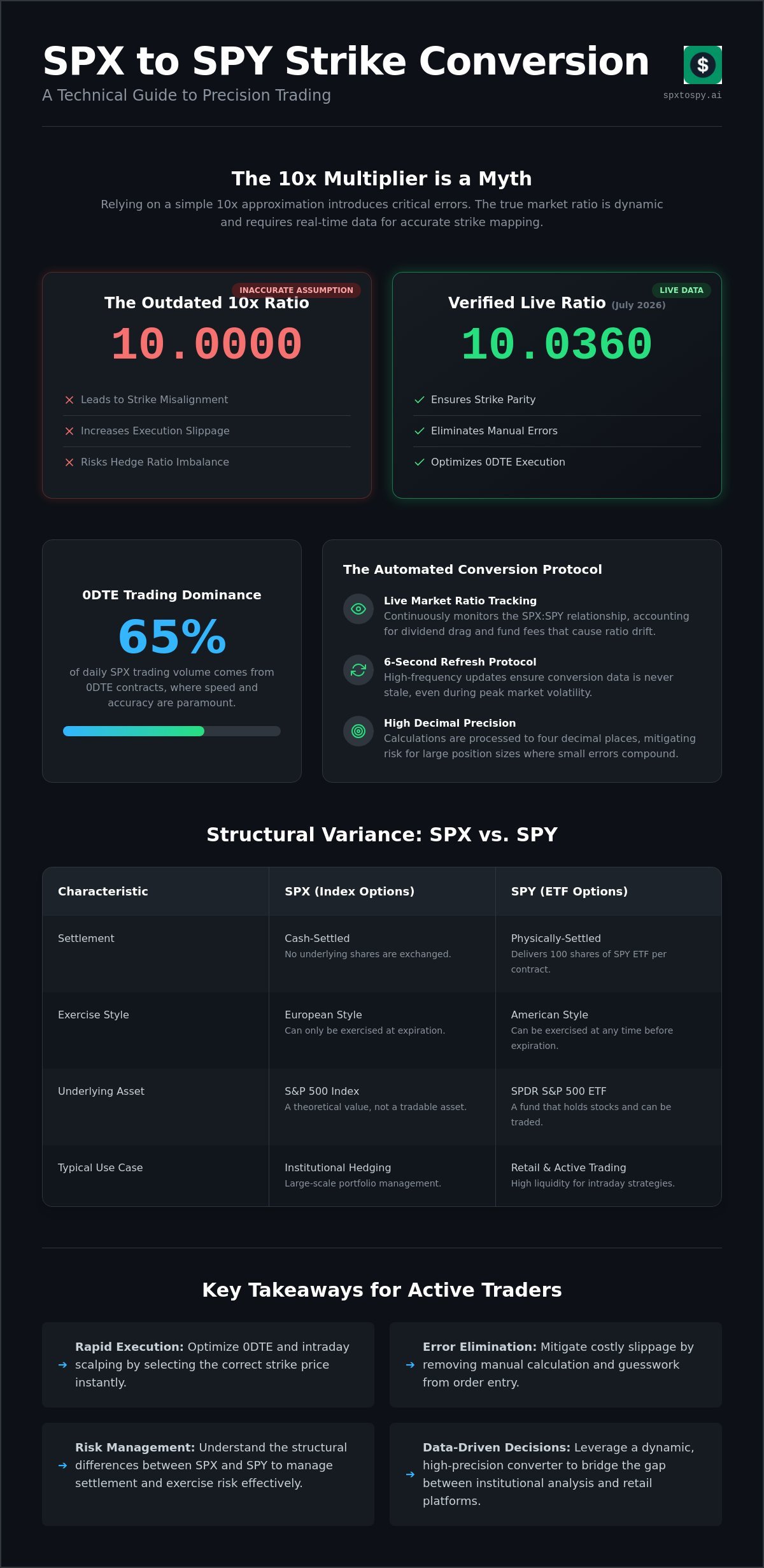
The 10x multiplier is a mathematical approximation, not a trading constant. As of July 2026, the verified real-time ratio between the SPX index and the SPY ETF is 10.0360. This 0.36% variance represents a significant deviation for high-volume traders. Using an outdated 10.0 ratio leads to strike selection errors. An automated s&p 500 options strike converter must account for these intraday shifts. Ratio drift occurs due to quarterly dividend distributions from S&P 500 constituents and SPY management fees. These factors create a wedge between the cash index and the tradable ETF. Referencing the official SPX contract specifications confirms the index’s cash-settled nature, which lacks the dividend-drag inherent in the physically-backed SPY. Tracking errors occur when the ETF price discovery lags behind the index movement. This lag is often visible during the first 30 minutes of the New York session.
Tracking the Live Market Ratio
The SPX:SPY relationship is a dynamic variable. Intraday fluctuations require constant monitoring. The converter tool implements a 6-second update protocol. This frequency ensures conversion accuracy during peak volatility. Market participants use this data to identify ratio mean reversion. When the ratio deviates from its short-term moving average, execution timing becomes critical. Traders can access live market ratio tracking to verify these shifts before order entry. Real-time processing eliminates the risks associated with manual calculation or stale 15-minute delayed data feeds. The 6-second refresh interval aligns with high-frequency data packets used by institutional desks. It provides a level of parity for retail traders attempting to map index movements to ETF execution. Constant motion in the ratio is the baseline expectation.
Computational Accuracy Requirements
Professional-grade strike mapping requires high decimal precision. Rounding to the nearest whole number is insufficient. Effective conversion logic processes the relationship to four decimal places. This level of granularity is necessary for managing large contract sizes where small errors scale rapidly. The system evaluates the midpoint of the bid/ask spread for both instruments to derive the most accurate conversion factor. Verification remains an operational priority. Users should cross-reference the converter output with live broker data to confirm local liquidity. This dual-layer verification protocol mitigates the impact of tracking errors. Relying on a dedicated s&p 500 options strike converter provides the baseline data needed for rapid decision-making in the 0DTE market. Precision is the only defense against the accumulation of small tracking discrepancies. Accurate mapping maintains the integrity of the original trade thesis across different market structures.
Execution Metrics for 0DTE and Intraday Scalping
Zero-days-to-expiration (0DTE) options represent 59-65% of daily SPX trading volume as of July 2026. Record average daily volumes reached 3.3 million contracts in June 2026. High-frequency scalping mandates zero-latency strike mapping. Manual calculations during peak volatility introduce execution lag. Stale data results in slippage. A dedicated s&p 500 options strike converter provides the necessary speed for intraday participants. It translates institutional SPX price levels into executable SPY strikes instantly. Rapid price discovery requires immediate action. This utility reduces cognitive load by removing mathematical friction. Traders focus on tape reading rather than arithmetic. Precise mapping ensures the trade thesis remains intact across different instruments. Accurate strike selection is the primary variable for maintaining expected value in 0DTE environments.
Scalping strategies rely on narrow profit targets. Every tick matters. A 0.01 deviation in the SPX:SPY ratio alters the delta profile of the position. Current July 2026 data shows retail premium trading at $6.8 billion per day. High retail participation increases liquidity but also heightens the need for precise entry. Using an automated s&p 500 options strike converter aligns retail execution with institutional index movements. It eliminates the “off-the-map” strike risk during fast-moving market regimes. Reliability is a clinical requirement for risk management. Speed is the only defense against rapid gamma expansion in 0DTE contracts. Traders managing this gamma exposure can benefit from understanding the 0DTE SPX SPY ratio framework for real-time precision strike price mapping to eliminate manual calculation lag during peak volatility windows.
0DTE Strike Selection Protocol
- Step 1: Identify SPX technical levels. Locate key support or resistance zones on the index chart.
- Step 2: Input the target SPX strike. Use the converter to process the current 10.0360 market ratio.
- Step 3: Extract the SPY equivalent. Identify the tradable contract for immediate platform entry.
This three-step logic maintains operational flow. It prevents decision paralysis during high-gamma windows. Precise outputs facilitate rapid order placement on retail interfaces. Traders requiring a dedicated SPY calculator for precision spy to spx strike conversion can access a purpose-built utility that applies real-time ratio tracking to eliminate manual calculation errors in high-gamma environments.
Retail Platform Integration (Robinhood/Webull)
Retail platforms like Robinhood and Webull lack native SPX index option chains for many users. Traders analyze SPX but execute on SPY. This fragmentation creates a data gap. The converter bridges this gap by providing executable parity. It accounts for liquidity differences between institutional index chains and retail ETF chains. Rapid conversion turns index analysis into actionable SPY orders. Execution speed is maximized. Tracking lag is minimized. This protocol is essential for participants managing high-frequency intraday positions. It ensures the retail order reflects the institutional data point with clinical accuracy. Day traders seeking the best SPX SPY converter for day traders can reference a dedicated technical resource that outlines the specific parameters of the SPX:SPY relationship and the workflow for integrating live ratio data into retail execution.
Structural Variance: SPX Index vs. SPY ETF Options
SPX and SPY options exhibit fundamental structural variances despite tracking the same underlying index. SPX options are cash-settled instruments. Upon expiration, the net cash value is credited or debited directly to the trading account. SPY options utilize physical settlement. This requires the delivery of 100 shares of the SPY ETF per contract if exercised. Exercise styles differ significantly. SPX follows the European style. Contracts can only be exercised at expiration. SPY follows the American style. Holders can exercise at any time before expiration. These mechanics dictate specific risk management protocols. A reliable s&p 500 options strike converter is necessary to manage these differences when hedging index positions with ETF instruments. Precise mapping ensures that the selected strike accounts for the 10.0360 ratio currently observed in July 2026.
Notional value is another critical distinction. One SPX contract is approximately 10 times the size of one SPY contract. Tax implications also diverge. SPX gains fall under Section 1256 of the IRS code. This grants 60% long-term and 40% short-term capital gains treatment regardless of the holding period. SPY gains are generally taxed as 100% short-term capital gains if held for under one year. This tax efficiency makes SPX preferred for high-volume traders. SPY provides more granular execution for smaller accounts. Using an automated s&p 500 options strike converter facilitates the transition between these two distinct tax and settlement regimes without calculation errors.
Settlement and Assignment Risk
Early assignment risk is a primary concern for SPY traders. American-style exercise allows counter-parties to exercise options before expiration. This often occurs to capture dividends. SPX eliminates this risk entirely. European exercise ensures positions remain open until the final settlement. Expiration pin risk is also higher in SPY. Physical delivery can lead to unexpected share positions and overnight margin requirements. SPX cash settlement avoids this complexity. Use the Real-Time SPX to SPY Strike Price Converter to identify exact parity levels needed for neutral hedging across these settlement styles.
Liquidity and Spread Analysis
Bid-ask spreads vary between the two chains. SPY options typically offer tighter spreads in penny increments. This caters to retail scalping and high-frequency entry. SPX spreads are wider in absolute terms but often tighter on a percentage of notional value basis. Volume profiles show record activity. In June 2026, average daily volumes for SPX 0DTE reached 3.3 million contracts. Liquidity at equivalent strikes is not always symmetrical. Slippage expectations must be adjusted when moving between instruments. Precise mapping prevents execution at illiquid levels. It preserves the trade’s expected value by identifying the corresponding strike where liquidity is deepest for the intended trade thesis.
Operational Protocol for spxtospy.ai Tool Integration
Access the Real-Time SPX to SPY Strike Price Converter for immediate data synchronization. The interface provides a dedicated environment for translating index levels into tradable ETF strikes. Monitor the 6-second ratio refresh indicator to ensure calculation validity. Stale ratios lead to execution errors during high-volatility windows. Input the target SPX strike. The s&p 500 options strike converter processes the input against live market variables. Mapping occurs instantaneously. This protocol eliminates manual calculation latency. Use the output as a secondary verification layer before committing capital. High-frequency 0DTE environments require this level of technical redundancy. Speed and accuracy remain the primary performance metrics for intraday participants. Reliable data is the baseline for all execution logic.
The conversion engine operates as a clinical utility. It removes the friction of mental math during rapid price discovery. Traders can maintain focus on tape reading while the tool handles the mathematical relationship between the index and the ETF. This systematic approach is essential for scaling positions across fragmented platforms. It ensures that the trade thesis remains consistent regardless of the execution venue. Accuracy is maintained through constant data feed monitoring. This is a functional requirement for any trader moving between institutional data and retail execution.
Tool Interface Navigation
Locating the live market ratio display is the primary step. The value updates every 6 seconds to reflect dividend accruals and tracking shifts. Enter custom strike values to align with specific strategy needs. Support and resistance levels on the SPX chart must be converted before order entry. Read the conversion output with four-decimal precision. This granularity is required for high-notional positions where rounding errors accumulate. The modular layout allows for rapid scanning during peak volatility. User inputs are processed via an optimized logic gate to minimize software-induced lag. The interface prioritizes data clarity over visual fluff.
Risk Management and Verification
Mandatory broker verification is required before order submission. Confirm local liquidity and bid-ask spreads on the retail platform. The converter provides a mathematical mapping, not an execution guarantee. Review the tool disclaimer. It clarifies that data output does not constitute financial advisory services. Direct trade execution remains the user’s responsibility. Integrating a dedicated s&p 500 options strike converter into a comprehensive SPX to SPY Converter workflow maintains operational consistency across different market regimes. This systematic approach ensures that every retail SPY order reflects the institutional SPX data point with clinical accuracy. Reliability depends on the user’s adherence to this verification protocol. The tool acts as a silent digital assistant for rapid decision-making. It is a precision instrument for the modern options market.
Maintain Execution Parity for Intraday Scalping
Intraday volatility requires immediate parity between index analysis and ETF execution. Manual 10x approximations introduce unacceptable slippage in 0DTE environments where premiums move rapidly. Precise mapping must account for structural variances including settlement styles and tax treatment. The July 2026 ratio of 10.0360 demonstrates the necessity of dynamic tracking over fixed multipliers. Utilizing a dedicated s&p 500 options strike converter ensures that every retail order reflects institutional data with clinical accuracy. High-precision data output minimizes the cognitive load during peak trading hours by removing manual arithmetic requirements.
Ratios refreshed every 6 seconds provide a verified baseline for cross-instrument hedging and risk management. This dedicated 0DTE technical utility eliminates calculation errors and tracking lag. Verification remains an operational priority for maintaining delta-neutral integrity across fragmented platforms. Reliable data is the only defense against tracking discrepancies and ratio drift. Accurate strike selection preserves the trade thesis during fast-moving price discovery windows. Optimization of order entry speed is a functional requirement for consistent performance.
Access the Real-Time SPX to SPY Strike Price Converter to optimize your execution workflow. Precision facilitates consistent execution results.
Frequently Asked Questions
How do I convert SPX strikes to SPY for Robinhood?
Input the target SPX strike into the mapping interface to identify the executable SPY equivalent. Robinhood does not support direct SPX index options, necessitating cross-instrument parity. The tool processes the current 10.0360 ratio to find the corresponding retail strike. This protocol ensures that ETF execution reflects institutional index analysis without mathematical lag. Rapid strike selection is critical for maintaining expected value during volatile sessions.
Why is the SPX to SPY ratio not always exactly 10?
The ratio deviates from 10.0 due to SPY expense ratios, tracking errors, and dividend distributions. SPX is a pure cash index, while SPY is a physically-backed ETF subject to fund management variables. As of July 2026, the verified ratio is 10.0360. Relying on a fixed multiplier results in strike misalignment and increased slippage during high-gamma windows. Precise mapping requires real-time data ingestion.
Is there a live options strike price tool for 0DTE traders?
The spxtospy.ai utility serves as a specialized high-frequency mapping tool. It caters to the 0DTE market, which accounted for 65% of daily SPX volume in July 2026. This s&p 500 options strike converter provides the zero-latency data required for intraday scalping. It bridges the gap between institutional data feeds and retail execution platforms. Real-time mapping is a clinical requirement for professional risk management.
How often does the SPX to SPY ratio refresh?
The SPX:SPY ratio updates every 6 seconds. This high-frequency refresh protocol maintains conversion integrity during peak volatility. Automated updates account for rapid price discovery and intraday ratio drift. Stale calculations introduce significant execution risk. Monitoring the refresh timestamp is a mandatory step in the operational workflow. Precision depends entirely on the currentness of the underlying data stream.
What is the mathematical formula for SPX to SPY strike conversion?
Conversion follows the formula: [Target SPX Strike] / [Current Market Ratio] = [Target SPY Strike]. Applying the July 2026 ratio of 10.0360 to an SPX strike of 5500 yields a SPY equivalent of 548.03. Traders select the nearest liquid strike on the SPY chain. The converter processes this relationship to four decimal places. High-precision output is necessary for managing high-notional contract sizes effectively.
Are converted SPY strikes as accurate as SPX strikes?
Mathematical mapping is precise, but execution depends on available SPY strike intervals. Discrete strike increments in the ETF chain may not perfectly align with the continuous index level. This creates a tracking discrepancy. Users must verify local broker liquidity and bid/ask spreads. The converter provides the theoretical parity level, acting as a secondary verification layer for trade entry during fast-moving market regimes.
Can I use this index options strike price converter for puts and calls?
The tool functions for all option types. The mathematical relationship between the index and the ETF is independent of contract direction. Input any SPX strike to derive the SPY equivalent for calls, puts, or multi-leg spreads. This s&p 500 options strike converter maintains operational consistency across all strategy variations. Precise mapping is essential for delta-neutral and gamma-scalping protocols in high-volume environments.
Does the converter account for dividend adjustments?
The 6-second refresh cycle automatically accounts for dividend-induced drift. SPY dividends create a wedge between the ETF price and the SPX index. The converter monitors these distributions to maintain accurate strike parity throughout the trading day. Manual adjustments for dividend yields are unnecessary. Automated tracking ensures that the conversion factor reflects the true relationship between the cash index and the physically-settled ETF.