
Choosing between SPX and SPY options based on premium alone is a tactical error. The spx vs spy settlement difference determines the transition from paper profit to realized risk. Traders frequently encounter unexpected assignment on SPY or miscalculate the AM settlement timing of monthly SPX contracts. These mechanical failures lead to inaccurate strike mapping and unnecessary margin calls during high volatility.
This technical comparison details the structural variations required to mitigate exercise risk and capture Section 1256 tax benefits. It provides the data necessary to eliminate pin risk and optimize strike price conversion for 2026 market conditions. Review the following breakdown of settlement timing, delivery methods, and tax efficiency protocols to maintain portfolio stability.
Key Takeaways
- Cash vs. Physical: Contrast SPX cash settlement via OCC against SPY physical delivery of 100 shares per contract to prevent unintended asset acquisition.
- Risk Mitigation: Analyze the spx vs spy settlement difference to eliminate SPY pin risk and manage SPX AM morning gap exposure.
- Exercise Protocols: Leverage European-style SPX contracts to remove the early assignment risk inherent in American-style SPY options.
- Tax Efficiency: Access Section 1256 benefits for SPX positions to apply 60/40 capital gains treatment regardless of duration.
- Strike Mapping: Utilize real-time ratio tracking for precise conversion between SPX index levels and SPY ETF pricing during high-volatility windows.
Fundamental Settlement Mechanics: Cash vs. Physical Delivery
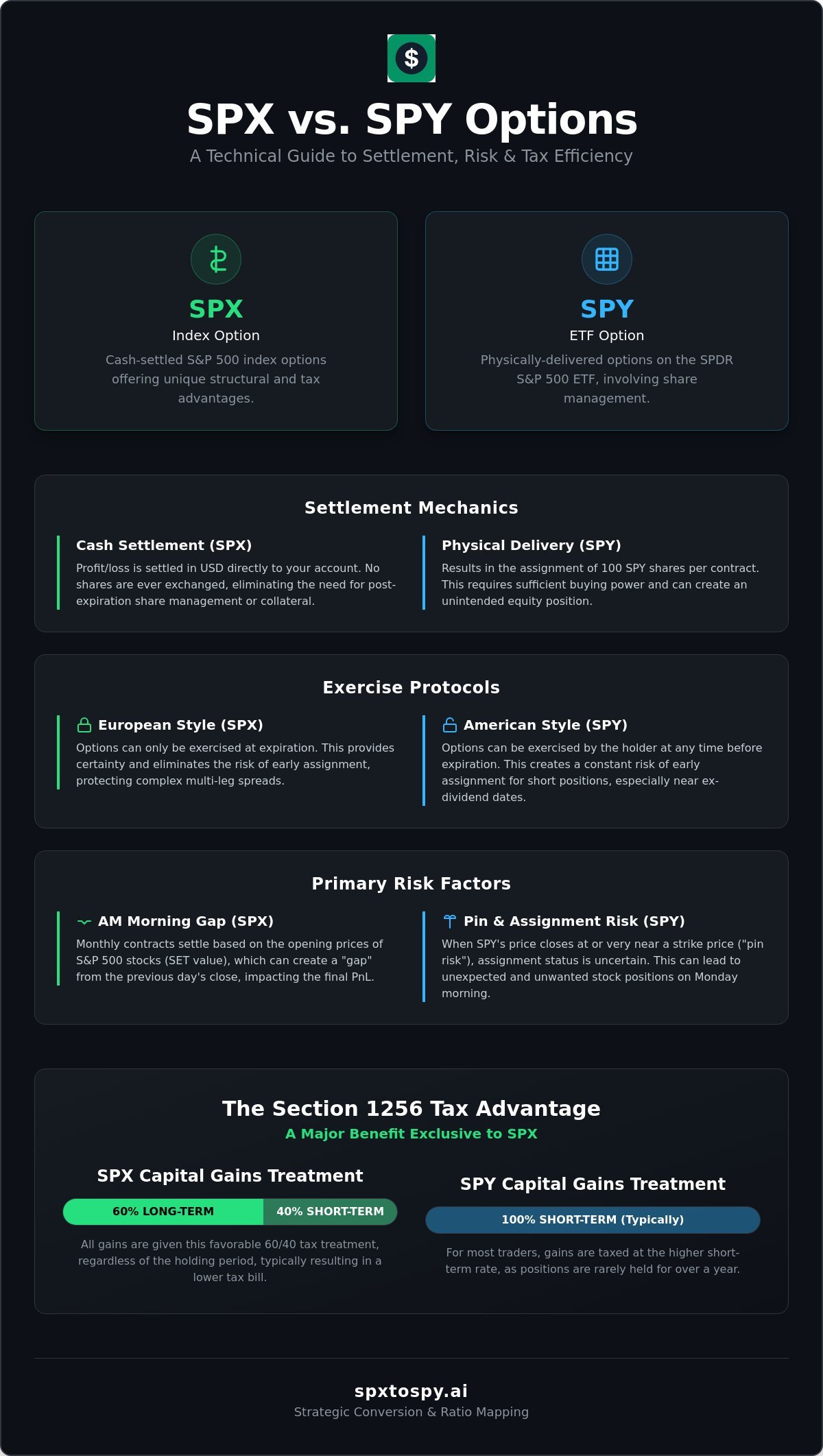
The spx vs spy settlement difference originates in the structural classification of the underlying asset. SPX is a broad-market index. SPY is an exchange-traded fund. This distinction dictates the final disposition of all in-the-money (ITM) contracts at expiration. SPX utilizes a cash-settlement process managed by the Options Clearing Corporation (OCC). SPY requires physical delivery of the underlying equity. These mechanics create diverging risk profiles for traders holding positions through the closing bell.
Index Options (SPX) and Cash Liquidation
Cash settlement eliminates the transfer of securities. Final profit and loss (PnL) is calculated as the numerical difference between the strike price and the final settlement value. This value is credited or debited to the trading account in USD. No underlying shares change hands. This mechanism is efficient for high-frequency traders and 0DTE strategists. It removes the necessity for equity collateral post-expiration. Margin requirements remain focused on the option premium rather than the notional value of 500 individual stocks. The process is automated. It ensures immediate liquidity without the friction of share management or secondary market transactions.
ETF Options (SPY) and Share Delivery
The SPDR S&P 500 Trust ETF is a single tradable security. Settlement results in the physical delivery of 100 shares per contract. Assignment triggers a long or short equity position in the portfolio. This requires immediate buying power to maintain the underlying shares. Traders must close positions prior to 4:00 PM ET to avoid weekend exposure or margin calls. Physical delivery introduces pin risk. This occurs when the SPY price hovers near the strike at the closing bell. The assignment status remains uncertain until the following trading session. The spx vs spy settlement difference creates operational friction for accounts with limited liquidation capacity.
- SPX Settlement: Pure cash. No share management. Immediate USD credit/debit.
- SPY Settlement: Share delivery. Physical assignment. Long or short equity position.
- Collateral: SPX requires zero equity collateral post-expiration. SPY requires 100% share value or margin equivalent.
- Liquidation: SPX positions liquidate automatically via OCC protocols. SPY positions convert to equity holdings requiring manual management.
- Complexity: SPX is mathematically direct. SPY involves share costs, dividend adjustments, and margin maintenance.
Traders must evaluate account size and margin availability before selecting an instrument. SPX offers a cleaner exit for those seeking index exposure without the burden of share ownership. SPY remains the standard for those requiring the ability to hedge specific share counts or engage in covered call strategies. Understanding these mechanics is the first step in mitigating exercise risk. Traders moving between these instruments must also account for the spx vs spy contract size difference, as the 10x notional gap between a single SPX contract and its SPY equivalent creates significant margin and position sizing implications.
Exercise Styles and Timing: European vs. American Protocols
The spx vs spy settlement difference extends to the temporal rights granted to the option holder. SPY options utilize American-style protocols. These grant the holder the right to exercise the contract at any point prior to the expiration deadline. SPX options adhere to European-style protocols. Exercise occurs only at expiration. This structural divergence forces traders to manage different risk variables, particularly when holding short positions through volatile sessions or corporate action windows.
Early Exercise Risk in SPY
Short SPY positions carry constant assignment risk. This risk is non-linear. It scales based on the moneyness of the option and the proximity to ex-dividend dates. When an ITM call option has negligible extrinsic value, the holder may exercise early to secure the dividend. This forces the short seller into a short share position. This results in an immediate dividend liability and potential margin expansion. In high-interest rate environments, early exercise risk for puts increases as holders seek to realize cash proceeds for immediate interest-bearing deployment. Traders must track these variables to avoid forced liquidation. Utilizing a real-time strike price converter helps identify which SPY strikes are most vulnerable to assignment compared to their SPX counterparts.
European Finality in SPX
SPX contracts offer structural immunity to early assignment. Traders reference the Cboe SPX contract specifications to confirm that positions remain intact until the final settlement calculation. This finality is essential for multi-leg spreads. In an SPY iron condor, a single leg assignment breaks the hedge. It leaves the trader with directional exposure and massive capital requirements. In SPX, the entire spread remains active until the SET value is determined. This allows for precise calculation of maximum loss without counterparty interference. The absence of early exercise removes the need for constant position monitoring during the trading day.
- SPY (American): Exercise possible T+0 through expiration. High risk during dividend cycles.
- SPX (European): Exercise restricted to expiration. Zero early assignment risk.
- Strategic Impact: SPY requires active dividend management. SPX supports complex spread mechanics with duration certainty.
- Margin: SPY assignment triggers equity margin. SPX settlement remains within the index options margin framework.
The spx vs spy settlement difference dictates the level of oversight required for a portfolio. SPY traders must account for the behavior of the option holder. SPX traders only account for the movement of the index. This makes SPX the preferred instrument for sophisticated spread trading where capital efficiency and duration certainty are prioritized.
Settlement Price Determination: The SET Value vs. Closing Print
The spx vs spy settlement difference is most critical during the final 24 hours of the contract lifecycle. Pricing for SPY and SPXW (weekly) options is determined by the 4:00 PM ET closing print. Monthly SPX options use an AM settlement protocol. This divergence creates different exposure windows. Traders must identify whether their position settles against the live spot price or the calculated SET value to avoid terminal price discrepancies.
The SET Value Calculation
The SET symbol is the official ticker for SPX monthly settlement. It is not a live-traded index. Calculation begins at 9:30 AM ET on the third Friday of the month. The value aggregates the first traded price of all 500 S&P constituent stocks. If a high-weight component stock experiences an opening delay, the SET value remains uncalculated. This creates a mathematical lag between the opening bell and the finalized SET print that can persist for several minutes. Traders often see a discrepancy between the SPX chart price at 9:30 AM and the final SET value. This variance can trigger unexpected losses on ITM spreads that appeared safe at the Thursday close.
PM Settlement Mechanics (SPXW and SPY)
Weekly SPX (SPXW) and all SPY expirations follow PM settlement protocols. The final value is the official 4:00 PM ET closing price of the index or ETF. This process is transparent. The price displayed on standard charting platforms at the bell is the settlement price. Predictability is high. Traders can manage risk in real-time until the final second of the session. Using the Real-Time SPX to SPY Strike Price Converter during the final 30 minutes of trading ensures accurate mapping between the SPX index level and the SPY ETF price before the PM print.
- SPX Monthly (AM): Trading ends Thursday 4:15 PM ET. Settlement occurs Friday morning. High overnight gap risk.
- SPX Weekly (PM): Trading ends Friday 4:00 PM ET. Settlement occurs immediately. Zero overnight gap risk.
- SPY (PM): Trading ends Friday 4:00 PM ET. Physical delivery risk persists after the bell.
- SET Symbol: Non-tradable. Used exclusively for cash liquidation calculations.
Price gapping is the primary hazard of AM settlement. The 17-hour window between the Thursday close and the Friday SET print exposes positions to global macro shocks. A position that is 10 points out-of-the-money (OTM) on Thursday can settle deep ITM on Friday if the market gaps at the open. SPY traders avoid this specific gap risk but remain exposed to pin risk during the final minutes of the Friday session. Understanding the spx vs spy settlement difference is mandatory for selecting the correct expiration cycle for a specific risk tolerance. Traders must also understand the spx spy price relationship and how dividend distributions and tracking error cause the ratio to deviate from the nominal 10x multiplier, particularly during settlement windows when precision mapping is most critical.
Settlement-Related Risk Factors: Pin Risk and Gapping
The spx vs spy settlement difference creates two distinct terminal risk categories: pin risk and gap risk. SPY traders face post-market uncertainty due to physical share delivery protocols. SPX traders face overnight exposure in monthly cycles due to AM settlement mechanics. Mitigation requires selecting the instrument that aligns with specific account liquidity and margin constraints. Failure to account for these variables results in unintended share positions or catastrophic loss on ITM spreads.
Pin Risk and After-Hours Assignment
Pin risk occurs when the SPY closing price is at or near a strike price at 4:00 PM ET. The contract status is not finalized at the bell. Long holders have until approximately 5:30 PM ET to submit exercise instructions to the OCC. This allows holders to react to after-hours price movement or macro data. A short seller may be assigned shares despite the 4:00 PM price being out-of-the-money (OTM). SPX eliminates this variable. Cash settlement values are fixed at the 4:00 PM close for weeklys or the Friday morning SET print for monthlies. No post-market exercise window exists for SPX. Traders seeking to eliminate after-hours assignment uncertainty should prioritize SPX over SPY. Use Live Market Ratio Tracking to evaluate these spreads during the final 30 minutes of the session.
Overnight Gapping in Monthly SPX
Monthly SPX options stop trading at 4:15 PM ET on Thursday. The settlement value is determined by the Friday morning SET print. Traders cannot adjust or close positions during the 17-hour window between the final trading session and settlement. Global macro shocks or earnings reports can cause the index to gap significantly. A position that appears profitable at Thursday’s close can settle at a maximum loss by Friday morning. Mapping these risks requires precise spx options strike price increments awareness to ensure hedges remain effective through the gap. Weekly SPX (SPXW) and 0DTE contracts avoid this specific hazard by utilizing PM settlement protocols.
- SPY: Close all ATM positions before 4:00 PM ET to prevent pin risk.
- SPX Monthly: Exit positions before the Thursday 4:15 PM ET close to avoid AM gap risk.
- 0DTE Strategies: Prefer SPXW for immediate cash liquidation and zero assignment risk.
- Margin: Account for the 10x notional value difference when switching from SPY to SPX.
Operational impact is immediate. SPX positions liquidate to cash automatically. SPY requires active share management or closing prior to the 4:00 PM ET deadline. Traders must weigh the tax benefits of SPX against the gap risk of monthly settlement. For most 0DTE and short-term strategies, the spx vs spy settlement difference favors the cash-settled index for its removal of the post-market exercise window. Calibrating position size when transitioning between these instruments demands a precise understanding of the spx vs spy contract size difference to prevent margin inefficiency during high-velocity sessions.
Strategic Conversion: Tax Efficiency and Ratio Mapping
The spx vs spy settlement difference includes a structural tax divergence that impacts net profitability. SPX options are classified as Section 1256 contracts. SPY options follow standard equity option taxation rules. This distinction creates a fiscal gap that scales with trading volume. Traders must integrate tax-efficient instruments with precise ratio mapping to maintain delta exposure while minimizing capital gains liabilities. Accurate conversion is the final step in settlement risk management.
Section 1256 Tax Advantage
Section 1256 status provides a significant advantage for high-frequency and 0DTE traders. SPX gains are taxed at a 60/40 split. 60% of profits qualify for long-term capital gains rates. 40% are taxed at short-term rates. SPY options are taxed at 100% short-term rates if held for under one year. For a trader in the 32% marginal bracket with a 15% long-term rate, the effective tax rate on SPX is approximately 21.8%. SPY remains at 32%. A net profit of $20,000 results in approximately $4,360 in taxes for SPX versus $6,400 for SPY. This represents a $2,040 savings. SPX also requires mark-to-market accounting at year-end. Positions are treated as sold at fair market value on the final trading day. This eliminates wash sale complexities inherent in SPY trading.
Execution Efficiency using the SPX:SPY Ratio
The relationship between SPX and SPY is not a static 10:1 ratio. The ratio fluctuates based on interest rates, dividend yields, and ETF tracking errors. Traders must utilize live spx spy ratio data to ensure strike price equivalence. In 2026, the ratio often deviates from the 10.0 integer due to the cost of carry and quarterly SPY dividend distributions. Mapping an SPX settlement target to a SPY exit requires the SPX to SPY converter for real-time accuracy. This tool refreshes every six seconds. It is essential for spx spy ratio arbitrage where minor pricing decouplings occur during high-volatility windows. Precise mapping prevents the miscalculation of ITM status during the AM or PM settlement print. Traders operating in fast-moving markets should also account for the impact of spx spy ratio latency, as stale data feeds can introduce strike conversion errors that compound execution risk during rapid price action.
- Tax Protocol: SPX uses 60/40 Section 1256 treatment. SPY uses ordinary income rates.
- Wash Sales: SPX is exempt from wash sale rules. SPY is subject to standard 30-day restrictions.
- Mapping Frequency: Ratios must be verified every 6 seconds during the final 30 minutes of trading.
- Strike Parity: Use the live converter to adjust for dividend-driven ratio drift.
The spx vs spy settlement difference dictates the final realized return after all regulatory and fiscal obligations are met. Utilizing index options removes assignment risk and reduces the tax burden. Traders must use automated mapping tools to bridge the pricing gap between the cash-settled index and the physically delivered ETF. This ensures that settlement planning remains data-driven and operationally efficient.
Operational Optimization of Settlement Protocols
Understanding the spx vs spy settlement difference is mandatory for maintaining margin stability and net tax efficiency. Cash-settled SPX options eliminate the physical delivery obligations and pin risks inherent in SPY share assignment. European-style exercise protocols ensure duration certainty for complex multi-leg spreads by removing early exercise variables. High-frequency traders must prioritize Section 1256 contracts to capture the 60/40 capital gains split regardless of the holding period.
Precise execution requires constant monitoring of the non-static relationship between index and ETF pricing. Ratios fluctuate based on 2026 interest rates and quarterly dividend schedules. Access the Convert SPX to SPY Strikes in Real-Time utility to utilize ratios refreshed every 6 seconds. This tool delivers the precision mapping necessary for 0DTE traders to navigate settlement windows without terminal strike price discrepancies. Maintain technical accuracy to secure consistent portfolio performance and operational reliability.
Frequently Asked Questions
What is the primary difference between SPX and SPY settlement?
SPX uses cash settlement via the OCC while SPY requires physical delivery of 100 shares per contract. This spx vs spy settlement difference means SPX positions liquidate to USD immediately upon expiration. SPY traders must manage equity positions or close before the 4:00 PM ET deadline to avoid share assignment and the associated margin requirements.
Does SPX have pin risk during settlement?
SPX does not have pin risk. Final PnL is locked at the 4:00 PM ET close for weeklys or the Friday morning SET print for monthlies. Because it is cash-settled and European-style, holders cannot exercise after the bell. This removes the post-market price movement uncertainty that affects SPY short sellers during the after-hours window.
How is the SET value calculated for SPX AM settlement?
The SET value aggregates the first traded price of each of the 500 S&P constituent stocks on the third Friday morning. It is a calculated value rather than a live-traded index price. Calculation completes only after every component stock has opened. This often results in a SET value that deviates from the SPX spot price displayed on charts at 9:30 AM.
Why is SPX taxed differently than SPY?
SPX options are classified as Section 1256 contracts by the IRS while SPY options are taxed as standard equity derivatives. This results in a 60% long-term and 40% short-term capital gains split for SPX regardless of the holding duration. SPY gains are taxed at 100% of the trader’s short-term rate unless the position is held for over one year.
Can I exercise SPY options early?
Yes, SPY options are American-style and can be exercised at any time before expiration. Early exercise typically occurs when an option is deep in-the-money or immediately preceding an ex-dividend date. Short sellers must monitor dividend cycles to avoid unexpected share assignment and the resulting dividend liabilities that can impact net profitability.
What happens if my SPY option expires exactly at the strike price?
At-the-money SPY options at expiration trigger pin risk. You may be assigned shares if the price moves in-the-money during the after-hours window before the 5:30 PM ET exercise deadline. This creates overnight directional exposure and potential margin calls. Closing the position before the 4:00 PM ET bell is the only method to eliminate this assignment uncertainty.
Is SPXW settlement different from standard SPX settlement?
SPXW weekly options use PM settlement based on the 4:00 PM ET closing price while standard monthly SPX options use AM settlement based on Friday morning opening prices. This spx vs spy settlement difference allows 0DTE traders to avoid the overnight gap risk associated with the 17-hour window in monthly contracts. Weeklys provide immediate liquidation certainty at the close.
How do I convert an SPX settlement value to SPY equivalent?
Apply the live SPX:SPY ratio to the index settlement value to determine the ETF equivalent. This ratio is approximately 10:1 but fluctuates based on interest rates and dividend yields. Utilizing a real-time converter is necessary for precision mapping during the final 30 minutes of trading to account for micro-fluctuations that occur before the final print.