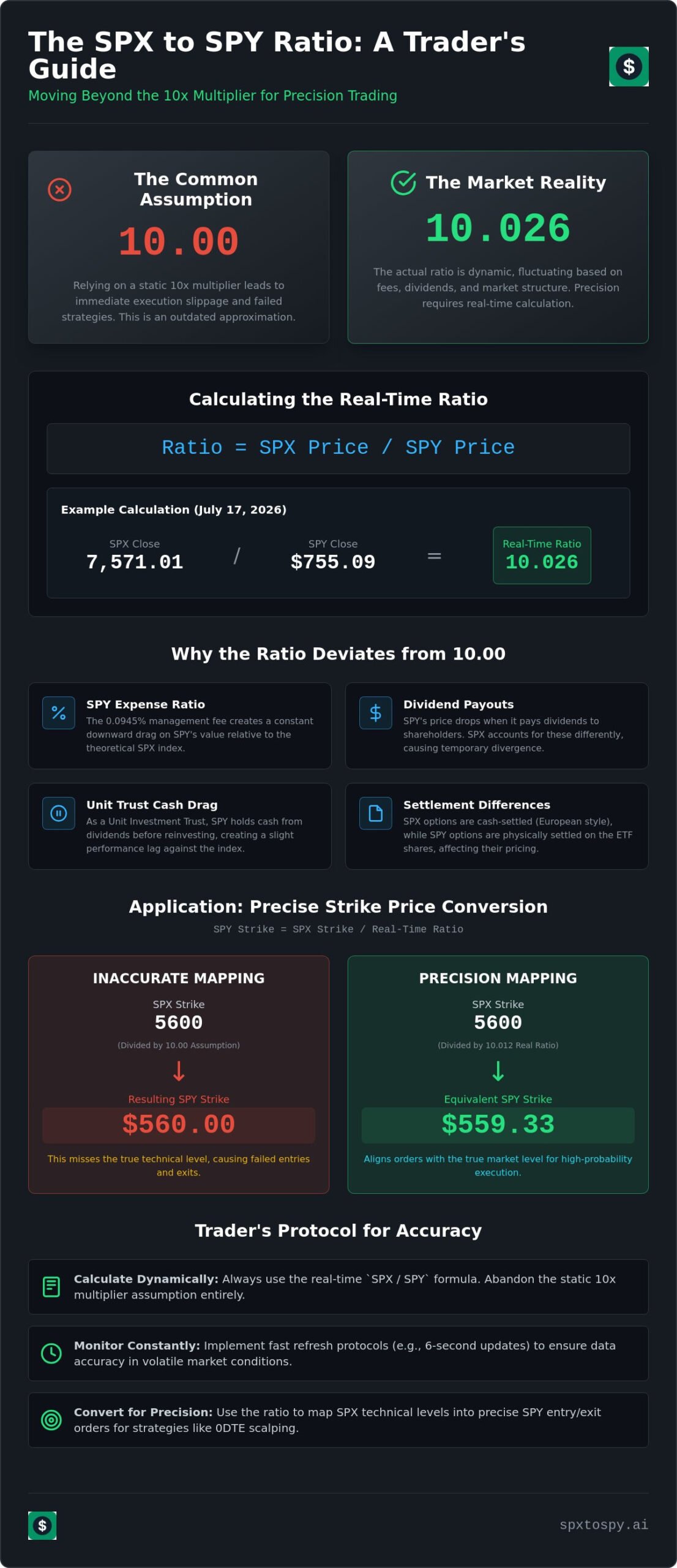
Assuming the SPX:SPY ratio is a static 10.00 multiplier causes immediate execution slippage. On July 17, 2026, the SPX closed at 7,571.01 against a SPY price of $755.09. This results in a real-time ratio of 10.026. Mastering the spx spy ratio meaning is essential for traders who require exact strike price equivalence between the cash index and the ETF proxy.
Mapping strikes based on outdated 10x assumptions leads to tracking errors and failed execution in multi-leg strategies. You need a reliable conversion method that accounts for the 0.0945% SPY expense ratio and dividend-induced price drops. This guide delivers a technical framework for precise strike translation.
We analyze the structural drivers of ratio deviation, including the Unit Investment Trust cash drag and European-style settlement differences. The following sections provide the mathematical logic for mapping SPX strikes to SPY equivalents with minimal slippage. Implement these protocols to ensure position accuracy in high-velocity market environments.
Key Takeaways
- Define the technical spx spy ratio meaning as the dynamic mathematical relationship used to map notional value between cash-settled indices and ETF proxies.
- Apply the SPX/SPY formula to calculate exact strike price equivalence and eliminate reliance on the static 10.00 multiplier.
- Identify divergence drivers including the 0.0945% SPY management fee and dividend-induced tracking errors to minimize execution slippage.
- Convert SPX technical levels into precise SPY entry orders for high-frequency 0DTE scalping strategies.
- Implement 6-second refresh protocols for real-time ratio monitoring to ensure data accuracy in volatile market conditions.
What is the SPX SPY Ratio? Technical Definition
The spx spy ratio meaning identifies the quantitative relationship between the S&P 500 Index (SPX) and the SPDR S&P 500 ETF Trust (SPY). This metric functions as a conversion factor for traders managing cross-instrument positions. It calculates the specific number of SPY shares required to match the notional value of one index unit. While the industry frequently assumes a fixed 10:1 multiplier, the actual ratio fluctuates based on dividends, management fees, and tracking error. Precise calculation is mandatory for professional-grade execution.
The core function of this ratio is translating notional value between cash-settled index options and physically settled ETF options. It provides the mathematical basis for:
- Strike Price Mapping: Identifying the equivalent SPY strike for an SPX technical level.
- Hedging: Neutralizing delta exposure across different instruments.
- Arbitrage: Exploiting mispricings between the cash index and its primary ETF proxy.
- Position Sizing: Ensuring equivalent risk profiles when migrating from SPY to SPX contracts.
Index vs. ETF: The Underlying Mechanics
The SPX is a theoretical statistical construct. It tracks the performance of 500 large-cap US equities without holding physical assets. Conversely, the SPDR S&P 500 ETF Trust is a tradable security that holds the underlying shares. This structural difference creates the ratio. The SPY is subject to a 0.0945% net expense ratio as of July 2026. It also experiences cash drag due to its Unit Investment Trust structure. These variables cause the ETF price to deviate from a perfect one-tenth fraction of the index value.
The 10x Multiplier Benchmark
The 10:1 mapping originates from standard contract specifications. One SPX options contract has a multiplier of $100. One SPY options contract also has a $100 multiplier but represents 100 shares of the ETF. Since SPY was designed to trade at roughly 1/10th the value of SPX, 10 SPY contracts theoretically equal one SPX contract. This 10x rule is the industry standard for rapid mental math and basic position sizing.
Approximation is insufficient for high-frequency execution. On July 17, 2026, the SPX stood at 7,571.01 while SPY traded at $755.09. This created a real-time ratio of 10.026. Relying on the 10.00 benchmark in this scenario results in a 2.6 basis point error. For 0DTE scalpers or institutional block traders, this discrepancy causes immediate slippage. Systematic monitoring of the spx spy ratio meaning is required to maintain strike price equivalence during volatile sessions.
Mathematical Relationship: The 10x Multiplier Explained
The mathematical spx spy ratio meaning is derived from the quotient of the current SPX spot price and the SPY share price. Formula: Ratio = SPX / SPY. For instance, an SPX value of 5,000.00 and an SPY price of $500.00 results in a ratio of exactly 10.000. This numerical output dictates the scaling factor for all derivative Greeks. Delta and Gamma values must be adjusted by this factor when comparing risk profiles between instruments. An SPX Delta of 0.50 does not represent the same notional exposure as an SPY Delta of 0.50 without applying the ratio multiplier.
Option Greeks scale linearly with the ratio. SPX Gamma reflects the change in Delta per one-point move in the index. SPY Gamma reflects the change in Delta per one-dollar move in the ETF. Because $1.00 in SPY represents approximately 10 points in SPX, the Gamma of an SPY option is roughly 10 times higher than its SPX equivalent for the same notional exposure. Failing to account for the dynamic spx spy ratio meaning leads to severe miscalculations in portfolio hedging and risk management. Consistent monitoring is required to maintain delta-neutral positions.
Deriving Strike Price Equivalency
Strike mapping requires high decimal precision to prevent execution errors. Formula: SPY Strike = SPX Strike / Ratio. Using a ratio of 10.012 instead of 10.000 shifts the equivalent SPY strike by several cents. This difference is critical for tight spreads. For example, an SPX 5600 strike maps to an SPY 559.33 strike when the ratio is 10.012. Precise strike equivalence ensures that limit orders align with technical levels across both markets. Traders should use a real-time conversion utility to maintain this accuracy during fast-moving sessions.
Notional Value and Contract Size
The Cboe SPX Options Specifications define the contract multiplier as $100. In contrast, SPY options represent 100 shares of the underlying ETF. One SPX contract covers approximately ten times the notional value of one SPY contract. Calculating equivalent position sizes requires applying the live ratio to the contract units. Notional Value = (Strike Price) x (Multiplier). For SPX at 7,500, the notional value is $750,000 per contract. For SPY at $750, the notional value is $75,000 per contract.
The live ratio provides the exact divisor to determine how many SPY contracts are needed to offset one SPX contract. If the ratio is 10.026, then 10.026 SPY contracts represent the exact notional equivalent of a single SPX contract. Precision matters. For a detailed breakdown of these variables, refer to the SPX SPY Ratio Calculation: Technical Formula and Strike Mapping documentation.
Why the SPX SPY Ratio Deviates from Exactly 10.00
The 10.00 multiplier is a theoretical target, not a fixed constant. Identifying the true spx spy ratio meaning requires accounting for structural divergence between the index and the ETF. As of July 2026, the SPY net expense ratio is 0.0945%. This management fee creates a persistent performance drag relative to the SPX index. This divergence compounds over time. It causes the ratio to drift further from the 10.00 baseline. Precision is mandatory for professional execution.
Dividends represent the primary driver of ratio deviation. SPY pays quarterly distributions to shareholders. On the ex-dividend date, the ETF share price drops by the dividend amount. The SPX index does not adjust for these payouts. Consequently, the ratio shifts upward. Historically, this relationship fluctuates between 10.05 and 10.12. Traders must monitor these shifts to avoid strike mapping errors during expiration weeks. Tracking error persists. The ratio fluctuates. Static math fails.
Structural differences also play a significant role in tracking error. The SPY is a Unit Investment Trust (UIT). This 1993-era structure prevents the fund from reinvesting dividends immediately upon receipt. This creates a “cash drag” during bull markets. For a deeper technical comparison of these instruments, review Fidelity’s Guide to Index vs. ETF Options. These nuances affect settlement and tax treatment, reinforcing why the ratio is never static. Understanding the spx spy ratio meaning requires recognizing these administrative inefficiencies.
The Impact of Dividends on Ratio Drift
Ex-dividend dates trigger immediate shifts in the SPX:SPY relationship. As of July 2026, the SPY trailing twelve-month dividend yield is approximately 1.00%. This represents an annualized payout of roughly $7.52 per share. Each payout lowers the ETF price relative to the non-dividend-paying index. This results in a long-term “decay” of SPY value. The ratio typically sits slightly above 10.00 to compensate for this lost value. High-frequency traders must adjust their strike mapping formulas before each quarterly distribution to maintain accuracy.
Tracking Error and Expense Ratios
Tracking error occurs when the ETF’s Net Asset Value (NAV) deviates from the index performance. Intraday fluctuations are caused by bid-ask spreads and liquidity gaps in the ETF market. Large institutional block trades can temporarily push the SPY price away from its fair value. This creates technical noise in the ratio. For 0DTE options, these minor discrepancies lead to immediate execution slippage. For long-dated LEAPS, the 0.0945% expense ratio becomes a dominant factor. It creates a widening gap over several months. You must use live data to verify current NAV premiums before committing to large-scale arbitrage positions. Traders seeking a deeper understanding of these mechanics should review the SPX SPY 10x ratio explained: technical mechanics and ratio deviation analysis, which isolates the specific variables causing ratio drift and provides a formula for real-time conversion.
Strategic Significance for Options Strike Mapping
Precise execution requires applying the spx spy ratio meaning to live entry orders. Professional traders don’t guess strike equivalence. They map technical levels with mathematical certainty. Translating SPX support and resistance into SPY limit orders prevents execution at sub-optimal prices. A 10-point SPX support level must be converted using the current ratio to identify the corresponding SPY strike. This process eliminates the guesswork associated with psychological “round number” mapping. It ensures that your orders align with the true underlying value of the index.
Arbitrage opportunities emerge when premiums misalign with the underlying ratio. Monitoring ratio deviations allows for the identification of overvalued or undervalued contracts between the two instruments. If the SPX:SPY ratio shifts to 10.03 while option premiums reflect a 10.00 relationship, a pricing inefficiency exists. Capitalizing on these gaps requires instantaneous calculation. Access a real-time SPX to SPY converter to verify these discrepancies before the market corrects the spread. High-frequency monitoring is the only way to capture these ephemeral alpha signals.
0DTE Scalping and High-Frequency Metrics
High-frequency 0DTE strategies demand extreme accuracy. A 0.01 ratio deviation significantly impacts out-of-the-money (OTM) strike selection. For an SPX strike at 5,600, a ratio of 10.00 implies an SPY strike of 560. A ratio of 10.01 shifts that target to 559.44. Choosing the wrong strike based on a static 10x assumption results in different delta exposure and probability of profit. Traders can automate this logic. Review the SPX SPY Ratio Formula: Technical Implementation in Thinkorswim for custom script integration. Mapping SPX “round numbers” to exact SPY decimals ensures that orders trigger at the intended psychological levels without manual calculation delay.
Cross-Instrument Hedging Protocols
Risk management depends on delta-neutrality. Hedging an SPX position with SPY contracts requires calculating the exact contract count. Use the live ratio as the divisor. One SPX contract covers approximately 10.026 SPY contracts when the ratio deviates from the benchmark. Rounding down to 10.00 leaves a residual unhedged exposure. Ratio drift causes hedge effectiveness to decay as the underlying prices move away from the initial calculation point. Adjust contract sizes dynamically. Maintain balance between the $100 SPX multiplier and the 100-share SPY unit. Constant recalibration is the only way to ensure total delta protection in volatile sessions. Tracking the spx spy ratio meaning provides the data necessary for these adjustments.
Real-Time Ratio Monitoring and Conversion Protocols
Manual calculation of the spx spy ratio meaning creates execution latency. High-frequency 0DTE traders require data refresh rates under ten seconds to maintain strike accuracy. A 6-second refresh interval ensures the ratio remains synchronized with the live price action. Automating this conversion process removes the risk of human error during rapid market shifts. Precise strike mapping is a requirement; not an option. Integrating live data into a unified workflow prevents the execution of orders at stale price levels.
Execution speed determines the profitability of scalping strategies. Relying on static multipliers or delayed data feeds results in immediate slippage. The technical spx spy ratio meaning shifts throughout the trading session as liquidity fluctuates. Professional traders use automated protocols to maintain a constant link between the cash index and the ETF proxy. This systematic approach ensures that every limit order reflects current market conditions.
Using the SPX to SPY Converter Tool
The conversion utility processes live SPX and SPY spot prices to output a real-time multiplier. It applies the SPX/SPY quotient instantly. This provides an immediate mapping of index strikes to ETF equivalents. Interpreting the live ratio display allows for rapid order entry. Automated mapping is essential in high-stress environments where price slippage occurs in milliseconds. Reliability depends on the frequency of data updates. The tool functions as a transparent layer between the user and the required variables.
Verification and Execution Best Practices
Data verification is the final safety protocol. Cross-reference the tool’s output with your broker’s option chain before committing capital. Ratio volatility increases during major economic events. FOMC meetings and CPI data releases cause rapid bid-ask expansion in SPY. This temporarily distorts the ratio. Monitor the spread between the cash index and the ETF during these windows. Consistency in your workflow minimizes tracking error. Utilize the Real-Time SPX to SPY Converter for Precision Mapping to ensure technical levels align with execution strikes.
Implementing Precise Strike Equivalence Protocols
The static 10.00 multiplier is a functional liability in professional trading environments. True mastery of the spx spy ratio meaning requires accounting for the 0.0945% SPY expense ratio and quarterly dividend adjustments. These variables ensure that the cash index and its ETF proxy rarely maintain a perfect integer relationship. Relying on approximations causes immediate execution slippage and tracking errors in multi-leg 0DTE strategies. Precision mapping is the only way to maintain the integrity of a technical trade plan.
Accurate strike selection preserves delta-neutrality and ensures that SPX technical levels align with SPY entry orders. Monitoring the live ratio eliminates manual calculation latency and human error during volatile sessions. Professional execution depends on data frequency and mathematical precision. Integrating real-time metrics into your workflow allows for the identification of ephemeral alpha signals and arbitrage opportunities that static math ignores.
Optimize your execution with 6-second data refreshes designed for professional day traders. Access the Real-Time SPX to SPY Strike Converter to ensure precision strike price mapping. Secure your mathematical edge with the most current market data available.
Frequently Asked Questions
What does the SPX SPY ratio represent in trading?
The ratio represents the mathematical quotient between the S&P 500 Index spot value and the SPY ETF share price. It functions as a conversion factor for determining notional equivalence. Traders use this metric to identify how many SPY units equal one SPX unit for hedging and strike mapping. It’s the technical basis for migrating positions between cash-settled and physically settled instruments.
Why is the SPX SPY ratio not exactly 10?
Structural inefficiencies cause persistent divergence. The SPY ETF incurs a 0.0945% net expense ratio and experiences cash drag due to its Unit Investment Trust structure. Quarterly dividend payouts also lower the ETF price relative to the non-dividend-paying index. These variables ensure the ratio typically fluctuates between 10.05 and 10.12 rather than remaining at a static 10.00 benchmark.
How do I calculate the SPY equivalent of an SPX strike price?
Divide the target SPX strike price by the current live ratio. Formula: SPY Strike = SPX Strike / Ratio. For example; an SPX strike of 5,600 divided by a real-time ratio of 10.026 equals an SPY strike of 558.55. Using the spx spy ratio meaning to perform this calculation prevents execution errors at sub-optimal technical levels during fast-moving market sessions.
How often does the SPX SPY ratio change?
The ratio fluctuates continuously during active market hours. It updates with every price tick of the SPX spot index and the SPY share price. Professional day traders utilize 6-second refresh intervals to maintain data accuracy. Relying on stale data leads to significant mapping errors; especially during high-volatility events like FOMC or CPI data releases when bid-ask spreads widen.
Does the SPX SPY ratio affect option premiums?
It dictates the scaling of Delta and Gamma across different contract types. While it doesn’t alter the intrinsic value of the underlying index; it determines the notional equivalence of the Greeks. Misinterpreting the spx spy ratio meaning results in incorrect position sizing and failed delta-neutral hedges. Precise ratio data is required to align risk profiles between SPX and SPY options accurately.
Is the SPX SPY ratio the same as the S&P 500 multiplier?
No. The SPX multiplier is a fixed $100 contract specification established by the Cboe. The ratio is a dynamic market variable representing the price relationship between the index and the ETF. One functions as a constant for contract valuation; the other functions as a fluctuating metric for instrument comparison. They serve distinct roles in derivative mechanics and position sizing.
Why should day traders monitor the live SPX SPY ratio?
Live monitoring eliminates execution slippage and tracking error. Intraday volatility causes the ratio to deviate from theoretical benchmarks. Traders use real-time tracking to ensure limit orders for 0DTE options align with exact technical support and resistance levels. Without live data; you risk entering trades at strikes that don’t represent the true underlying value of the index technicals.
Can I use the 10x rule for 0DTE options trading?
The 10x rule is insufficient for professional-grade execution. A minor 0.01 deviation in the ratio shifts equivalent strikes by several cents. This discrepancy alters the delta exposure and the probability of profit for the position. Technical traders must utilize the live ratio to ensure precise strike mapping and maintain consistent risk management across high-frequency scalping strategies.