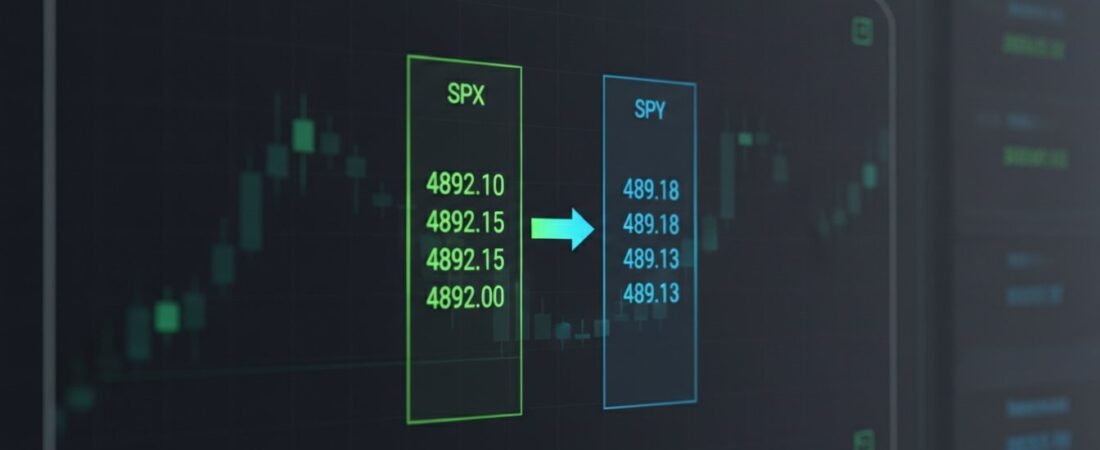
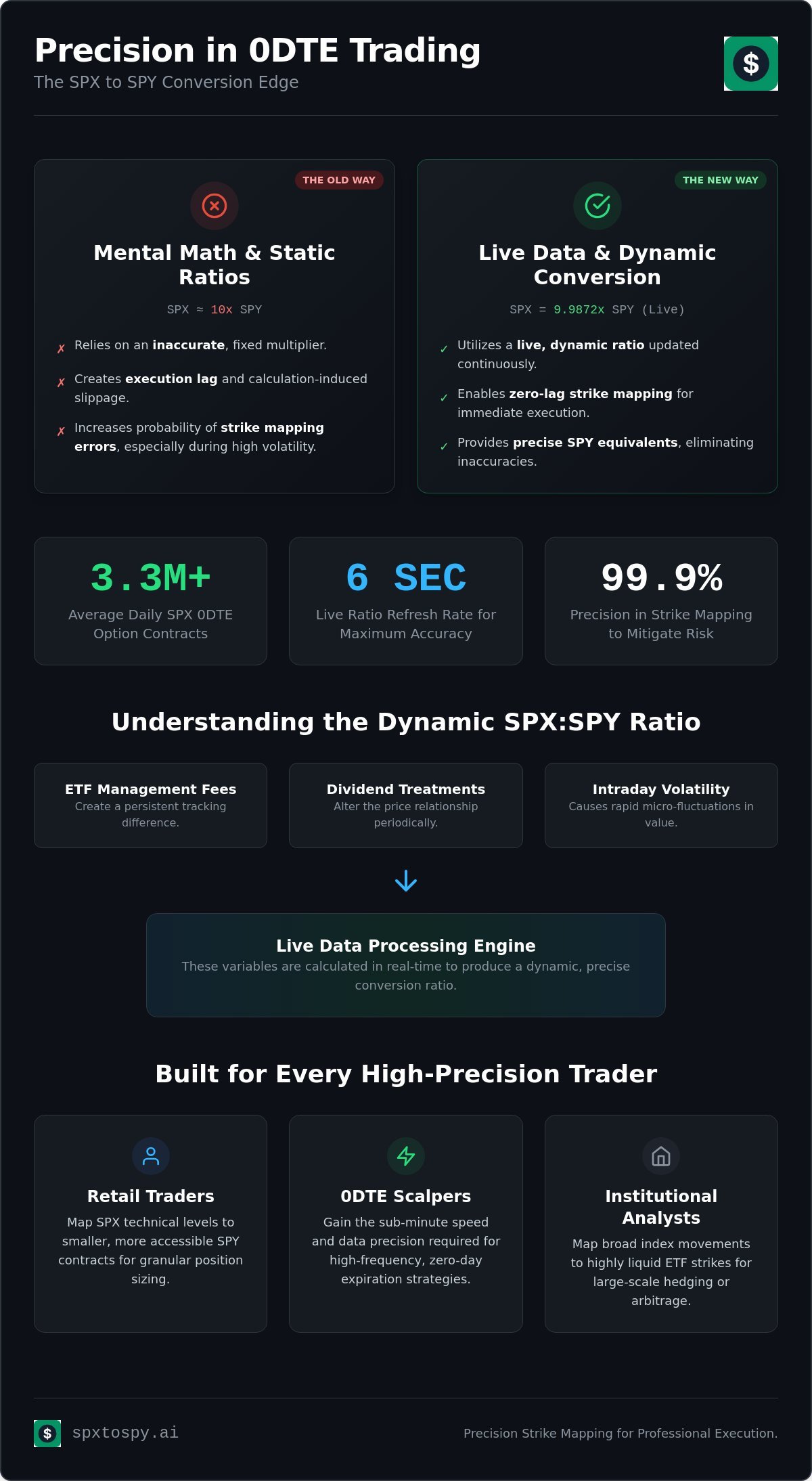
A static 10x ratio is a mathematical approximation that fails under intraday volatility. Relying on mental math during peak 0DTE volume creates execution lag and increases the probability of strike mapping errors. You recognize that manual calculations are inefficient when tracking the S&P 500 index against its ETF counterpart. The spx spy strike price tool addresses this technical gap by providing precise equivalents based on live market data. This utility ensures zero-lag strike mapping with a ratio refresh rate of six seconds. It eliminates the inaccuracies inherent in fixed multipliers and allows for immediate translation of SPX levels to SPY strikes.
Precision is mandatory when SPX 0DTE options average 3.3 million contracts per day. Tracking differences from management fees and dividend treatments mean the 10:1 relationship is rarely exact. This article details the technical utility of real-time conversion for professional execution. You’ll learn the specific mechanics of live-ratio tracking, the data protocols required for accurate mapping, and the risk mitigation strategies necessary for high-frequency environments. The focus remains on functional efficiency and the elimination of calculation-induced slippage in your trading workflow.
Key Takeaways
- Utilize the spx spy strike price tool to remove execution latency and eliminate errors associated with manual mental calculations.
- Access live-ratio data refreshed at six-second intervals to account for tracking differences between the SPX index and the SPY ETF.
- Translate gamma-sensitive SPX levels into precise SPY equivalents for improved 0DTE strike selection and risk management.
- Apply verification protocols for illiquid strikes and non-standard intervals to maintain data integrity across different broker platforms.
- Monitor dynamic ratio shifts throughout the trading day to identify intraday trend deviations and adjust strike mapping accordingly.
SPX SPY Strike Price Tool: Technical Utility Overview
The spx spy strike price tool provides a technical interface for the direct conversion of index levels into ETF strikes. It operates as a single-purpose utility. The primary function is the synchronization of two distinct market instruments tracking the S&P 500 index. Manual mapping introduces human error. High-volatility environments amplify these risks. This tool removes the need for mental math. It ensures that execution aligns with technical analysis. The 2026 trading environment requires data precision over approximation. This utility delivers that accuracy through a clinical interface focused on functional output.
The Mental Math Problem in Options Trading
The 10:1 ratio between SPX and SPY is a theoretical baseline. It’s rarely a precise constant in live markets. Intraday tracking error stems from multiple variables. These include ETF management fees and dividend treatment differences. Static multipliers fail to capture these micro-fluctuations. Executing a trade based on an outdated ratio results in strike mismatch. This is particularly dangerous for gamma-sensitive positions. The spx to spy converter addresses this by monitoring the real-time spread. It calculates the dynamic ratio every six seconds. Traders can then map SPX resistance levels to SPY strikes with higher confidence. It converts complex variables into actionable data points. It eliminates the calculation lag that compromises trade entry timing.
Target Use Cases: From Retail to Professional
Retail traders using platforms like Robinhood often prefer SPY for its smaller contract size. It allows for more granular position sizing compared to full-sized SPX contracts. These users must map SPX technical levels to SPY strikes to ensure consistency with index-based analysis. The spx spy strike price tool facilitates this translation instantly. Institutional analysts also require this utility. They map broad index movements to highly liquid ETF strikes for large-scale hedging or arbitrage strategies.
The 0DTE segment is the most demanding use case. Volume for these contracts reached record highs in June 2026; single-day peaks hit 7.8 million contracts on June 5. Scalpers in this space operate on sub-minute timeframes. They can’t afford the latency of manual calculation. The tool supports this high-frequency requirement. It provides the data speed necessary for zero-day expiration strategies. FINRA’s 2026 intraday margin standards emphasize the need for constant equity maintenance. Precise strike mapping helps traders stay within these regulatory boundaries. It minimizes the risk of unintended margin calls through accurate level identification.
Technical Specifications: Live Ratio and Refresh Metrics
The spx spy strike price tool utilizes a high-frequency data architecture. The core metric is a 6-second refresh interval. This frequency ensures real-time accuracy for strike mapping. High-resolution conversion requires decimal precision to multiple places. This is essential for both In-The-Money (ITM) and Out-Of-The-Money (OTM) strike selection. The utility uses a broker-independent data feed. This approach provides objective conversion values. It avoids the bias of individual broker bid-ask spreads or internal pricing latencies. The clinical interface prioritizes these data points to facilitate rapid decision-making.
Understanding the 6-Second Refresh Cycle
High-frequency updates are mandatory in 0DTE trading. Price action is non-linear. Standard retail quotes often lag by 15 minutes. This delay makes them irrelevant for strike mapping. Even “real-time” feeds from major brokers can have internal execution lag. A 6-second refresh cycle prevents strike price slippage. Slippage occurs when the mapped SPY strike no longer matches the current SPX index level. This gap increases during high-volatility sessions. Rapid updates allow traders to synchronize execution with the index. It provides a consistent data stream when market velocity is highest. This frequency supports professional-grade execution for retail-sized accounts.
The Dynamic SPX:SPY Ratio Explained
The 10x ratio is a mathematical baseline. It’s not a fixed constant. Intraday deviations are common. Several factors cause the ratio to move away from 10.00. SPY ETF management fees create a persistent tracking difference. Dividend distributions also alter the price relationship between the index and the ETF. You can find technical details on these instruments in the SPX options contract specifications. The spx spy strike price tool monitors these variables to provide a dynamic multiplier.
Precision mapping is critical for 0dte spx spy ratio strategies. A deviation of just 0.02 in the ratio can result in a strike price mismatch. This error leads to incorrect delta and gamma exposure. The converter tracks these fluctuations dynamically. It calculates the exact multiplier based on current market prices. This objective data remains separate from broker-specific pricing models. Traders should monitor the live market ratio tracking to ensure their execution levels are mathematically sound. This technical rigor mitigates the risks associated with manual approximation. It provides the functional data required for precise strike selection.
0DTE Strategy: Precision Strike Mapping for Day Traders
Zero-days-to-expiration (0DTE) trading demands immediate strike identification and rapid order entry. Market participants often perform technical analysis on the index while executing trades through the ETF. This dual-instrument approach requires a synchronized spx spy strike price tool to maintain level consistency. Execution friction occurs during the transition from chart analysis to order ticket preparation. Reducing this latency is critical when price action moves at high velocity. Precise mapping ensures that the intended risk profile remains intact across different asset classes. Consistency in strike selection prevents unintended exposure shifts during high-volume sessions.
Gamma and Delta Mapping
Gamma risk accelerates as expiration approaches. Traders must translate SPX Greek values into SPY equivalents to manage their intraday risk parameters effectively. Delta exposure can shift significantly if the selected strike is even one point off the intended index level. The Cboe SPX Index Options market provides the baseline liquidity for these calculations. Selecting the correct strike ensures that your hedge or speculative position reacts as expected to index price movements. Mapping these Greeks requires accounting for the dynamic ratio rather than a fixed 10x multiplier. Strike equivalence represents the SPX index level adjusted by the instantaneous market ratio and calculated to four decimal places for accurate SPY strike selection.
Execution Workflow for 0DTE Scalpers
Scalpers operating on sub-minute timeframes require a standardized workflow. Transitioning from SPX resistance levels to SPY order tickets must be instantaneous. The spx spy strike price tool facilitates this by providing a pre-calculated target. This process eliminates the need to cross-reference multiple option chains manually. It also helps identify mispriced strikes where the ETF bid-ask spread may offer better entry than the index counterpart. Integrating index options strike price converter data into your terminal setup minimizes cognitive load during peak trading hours.
The 2026 market environment has seen record-breaking 0DTE activity. On June 5, 2026, SPX options reached a single-day record of 7.8 million contracts. This volume creates significant liquidity but also increases the speed of price fluctuations. Scalpers use real-time conversion to stay ahead of these movements. They monitor the live ratio to detect intraday trend shifts that might affect strike equivalence. Maintaining this technical oversight is essential for surviving high-volatility events. The goal is a seamless transition from index-based signal to ETF-based execution without calculation-induced slippage. This clinical approach to mapping supports disciplined risk management in the most aggressive trading environments.
Mapping SPX Strikes to SPY Equivalents: Accuracy Protocols
Strike conversion requires a strict verification protocol. The spx spy strike price tool provides the mathematical equivalent based on live data. Users must cross-reference these values with broker order tickets before final execution. This step prevents entry errors during rapid price shifts. Identifying the “Best Fit” SPY strike involves evaluating the proximity of the converted value to available ETF intervals. High-resolution mapping ensures that the selected strike maintains the intended delta exposure. Accuracy is the primary objective of this utility. It’s essential to confirm that the broker’s option chain reflects the same liquidity profile suggested by the converter. Understanding the precise mechanics of translating an spx strike price in spy requires accounting for settlement differences, real-time ratio deviations, and the specific variables that cause decimal-level mapping errors in 2026 market conditions. Traders who need a comprehensive methodology for identifying the precise spy equivalent of spx strike using high-frequency data will find that dynamic ratio tracking is essential for eliminating basis point drift in cross-instrument hedging and arbitrage strategies.
Settlement and Liquidity Considerations
Structural differences exist between these instruments. SPX options use European-style exercise and are cash-settled. SPY options use American-style exercise and involve physical delivery. These factors influence conversion logic during volatile sessions. Liquidity gaps in SPY strikes can affect the reliability of the mapped equivalent. If a converted level lands on an illiquid strike, the bid-ask spread may widen significantly. This increases the total cost of the trade. Traders must account for these gaps to maintain execution efficiency. Risk mitigation is particularly vital during the final hour of 0DTE trading. Pinning risk near expiration can cause significant price deviations between the index and the ETF. Don’t assume the 10x ratio holds during these periods. Monitoring live market ratio tracking allows for real-time adjustments to these variables.
Strike Interval Discrepancies
Interval standards differ across the S&P 500 complex. SPX strikes typically operate on $5 increments. SPY strikes frequently use $1 or $0.50 intervals. This discrepancy requires a systematic rounding protocol. The spx spy strike price tool identifies the nearest liquid SPY strike to any given SPX target. It maintains mathematical integrity by applying consistent rounding logic to the dynamic ratio. Users must distinguish between the theoretical equivalent and the tradable strike. Non-standard SPY intervals can create mapping offsets. Precise decimal resolution helps identify these deviations early. The “Best Fit” logic accounts for the current bid-ask midpoint of both assets. This ensures the conversion isn’t just a division of prices but a reflection of tradable liquidity. This clinical approach to strike selection ensures that order entry aligns with the underlying index analysis. It eliminates the ambiguity of manual estimation.
Operational Workflow: Using the SPX to SPY Converter
The operational workflow for the spx spy strike price tool prioritizes execution speed. High-velocity market moves require a streamlined interface. Traders must transition from technical analysis to order entry without distraction. This utility functions as a dedicated layer in a professional trading setup. It provides constant data stream visibility. Monitoring the live ratio identifies intraday trend shifts. These shifts impact strike equivalence. Integrating the converter into a multi-monitor environment ensures that mapping data is always accessible. This setup is designed for zero-lag performance. It functions as a silent, efficient digital assistant for strike translation.
Step-by-Step Conversion Process
Follow this protocol for precise strike identification:
- Input the target SPX strike price into the designated field.
- Monitor the real-time SPY equivalent generated by the current 6-second ratio.
- Compare the result against the broker’s option chain to ensure liquidity.
- Adjust for non-standard intervals using the rounding logic established in previous sections.
- Execute the order once the mapping is verified.
This process takes less than three seconds. It eliminates the cognitive load of manual calculation. Verification remains a critical step. Market conditions can change between data refreshes. Professional traders use the tool to confirm their mental estimates. It serves as a mathematical audit for every trade. The speed of the spx spy strike price tool allows it to keep pace with rapid price action. It ensures that the strike selected on the order ticket matches the intended index level.
Optimizing User Interface for Speed
The interface uses a minimalist design. It removes all non-essential elements. This clinical layout is optimized for rapid scanning. Data points are presented in a modular fashion. This allows for instant information processing during peak 0DTE volume. A cluttered UI increases the risk of misinterpretation. This tool avoids that risk through extreme minimalism. It doesn’t provide commentary or advice. It only provides the required variables. This focus on functional efficiency is essential for professional-grade mapping. It supports high-frequency decision-making. Traders can maintain focus on the price action while the converter handles the mathematical translation. This setup is superior to strategy-specific calculators that require multiple inputs. It provides a single-purpose solution for strike mapping.
Successful 0DTE execution relies on objective data. The 2026 market environment doesn’t allow for approximation. On record-volume days, such as June 5, 2026, every second impacts the fill price. The workflow described here ensures that you remain synchronized with the index. It provides a reliable bridge between SPX analysis and SPY execution. Use the tool consistently to maintain discipline. Avoid the temptation to use static 10x multipliers. The dynamic ratio is your primary reliability marker. This workflow integrates that marker into your daily routine. It creates a robust framework for managing S&P 500 options exposure. It ensures that your execution is as precise as your analysis.
Precision Execution Protocols for 2026 Market Dynamics
Precision execution requires technical synchronization. Static 10x assumptions fail during high-volatility sessions. Accurate conversion depends on live-ratio data points. The spx spy strike price tool delivers this information with clinical precision. It removes calculation lag from the 0DTE workflow. You’ve reviewed the 6-second refresh metrics and mapping protocols. Apply these technical standards to your order entry process to mitigate execution risk. Reliance on manual estimates is an unnecessary variable in high-frequency environments.
High-frequency environments demand zero-distraction utilities. Manual estimates increase the probability of strike mismatch. Use a dedicated converter to maintain mathematical integrity across the S&P 500 complex. Track the dynamic ratio every six seconds to ensure strike equivalence. This functional approach supports disciplined risk management. Access the necessary variables for immediate decision-making. Maintain technical oversight of your positions. Synchronize your analysis with your execution. Achieve consistent results through data-driven strike selection.
Access the Real-Time SPX to SPY Strike Price Tool
Frequently Asked Questions
How accurate is the spx spy strike price tool during high volatility?
Accuracy is maintained through high-frequency data ingestion. The spx spy strike price tool processes market variables every six seconds to eliminate calculation-induced slippage. High-volatility environments require this refresh rate to account for rapid index movements. Manual mapping fails during peak velocity. This utility ensures that the output reflects current market conditions rather than static approximations. Verify all results against live broker chains before final order entry.
Why does the SPX to SPY ratio change every six seconds?
The ratio updates at six-second intervals to reflect intraday tracking error. SPY ETF management fees and dividend treatments create constant price deviations from the index. A static 10x multiplier is insufficient for precise mapping. Frequent updates capture these micro-fluctuations. This ensures the conversion logic remains synchronized with the underlying index. Dynamic tracking provides a reliability marker for professional execution.
Can I use this tool for 0DTE options trading?
Optimization for 0DTE trading is a core functional requirement. June 2026 data shows SPX 0DTE volume averaging 3.3 million contracts daily. Scalpers require sub-minute precision to manage gamma-sensitive positions. The spx spy strike price tool reduces execution friction by providing immediate strike identification. It supports rapid transitions from index analysis to ETF order tickets. This speed is essential for navigating high-volume sessions without calculation lag.
Does the tool account for SPY dividend adjustments?
Dynamic ratio tracking incorporates all tracking error variables. This includes SPY dividend adjustments and management fee impacts. These factors cause the price relationship to deviate from the theoretical 10.00 constant. The converter monitors the instantaneous spread between the index and the ETF. This ensures that the mapped strike accounts for the current fund valuation. Professional mapping requires this level of technical rigor to maintain delta consistency.
Is the conversion ratio the same for puts and calls?
The conversion ratio remains uniform for both puts and calls. It’s derived from the price relationship of the underlying SPX index and SPY ETF. Strike equivalence is a mathematical translation of price levels. It doesn’t vary based on option type or Greek sensitivity. Use the same dynamic ratio for call spreads and put hedges. This consistency ensures that your directional bias is accurately reflected in the selected ETF strike.
Why is my broker showing a slightly different SPY price than the converter?
Broker-specific pricing models and internal data latencies cause minor discrepancies. Individual brokers use proprietary bid-ask midpoints. The converter utilizes an independent, broker-neutral data feed for objective mapping. Verification with your specific trading platform is a mandatory safety protocol. These minor price offsets are common in high-frequency environments. Always confirm the tradable liquidity on your order ticket before committing capital to a position.
Do I need a subscription to use the SPX to SPY strike price tool?
Access the spx spy strike price tool directly via the web interface. This utility is designed for immediate clinical use without complex onboarding requirements. It functions as a transparent layer between the user and market data. Check the utility homepage for current access protocols and data feed specifications. The focus remains on functional efficiency and rapid strike translation. It’s a single-purpose tool for professional 0DTE day traders.
What is the difference between the 10x ratio and the live market ratio?
The 10x ratio is a theoretical approximation used for general analysis. The live market ratio is the actual mathematical relationship between SPX and SPY at a specific timestamp. Tracking error and dividend treatments mean the ratio is rarely exactly 10.00. Using the live ratio prevents strike mapping errors of $0.50 or more. This precision is mandatory for managing risk in gamma-heavy 0DTE strategies. Accuracy requires dynamic tracking.