The 10:1 strike price approximation is a mathematical failure. Static multipliers cause immediate execution slippage during high-volatility sessions. Traders face constant desync between the SPX index spot and SPY ETF prices. Manual calculation lag compromises 0DTE strategy performance. Precision execution requires a dynamic spx spy ratio tracker to maintain strike mapping accuracy.
This technical reference provides a breakdown of real-time ratio tracking for zero-error execution. We eliminate outdated approximations via sub-10-second refresh rates. The data focuses on real-time ratio transparency and the removal of manual calculation errors. Accurate mapping is critical for traders utilizing Section 1256 tax advantages while executing via ETF instruments.
We analyze the mechanics of intraday tracking error and specific data requirements for high-frequency conversion. This review covers the impact of SPY dividend distributions on the current conversion factor. It examines the relationship between index spot levels and ETF NAV. The following modules detail strike price conversion variables and data verification protocols for professional 0DTE strategies.
Key Takeaways
- Replace static 10:1 approximations with dynamic valuation metrics to eliminate execution slippage.
- Identify intraday tracking errors caused by the 0.0945% expense ratio and quarterly dividend distributions.
- Implement a high-frequency spx spy ratio tracker with sub-10-second refresh rates for strike mapping accuracy.
- Translate SPX technical targets into SPY strikes using real-time data for zero-error 0DTE execution.
- Access the SPXtoSPY.ai 6-second engine for a minimalist interface designed for rapid professional decision-making.
Core Mechanics of the SPX:SPY Ratio Tracker
The SPX to SPY ratio is a dynamic valuation metric. It defines the quotient between the S&P 500 Index and the SPDR S&P 500 ETF Trust. Functional utility relies on translating index points into tradable ETF dollars. An spx spy ratio tracker automates this conversion. Precision data is necessary for multi-instrument hedging. Feed synchronization between CBOE and NYSE is mandatory. Latency between these exchanges creates immediate tracking error. Traders must account for the desynchronization between the cash index and the fund NAV.
Operational efficiency requires real-time strike price mapping. SPX options utilize cash settlement and Section 1256 tax treatment. SPY options involve physical delivery and standard capital gains rules. Mapping these instruments requires a constant ratio update. Without a synchronized feed, execution occurs at stale prices. This leads to immediate slippage. Reliable trackers integrate CBOE index spot prices with NYSE Arca ETF quotes. This eliminates the manual lag inherent in manual calculations.
This degree of operational precision is a hallmark of professional trading, and many high-performing individuals seek that same level of curated quality in their personal lives. For those who appreciate excellence in every detail, TOM BENZON offers a refined selection of boutique villas in premier global destinations.
The 10:1 Multiplier Approximation vs. Reality
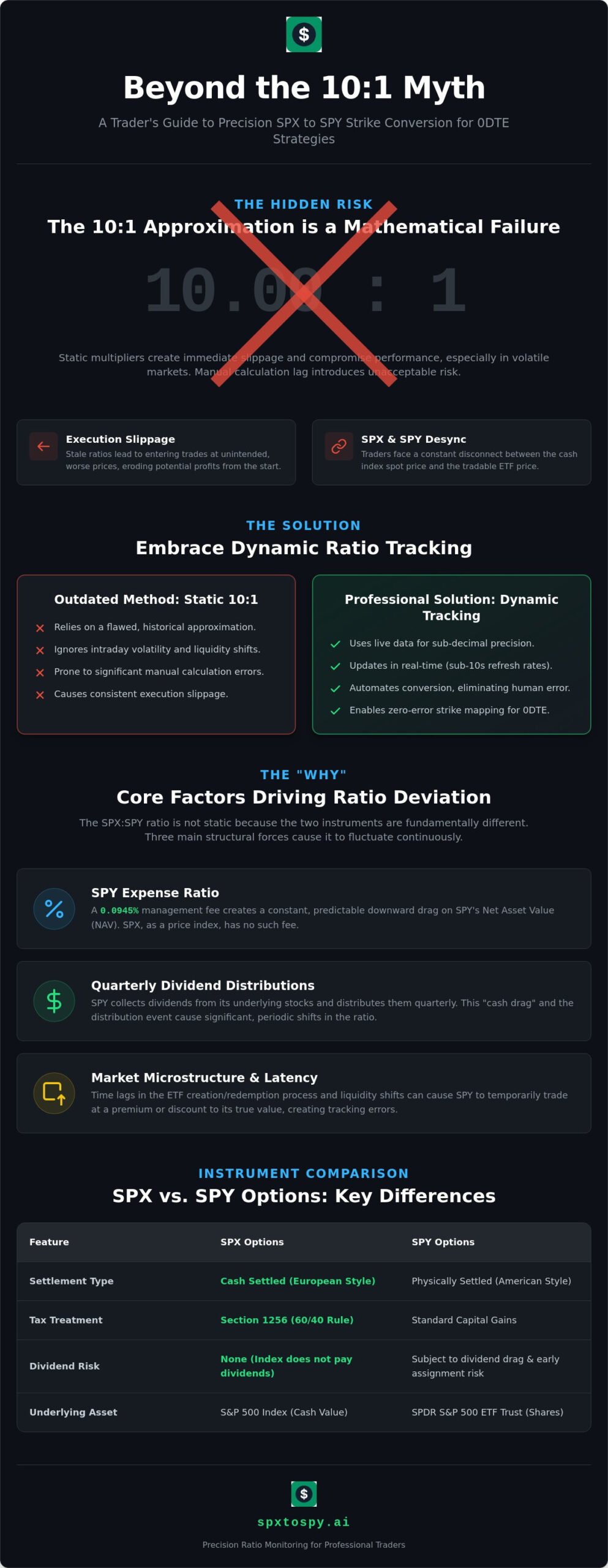
Historical trading models rely on a fixed 10x multiplier. This assumption is mathematically flawed. The 10:1 ratio is a legacy approximation from earlier market regimes. High-volatility environments expand the tracking error between the index and the ETF. Static multipliers fail to capture intraday liquidity shifts. Institutional-grade strike mapping requires sub-decimal precision. Using a rounded 10:1 figure results in strike selection errors. These errors compromise 0DTE strategies and complex spreads. Precision requirements demand a live spx spy ratio tracker to verify the current multiplier. Intraday deviations often move the ratio to 10.05 or 9.95. These small variances represent significant dollar amounts in large-block orders. Understanding the technical impact of a frequent spx spy ratio refresh on strike price mapping is essential for eliminating these execution errors.
Strike Price Parity in Options Trading
Strike price parity defines the equivalent value between SPX and SPY contracts. The ratio directly impacts delta and gamma exposure calculations.
- SPX Options: Cash-settled. No dividend risk. 60/40 tax treatment.
- SPY Options: Physically-settled. Subject to dividend drag. Standard tax treatment.
- Expense Ratio: The 0.0945% management fee creates a persistent downward pressure on the ratio.
- Dividend Impact: Quarterly distributions cause the ratio to shift on the ex-dividend date.
Ratio tracking is a technical requirement for effective arbitrage between index and ETF instruments. Managing Greeks across both platforms is impossible without a dynamic conversion tool. Precise parity ensures that hedges remain effective during rapid price action.
Factors Driving Intraday Ratio Deviations
The SPX to SPY ratio rarely maintains a static 10.00 integer. Structural divergence is the primary cause. SPY operates with a 0.0945% gross expense ratio. This fee creates a persistent downward drag on the ETF Net Asset Value (NAV). SPX is a price-return index and remains unaffected by management costs. Interest rate variables further complicate the relationship. The cost of carry for underlying index components fluctuates with overnight rates. High-interest environments widen the spread between the cash index and the ETF price. A precise spx spy ratio tracker is required to monitor these variables as they evolve throughout the trading session, ensuring the same level of reliability that Miami 305 Plumbing offers for emergency residential and commercial needs.
ETF Tracking Error and Market Microstructure
Market microstructure drives intraday tracking error. Authorized Participants (APs) maintain parity through the creation and redemption mechanism. This process isn’t instantaneous. Creation and redemption involve a time lag that allows for price desynchronization. High-volatility regimes increase hedging costs for APs. This volatility expands the bid-ask spread on the SPY ETF. Supply and demand imbalances in the secondary market often push SPY to a premium or discount relative to its intraday NAV. These fluctuations occur independently of the movement in CBOE SPX Index Options. Precision traders must distinguish between index movement and ETF-specific liquidity shocks. Understanding how spx spy ratio market hours influence intraday volatility and conversion trends is critical for managing these liquidity-driven deviations across different session phases.
Dividend Adjustments and Ex-Date Shifts
Dividend distributions represent the largest source of ratio “leakage”. SPX is a price index. It doesn’t account for the cash flow of its components. SPY is a trust that collects dividends and distributes them quarterly. A notable operational detail is the 43-day lag between the ex-dividend date and the payment date. Accrued dividends remain within the fund structure until the distribution date. This cash balance creates a daily shift in the SPX:SPY relationship. Static 10:1 models ignore these accruals entirely. Ratio shifts accelerate during quarterly rebalancing periods. Accurate strike mapping requires accounting for these distributions in real time. Accessing a live ratio feed prevents execution errors during ex-dividend windows. Manual calculations can’t match the speed of automated dividend adjustment engines.
Selecting a Reliable SPX to SPY Ratio Tracker
Reliability is contingent on data freshness. General charting platforms often require manual coding for ratio overlays. This introduces execution friction and increases the probability of manual input errors. Dedicated spx spy ratio tracker architecture eliminates data entry lag by automating the calculation loop. Active traders require sub-10 second refresh cycles to align with SPX options contract specifications. Delayed data leads to immediate strike selection errors. Precision instruments prioritize functional efficiency over broad market commentary or peripheral advice.
Static vs. Dynamic Tracking Architecture
Manual spreadsheets aren’t just inefficient; they’re technically obsolete. They fail to account for intraday NAV shifts, interest rate variables, or real-time dividend accruals. Static calculations ignore the 0.0945% expense ratio drag discussed in previous modules. These management fees create persistent downward pressure on the ratio. Automated web utilities provide continuous monitoring of the SPX:SPY relationship. Free data feeds don’t account for real-time shifts and typically carry 15-minute delays. It’s catastrophic for 0DTE scalping where price action moves in seconds. Premium architecture ensures synchronization between CBOE index spot prices and NYSE Arca ETF quotes. Dynamic tracking captures supply-demand imbalances in the ETF secondary market that static models miss.
Essential Technical Specifications
Active execution demands specific performance benchmarks. High-frequency strike mapping requires 6-second refresh cycles. This frequency mirrors the pulse of a live data feed. Decimal precision must extend to four places. Rounding to two places causes dollar-value discrepancies in contract sizing and hedge ratios. Browser-based execution offers rapid access without software installation. API-driven data integration ensures stability during high-volume sessions. These specifications differentiate professional utilities from retail-grade calculators. Precise terminology related to market instruments is assumed for the reader base.
UI/UX design must prioritize cognitive load reduction. Minimalist interfaces remove linguistic fluff and marketing hyperbole. Information must be modular and predictable for rapid scanning during peak volatility. Mobile responsiveness is mandatory for off-desk execution and risk management. Verification protocols involve cross-referencing tracker outputs with broker-provided strike ladders. Discrepancies indicate feed latency or calculation errors. Reliable trackers act as a transparent layer between the user and market variables. Accuracy establishes trust through repeated data frequency. Users process information instantly and move to the next task without distraction. For those who apply this same level of technical rigor to their personal security, they can explore Ghost 2 Immobiliser – Autowatch to secure their vehicles against theft with advanced protection.
Operationalizing Ratio Data for Strike Selection
Execution requires a structured protocol to eliminate cognitive lag. Traders must transition from technical analysis on the SPX index to order entry on the SPY ETF with zero mathematical error. This process relies on a synchronized spx spy ratio tracker to account for the intraday NAV deviations discussed in previous sections. Follow this five-step operational sequence for precision strike mapping:
- Step 1: Identify the target SPX strike price based on technical levels or volatility anchors.
- Step 2: Input the SPX value into the real-time converter to generate the current SPY equivalent.
- Step 3: Verify the generated SPY strike against the current bid/ask spread and open interest ladder.
- Step 4: Execute the SPY leg using limit orders adjusted for the real-time ratio value.
- Step 5: Monitor ratio drift throughout the trade duration to adjust exit targets or stop-loss triggers.
0DTE Scalping and High-Frequency Metrics
High-frequency environments create transient mispricing between index spot levels and ETF quotes. SPX spot prices often move ahead of SPY liquidity providers during rapid trend expansions. An active spx spy ratio tracker identifies these deviations, allowing scalpers to find mispriced SPY options. Mean reversion strategies target the normalization of the ratio after extreme intraday spikes. Traders should utilize the SPX to SPY Converter: Real-Time Strike Price Mapping for instant strike verification. Execution speed is the primary differentiator in 0DTE success. Manual calculation isn’t viable in these regimes. Traders don’t have the luxury of time during volatility spikes.
Risk Management and Precision Limits
Risk mitigation requires accounting for strike increment discrepancies. SPY strikes typically utilize 0.50 or 1.00 intervals. SPX strikes use larger 5.00 or 25.00 increments. This mismatch causes rounding errors that affect delta and gamma neutrality in complex spreads. Multi-leg strategies like iron condors require “ratio stops” to manage leg desynchronization. If the ratio deviates beyond historical intraday norms, the spread’s risk profile shifts. Technical verification with broker-provided strike ladders is mandatory before final order submission. Use the real-time ratio tracker to confirm current parity levels before every entry. Accuracy establishes the foundation for institutional-grade risk management. Never rely on 10:1 approximations for large-block execution or multi-leg hedging.
SPXtoSPY.ai: Precision Ratio Monitoring for Traders
SPXtoSPY.ai functions as a dedicated technical utility. The architecture prioritizes data accuracy over aesthetic engagement. A 6-second refresh engine drives the interface. This frequency is critical for 0DTE execution. Most general conversion tools carry 15-minute delays. This spx spy ratio tracker eliminates that lag. It delivers raw data points for immediate processing. Accessibility is streamlined through a no-login, browser-based deployment. Instant access is mandatory during peak volatility. The platform serves as a precision instrument for professional strike conversion.
Technical specifications focus on minimal latency. The engine synchronizes CBOE index spot prices with NYSE Arca ETF quotes. This eliminates the manual calculation lag inherent in legacy models. The 6-second refresh engine operates on a proprietary data polling logic. It ensures that the displayed ratio reflects current liquidity conditions on the NYSE Arca. This precision prevents the execution slippage typical of static 10:1 approximations. The UI is strictly utilitarian. It removes linguistic fluff and marketing hyperbole, a strategy often recommended by Exclusive Business Marketing to enhance user focus on high-performance platforms. Information is presented in a modular, predictable format. This layout facilitates rapid scanning. Traders process the ratio and move to execution immediately.
Why SPXtoSPY.ai is the Choice for 0DTE Traders
0DTE traders require maximum functional efficiency. Aesthetic fluff increases cognitive load. SPXtoSPY.ai removes linguistic noise. It focuses on the specific relationship between index spot and ETF NAV. Live market ratio tracking is essential during the final 60 minutes of trading. Power hour volatility expands tracking error. Supply and demand imbalances in the secondary market require constant monitoring. Integration into a daily trading workflow is seamless. The tool acts as a transparent layer between the trader and the market. It provides the necessary variables for rapid decision-making without distraction.
This preference for streamlined, high-quality resources often extends beyond the trading desk; for instance, when planning travel, many professionals explore Hotels worldwide with Luxury Bookings AE to find luxury accommodations that match their high standards for quality and service.
Future-Proofing Your Conversion Strategy
Market shifts and index composition changes occur regularly. Evolving technical stacks require reliable data anchors. SPXtoSPY.ai adapts to these variables. It accounts for the 0.0945% expense ratio drag and quarterly dividend shifts discussed in previous modules. Maintaining a consistent conversion strategy requires high-frequency verification using a reliable spx spy ratio tracker. The tool remains a dedicated, single-purpose utility. It doesn’t stray into broader market commentary. It reinforces its identity through accuracy and data frequency. Professional execution demands this level of technical focus. Access the Live SPX to SPY Ratio Tracker Now for real-time strike mapping. Precision is the only variable that matters during high-volatility sessions.
Precision Strike Mapping for Active Execution
Static 10:1 approximations introduce mathematical risk in high-volatility environments. Intraday tracking error stems from the 0.0945% expense ratio and quarterly dividend accruals. These variables necessitate a dynamic spx spy ratio tracker for zero-error strike mapping. Precision execution relies on sub-10 second data refresh cycles to maintain parity between index spot and ETF NAV. Manual calculation lag is a primary cause of execution slippage in 0DTE strategies. Accuracy is the only variable that establishes trust in high-frequency regimes. Traders who require a deeper technical breakdown of how data polling frequency affects conversion accuracy should review the analysis of spx spy ratio refresh intervals and their direct impact on strike price mapping.
Functional efficiency requires a minimalist, zero-latency interface. Traders must prioritize data frequency over aesthetic fluff during power hour. SPXtoSPY.ai provides a technical environment designed specifically for active day traders. The 6-second refresh engine ensures real-time ratio transparency for professional decision-making. Verify current parity levels before every order entry to ensure institutional-grade risk management across all instruments. Structured protocols eliminate cognitive load and facilitate faster execution. Technical focus remains the foundation of successful arbitrage and hedging operations. Active participants managing opening and closing session risk should also consult the detailed breakdown of spx spy ratio market hours and intraday volatility conversion trends to align their strike mapping protocols with session-specific ratio behavior.
While technical focus is essential for market execution, many leaders are now looking to apply similar precision to their overall organizational health. To discover how to transition from extractive models to nature-aligned practices, learn more about Jannine Barron and her regenerative business mentorship.
Maintain precision in every session. Convert SPX to SPY Strikes in Real-Time to eliminate calculation errors and secure optimal entry levels.
Frequently Asked Questions
Why is the SPX to SPY ratio not exactly 10.00?
The ratio deviates from 10.00 due to the SPY expense ratio of 0.0945% and quarterly dividend distributions. SPX is a price-return index without management fees or cash holdings. SPY is a trust that incurs daily operating costs and collects dividends. These structural factors create a persistent downward drag on the ETF price relative to the index spot level.
How often does the SPX SPY ratio tracker refresh?
The spx spy ratio tracker refreshes every 6 seconds. This high-frequency polling logic synchronizes CBOE index spot prices with NYSE Arca ETF quotes. Sub-10 second updates are mandatory for professional 0DTE scalping. Delayed feeds from general charting platforms result in immediate strike mapping errors and execution slippage.
Can I use this tracker for 0DTE options trading?
Yes, the utility is designed specifically for 0DTE options execution. It identifies transient mispricing between the SPX index and SPY ETF liquidity. Traders use the real-time conversion to map SPX technical levels to SPY strikes instantly. Rapid data refresh cycles eliminate the risk of manual calculation lag during peak volatility.
Does the SPX to SPY ratio change during market hours?
Intraday shifts occur constantly due to supply and demand imbalances in the ETF secondary market. Supply shocks or liquidity expansions can push SPY to a premium or discount relative to its Net Asset Value (NAV). The ratio fluctuates as these imbalances resolve. Monitoring these shifts is required to maintain strike parity throughout the session.
Is the ratio conversion accurate for Robinhood SPY strikes?
Ratio conversion applies to all SPY strikes regardless of the brokerage platform. Robinhood utilizes standard SPY option chains with 0.50 and 1.00 strike increments. The tracker provides the decimal equivalent for mapping these strikes from SPX technical targets. Users must verify the generated strike against the broker’s available ladder before entry.
What factors cause the SPX:SPY relationship to drift?
Drift is driven by the cost of carry, interest rate fluctuations, and the ETF management fee. Market microstructure also plays a role through the creation and redemption process managed by Authorized Participants. These mechanisms attempt to maintain parity but involve inherent time lags. Accrued dividends further expand the ratio gap on a daily basis.
Do I need to account for dividends when using a ratio tracker?
No, the automated spx spy ratio tracker integrates dividend accruals into the real-time calculation. SPY collects dividends from S&P 500 components and distributes them quarterly with a notable payment lag. Manual models fail to account for the cash balance held within the trust. The tracker accounts for these distributions to ensure strike mapping accuracy.
Is this tool free for professional day traders?
The utility is accessible as a browser-based technical tool for instant strike conversion. It prioritizes functional efficiency and data frequency for professional trading workflows. No login is required for standard ratio monitoring. This ensures rapid access for traders managing time-sensitive 0DTE spreads and hedges without software installation delays.