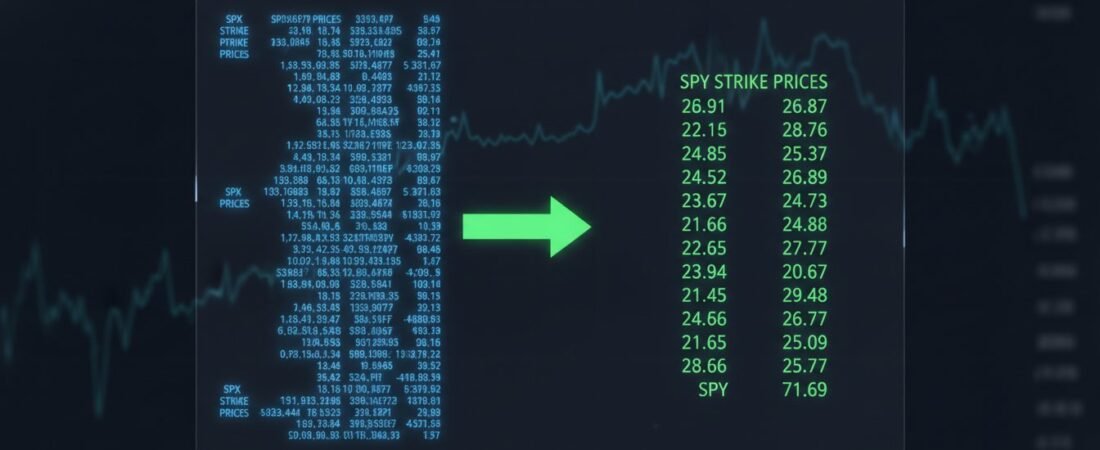
The 10x multiplier is an execution liability. SPX notional value is approximately 10 times that of SPY, but the conversion ratio is dynamic. Current verified ratio: 10.05 as of July 9, 2026. Relying on mental math for spy to spx strike conversion results in manual calculation errors and suboptimal fills. Risk is critical. SPX 0DTE contracts represent 59% to 65% of daily trading volume. Precise mapping is mandatory for high-frequency execution. Data precision determines profitability in high-gamma environments.
Manual errors and tracking discrepancies erode profitability. This tool facilitates precise options trades by converting SPX strikes to SPY equivalents with real-time ratio tracking. System features: six-second refresh cycles and clinical strike mapping. Technical overview: live ratio updates, zero-error strike mapping, and 0DTE data protocols. Interface design prioritizes functional efficiency and zero distraction. Eliminate execution lag. Maintain clinical accuracy. This utility provides the necessary variables for rapid decision-making in volatile markets.
Key Takeaways
- Dynamic market ratios render the fixed 10x multiplier obsolete. Precision mapping is required for accurate execution.
- Automated spy to spx strike conversion eliminates manual calculation errors during high-volatility 0DTE sessions.
- Real-time data protocols utilize 6-second refresh cycles to maintain strike mapping integrity and pricing accuracy.
- Standardized workflows facilitate rapid level selection for execution on retail platforms including Robinhood and Webull.
- Clinical utility design prioritizes functional efficiency and zero-distraction execution for professional day traders.
The SPY Calculator: Why the 10x Rule Fails 0DTE Traders
The SPY calculator serves as a technical mapping utility for high-precision index-to-ETF strike conversion. Professional execution requires exact parity between SPX levels and SPY instruments. Many retail participants utilize a fixed 10x multiplier to estimate levels. This heuristic is mathematically flawed. It ignores dynamic market variables that dictate the actual relationship between the underlying index and the tracking fund. Effective spy to spx strike conversion requires accounting for real-time ratio drift. Static math leads to execution at incorrect strikes. This results in missed fills or adverse selection in fast-moving 0DTE environments.
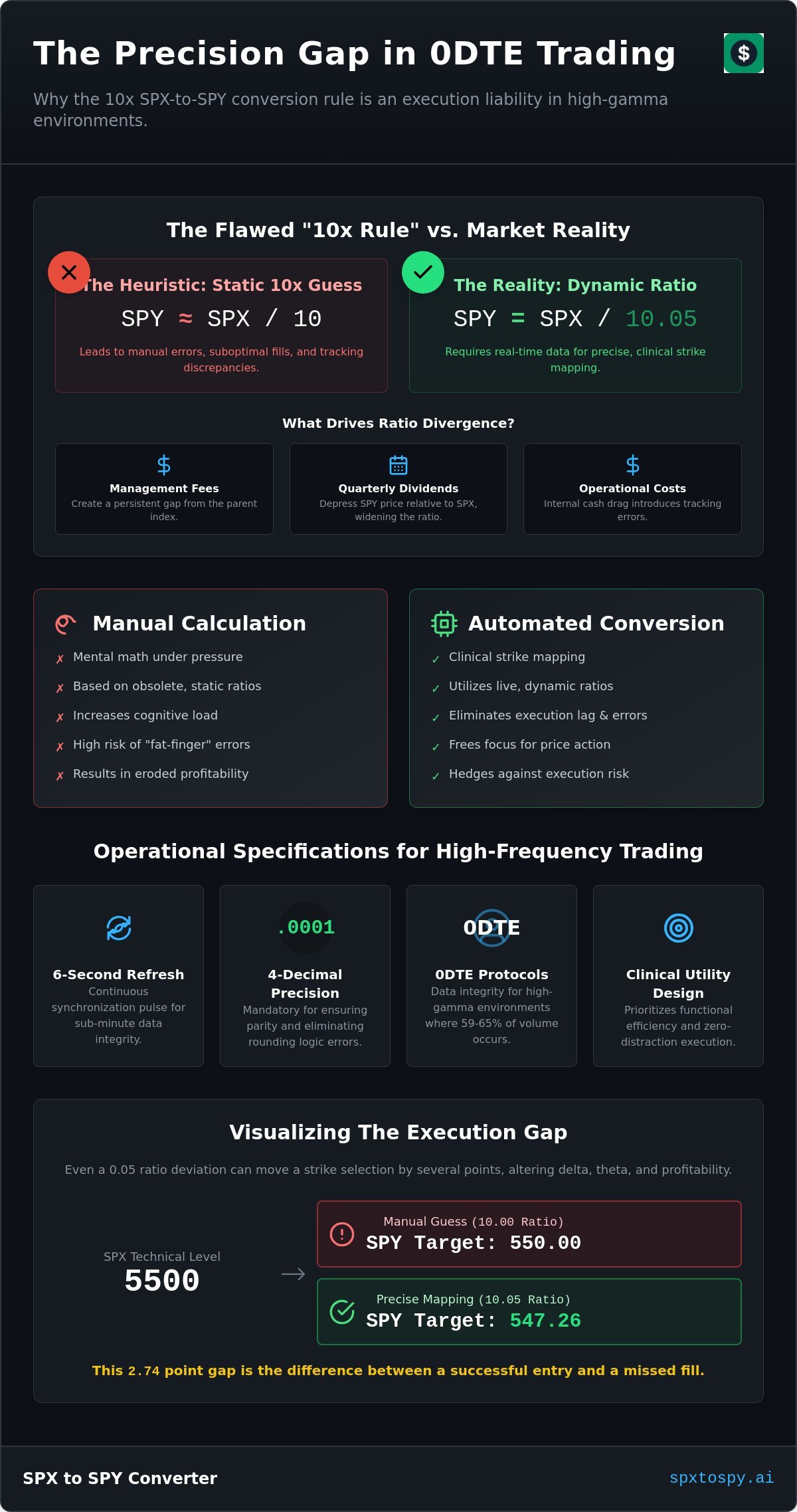
Ratio divergence is constant. SPX is a theoretical index. The SPDR S&P 500 ETF Trust (SPY) is a tradable security subject to management fees, operational costs, and dividend distributions. These factors ensure the ratio is rarely exactly 10.00. As of July 9, 2026, the verified conversion ratio was 10.05. A 0.05 deviation represents a significant pricing gap. In high-volatility sessions, the last significant digits of the ratio exhibit extreme sensitivity. Rough estimates fail when gamma is at its peak. Precision mapping is the only viable protocol for 0DTE profitability.
The Mechanics of Tracking Error
Tracking error is the primary driver of ratio divergence. SPY management fees and internal cash drag create a persistent gap from the parent SPX index. The fund must hold cash for redemptions and expenses, which doesn’t track index performance perfectly. Quarterly dividends further complicate the math. When SPY goes ex-dividend, the share price drops relative to the index. This depresses the SPY price. It widens the ratio. Traders relying on “rule of thumb” math often target strikes that don’t align with their technical thesis. Arithmetic latency during a breakout causes failed entries. Precise mapping eliminates this variable.
The Cost of Execution Errors
Execution errors carry heavy premiums in 0DTE trading. A 0.05 ratio shift can move a strike selection by several points in SPX terms. This shift significantly alters the expected delta and theta of a position. Miscalculating the strike leads to buying more expensive OTM contracts or missing the intended ITM protection. For comprehensive mapping protocols, refer to the index options strike price converter for broader market context. Scalping requires sub-second decision-making. Psychological fatigue increases the risk of “fat-finger” math errors. Automated conversion removes the cognitive load. It ensures the trader focuses on price action rather than long division. Precision is the hedge against execution risk.
Real-Time Conversion Logic: 6-Second Refresh Protocols
0DTE options liquidity demands sub-minute data integrity. The 6-second refresh cycle operates as a continuous synchronization pulse. This frequency aligns with the rapid decay of zero-days-to-expiration contracts. Sub-minute updates are critical. Liquidity pools shift instantly. A stale ratio leads to execution at the wrong strike. The tool functions with clinical objectivity, removing subjective interpretation from the mapping process. Data integrity is the primary requirement for professional execution.
Dividend drag is not a static discount. It is a continuous pressure on the SPY price. This makes spy to spx strike conversion a moving target. Competitor tools often use end-of-day ratios or fixed coefficients. This results in significant tracking error by mid-session. The 6-second refresh logic accounts for these intra-day shifts. Accuracy is maintained throughout the trading day. Utilizing the Real-Time SPX to SPY Strike Price Converter ensures strike mapping aligns with current market reality, providing a necessary edge in high-gamma environments.
The live market ratio functions as a dynamic variable rather than a static coefficient. Market volatility impacts the spread between the index and the ETF. The 6-second pulse captures these micro-adjustments. This prevents the “chaos” in the last significant digits observed in manual calculations. The output is a purely technical data point. It is designed for rapid scanning and immediate action. Speed and precision are prioritized over narrative explanation.
Computational Accuracy and Decimal Precision
Four-decimal precision is mandatory for strike mapping. The system tracks the ratio to 0.0001 to ensure parity. The SPX:SPY ratio is defined as the live-calculated quotient of current SPX and SPY mid-prices. This quotient determines the exact mapping point for any given technical level. Rounding logic is deterministic. The calculator maps the theoretical index level to the nearest available SPY strike. It accounts for the $1 or $0.50 strike intervals found in retail option chains. This ensures the output is immediately actionable for traders using standard brokerage platforms.
Data Integrity and Market Hours
Operational focus centers on regular market hours. Pre-market and after-hours data feeds exhibit wider bid-ask spreads. This impacts ratio accuracy. The utility prioritizes real-time processing speed over historical archives. No historical data is stored. This architecture reduces latency and ensures the data pulse remains current. Traders must verify mapped strikes with their broker before order entry. The tool acts as a precision assistant for spy to spx strike conversion, not a financial advisor. Verification is a requirement of responsible risk management.
SPX to SPY Strike Price Mapping: Manual vs. Automated Precision
Time-to-execution defines 0DTE profitability. Manual spy to spx strike conversion requires 10 to 15 seconds of cognitive processing. High-volatility sessions compress this window. Automated mapping reduces latency to under one second. The SPX to SPY converter utility functions as a critical component of a professional execution stack. It removes the mathematical bottleneck between technical analysis and order entry. Precise mapping is the benchmark for professional grade trading setups.
Eliminating Arithmetic Risk
Manual calculations introduce systemic risk. Traders frequently commit division errors when adjusting SPX levels by a non-integer ratio. Common failures include:
- Inaccurate rounding to the nearest $0.50 or $1.00 SPY strike.
- Decimal placement errors during rapid mental division.
- Reliance on a static 10x multiplier during dividend induced ratio drift.
Stale premium data occurs when the trader targets an outdated level. If the SPX:SPY ratio is 10.05 but the trader uses 10.00, the resulting strike selection is off by approximately 5 SPX points. This causes execution slippage. The trader pays for a delta they didn’t intend to hold. Automated conversion enforces decimal integrity. It ensures the selected strike aligns with the current market quotient. This prevents the loss of edge due to poor strike mapping. Precision is the only defense against market induced chaos.
Speed as a Competitive Advantage
0DTE option fills are highly sensitive to timing. A 3-second delay in strike selection results in price movement. In high-gamma environments, premiums shift significantly within seconds. Manual math creates a lag that competitors exploit. The utility’s minimalist UI facilitates rapid scanning. No linguistic fluff. No distractions. The interface delivers raw data points for immediate consumption. It acts as a transparent layer between the trader and the live feed. This allows for near-instantaneous strike identification during rapid price action.
Professional execution requires removing human error from the data chain. The digital assistant provides the necessary variables instantly. Automated spy to spx strike conversion allows the trader to focus on order size and entry timing. The utility handles the mathematical relationship between the index and the ETF. This separation of concerns increases execution speed. It maintains clinical objectivity during high-stress market moves. Efficiency is the primary metric for 0DTE success.
The relationship between SPX and SPY is not a constant. It is a fluid data stream. Traders using manual methods are essentially trading against a delayed tape. The automated utility synchronizes the trader with the current market pulse. Every six seconds, the system recalibrates. This frequency matches the update speed of professional level 2 data feeds. It provides a level of precision that mental arithmetic cannot replicate. Accuracy is the requirement. Day traders seeking the best SPX SPY converter for day traders require a tool engineered specifically for zero-latency strike mapping and live ratio synchronization.
Operational Specifications for High-Frequency Strike Selection
Standardized protocols ensure technical levels translate to available liquidity. High-frequency execution requires a recursive mapping loop. SPX levels identified on charts must be converted to SPY strikes before order entry. This operational sequence prevents execution at unintended delta levels. The spy to spx strike conversion utility serves as the primary data bridge for retail execution.
Workflow Integration for Retail Traders
- Step 1: Identify key SPX level on technical charts. Use high-precision charting software for level identification.
- Step 2: Input the identified SPX strike into the conversion tool. The system calculates the current quotient immediately.
- Step 3: Map the output to the nearest available SPY strike on the broker option chain.
Retail platforms like Robinhood and Webull prioritize interface simplicity over technical mapping. They don’t offer native index-to-ETF conversion. Traders must maintain an external data pulse. Use the Real-Time SPX to SPY Strike Price Converter to obtain the specific variables needed for accurate contract selection. Clinical accuracy is mandatory. Brokerage platforms often display SPY options in $0.50 or $1.00 increments. SPX options use wider intervals or different decimal points. This discrepancy creates a mapping gap. The conversion tool resolves this by calculating the theoretical SPY price to four decimal places. Traders then round to the nearest liquid strike. This protocol minimizes the distance between the theoretical index level and the executed ETF contract.
Managing Spread Precision
Iron Condors and Vertical Spreads demand multi-leg mapping. Each strike in a complex instrument must be verified against the current ratio. SPX strikes frequently lack a direct 1:1 SPY equivalent. This occurs due to the dynamic ratio and standardized strike intervals in SPY. Strategy requires selecting the next-best strike. Analyze the delta and gamma profile of adjacent strikes. Choose the strike that most closely mirrors the intended SPX risk exposure. Precision mapping is the standard for professional 0DTE execution. Directional put strategies require the same rigor; traders executing SPX puts to SPY puts conversion must account for dynamic basis deviations to maintain risk parity across execution platforms.
Delta neutrality depends on this precision. A miscalculated leg shifts the entire portfolio risk profile. The SPY calculator maintains this equilibrium. It provides a standardized mapping protocol for all legs of a complex trade. Without automated mapping, the risk of leg-mismatch increases. This is especially true during high-stress market moves where bid-ask spreads widen significantly.
Specific market conditions trigger ratio divergence. Re-check the current quotient when these signals occur:
- High-velocity price moves exceeding 1% in a 15-minute window.
- Rapid expansion of the bid-ask spread in SPX or SPY.
- Ex-dividend dates where dividend drag increases tracking error.
- Major economic data releases like CPI or FOMC events.
These events increase tracking error between the index and the ETF. Manual math fails during periods of high cognitive load. Automated mapping maintains execution speed. It ensures the trader remains synchronized with the market pulse. Professional execution is data-centric.
Executing with the SPX to SPY Converter Utility
The spxtospy.ai toolset provides a dedicated environment for high-precision mapping. Functional efficiency is the primary objective. The 6-second refresh cycle serves as the industry benchmark for 0DTE accuracy. This specific frequency prevents the use of stale ratios during high-gamma sessions. It mirrors the pulse of live market feeds. Professional spy to spx strike conversion requires this level of granularity. The tool processes quotients to four-decimal places. This ensures the mapping integrity of the SPX:SPY relationship. Clinical objectivity is maintained by removing all subjective variables.
Design logic follows a minimalist signature. Most retail tools clutter the interface with market news or graphics. This utility removes all linguistic fluff. The interface starts and ends with the data points. This architecture improves data processing speed for the trader. It acts as a transparent digital assistant. Rapid scanning is the intended use case. The utility is free and supported by display advertising. This model ensures the tool remains a dedicated, single-purpose utility for the trading community.
Operational focus remains strictly on the immediate data needs of the user. The tool doesn’t store historical data. It doesn’t offer financial advisory services or direct trade execution. Users must treat the output as a technical reference point. Market conditions can shift between refresh cycles. Professional traders maintain a risk-aware stance. Final verification of all mapped strikes with a broker is a mandatory protocol. This maintains a responsible approach to high-risk 0DTE instruments. Precision is the objective. Verification is the requirement.
The Minimalism Advantage
Cognitive load is reduced through extreme minimalism. Every data point is presented in a predictable, modular fashion. The syntax is designed for rapid scanning during high-stress market moves. Narrative sentences are absent. Direct labels and short fragments are utilized. This mirrors the rhythm of a live data feed. The absence of metaphors or descriptive adjectives reinforces the clinical tone. The brand projects the personality of a precision instrument. It is no-nonsense and reliable. Efficiency is the priority.
This commitment to a professional image often extends beyond digital tools; many trading firms utilize SwagStore.NET to create custom-branded merchandise and corporate gifts that align with their high-performance culture.
Final Execution Checklist
Adhere to the following protocol before executing any 0DTE order:
- Check the current ratio timestamp. Ensure the data pulse is synchronized with the live market.
- Verify the mapped SPY strike against current brokerage liquidity. Check for sufficient open interest and tight bid-ask spreads.
- Cross-reference technical levels. Ensure the spy to spx strike conversion aligns with the intended price target in SPX.
- Confirm rounding logic. Verify the selection of the nearest liquid strike on platforms like Robinhood or Webull.
Access the Real-Time SPX to SPY Converter
Optimize 0DTE Execution via Precise Strike Mapping
Standardized mapping protocols eliminate the execution risk associated with the static 10x rule. Professional 0DTE trading requires clinical accuracy. Live market ratios fluctuate constantly due to tracking error and dividend drag. Manual spy to spx strike conversion introduces arithmetic latency and fat-finger risks. High-volatility environments demand sub-minute data integrity. System architecture featuring 6-second refresh cycles provides the necessary parity for rapid strike selection. Minimalist interface design ensures zero-latency data processing for professional scalpers. This utility functions as a silent digital assistant for strike mapping. It removes cognitive load and prioritizes functional efficiency. Data integrity is the benchmark for professional execution. Traders using retail platforms like Robinhood or Webull require external technical parity. Automated mapping facilitates this synchronization. The removal of linguistic fluff optimizes scan speed. Every second matters in high-gamma environments. Maintain precision. Achieve zero-error strike mapping and maintain a clinical edge in the 0DTE market.
Convert SPX to SPY Strikes in Real-Time
Frequently Asked Questions
How accurate is the SPY calculator compared to manual division?
The tool provides clinical accuracy by eliminating human arithmetic error. Manual division during high-volatility sessions results in calculation lag and decimal placement mistakes. Automated mapping utilizes live market data to ensure the quotient remains current. This precision is mandatory for professional execution. Relying on mental math often leads to selecting strikes that don’t align with the intended delta profile.
Why does the SPX to SPY ratio change throughout the trading day?
Tracking error and dividend drag cause constant ratio divergence. SPY is a tradable security with internal management fees and cash drag. The parent SPX index is a theoretical calculation. These variables ensure the ratio deviates from the static 10.00 multiplier. Real-time updates capture these micro-adjustments. Effective spy to spx strike conversion requires accounting for this persistent drift to maintain pricing parity.
Can I use this tool for 0DTE SPX options execution?
The tool functions as a technical mapping utility for strike identification. It doesn’t provide direct trade execution or financial advisory services. Traders use the output to identify corresponding SPY strikes for execution on retail brokerage platforms. Verification with a broker is required before order entry. The utility provides the necessary variables for decision-making but does not interact with brokerage APIs.
What refresh rate does the spxtospy.ai tool use?
Data ratios refresh every six seconds. This sub-minute cycle is the benchmark for 0DTE trading accuracy. It mirrors the update frequency of professional Level 2 data feeds. Static tools often rely on stale end-of-day ratios. The 6-second pulse ensures the trader remains synchronized with the current market quotient. Speed and precision are prioritized to minimize tracking error during rapid price action.
Is there a difference between SPY and SPX strike intervals?
Yes, SPY and SPX utilize different strike increments. SPY options frequently feature $0.50 or $1.00 intervals. SPX options typically utilize wider increments or different decimal structures. This discrepancy creates a mapping gap for traders using retail platforms. The calculator identifies the theoretical SPY equivalent to four decimal places. Traders must round to the nearest liquid strike on their broker’s option chain to ensure execution.
Does the calculator account for SPY dividend dates?
Live market ratio tracking inherently accounts for dividend drag. When SPY goes ex-dividend, the share price drops relative to the index. This shift widens the conversion ratio instantly. The 6-second refresh cycle captures this divergence as it occurs in the live mid-prices. Traders don’t need to manually adjust for dividends. The tool provides the adjusted quotient automatically through its real-time data feed.
Can I use the SPY calculator for S&P 500 futures like /ES?
This utility is specifically designed for SPX to SPY parity. It isn’t optimized for /ES futures mapping. Futures contracts involve different pricing mechanics including basis and cost of carry variables. Using an index-to-ETF converter for futures results in significant tracking error. Professional execution requires utilizing tools specific to the instrument being traded. This tool remains hyper-focused on the SPX and SPY relationship.
Why is decimal precision important for SPY equivalent strikes?
High decimal precision is required due to extreme gamma sensitivity in 0DTE contracts. A deviation of 0.001 in the ratio shifts the intended SPX level by several points. This shift impacts premium pricing and delta exposure. The spy to spx strike conversion must be exact to maintain portfolio equilibrium. Four-decimal precision ensures the selected ETF strike mirrors the index technical level with minimal slippage.