
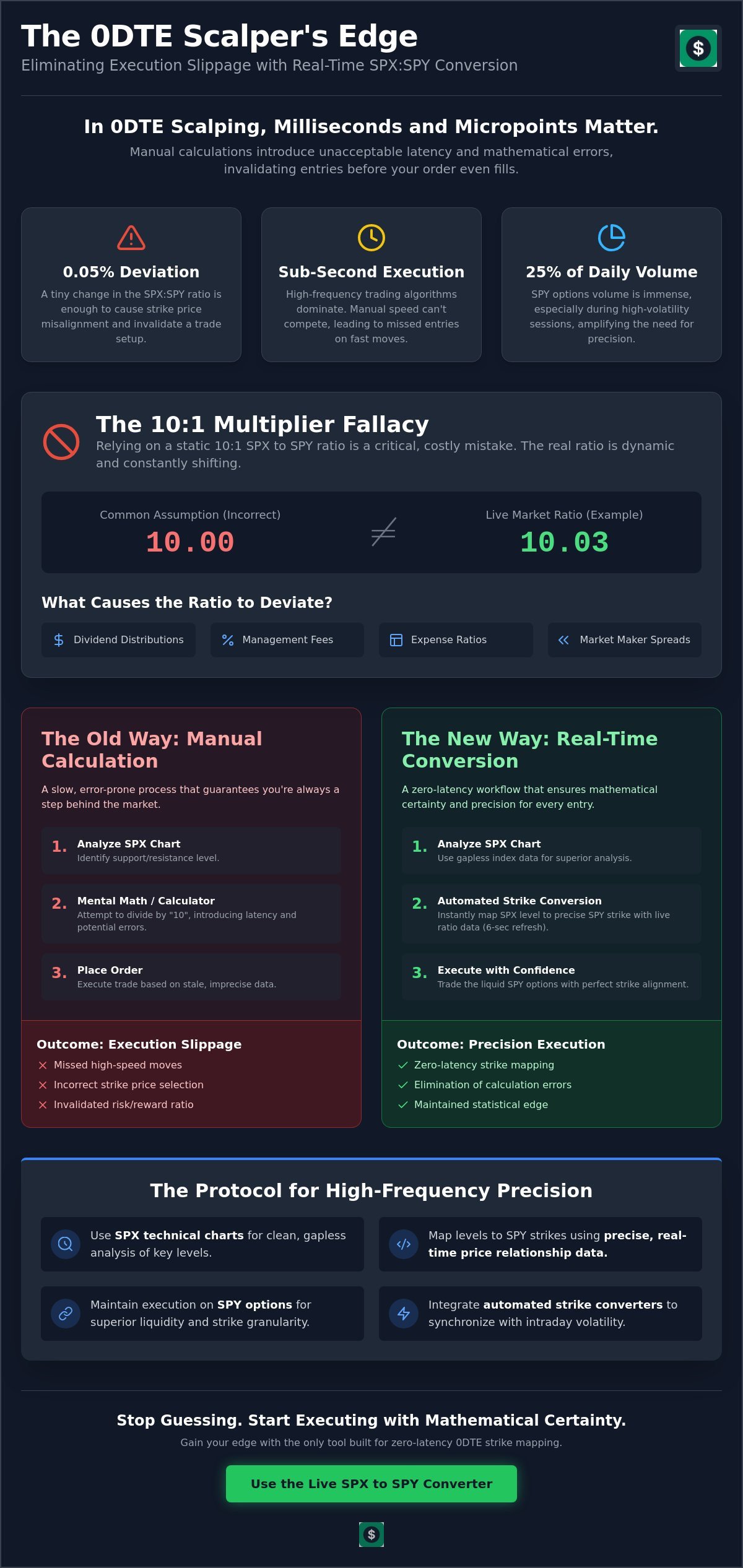
Scalping 0DTE options requires sub-second execution. A 0.05% deviation in the expected 10:1 SPX to SPY ratio results in strike price misalignment that invalidates an entry before the order fills. Manual calculation during high-volatility sessions, where SPY options volume currently accounts for over 25% of daily averages, introduces unacceptable latency and mathematical error. Traders frequently miss fast moves while attempting to reconcile index levels with ETF equivalents, leading to significant execution slippage.
Precision in strike selection is mandatory for maintaining a statistical edge. Mastery of the spx spy ratio for scalping allows for the execution of high-frequency trades with mathematical certainty. This technical framework ensures that index strikes map to ETF equivalents without the delay of manual input. You will learn to utilize real-time data to eliminate calculation drift and improve entry precision for 0DTE scalps.
This analysis details the mechanics of the structural 10:1 multiplier and the impact of current market variables, such as the 13.62% implied volatility level recorded in July 2026. It provides the protocol for zero-latency strike mapping within the current regulatory landscape. This system prioritizes functional efficiency to reduce mathematical errors in fast-moving markets.
Key Takeaways
- Map SPX index-level support and resistance to SPY option strikes using precise price relationship data.
- Eliminate execution errors caused by the 10:1 multiplier fallacy through real-time spx spy ratio for scalping monitoring.
- Utilize SPX technical charts for gapless analysis while maintaining SPY execution for liquidity and strike granularity.
- Integrate automated strike price converters with 6-second refresh intervals to synchronize strike selection with intraday volatility.
Understanding the SPX:SPY Ratio Mechanics for Intraday Scalping
The SPX:SPY ratio represents the numerical relationship between the S&P 500 Index and the SPDR S&P 500 ETF Trust. Scalpers utilize this metric to translate index-level price action into executable ETF option strikes. High-frequency scalping requires precise mapping because support and resistance levels on the SPX chart don’t always align with round numbers on the SPY chain. Arbitrageurs maintain the price tether between the cash index and the tradable instrument by exploiting micro-discrepancies. This activity ensures the ETF tracks the underlying components, yet the relationship is rarely static. Market hours dictate ratio stability. Liquidity peaks during the New York session, while pre-market and after-hours periods exhibit wider spreads and ratio drift.
The Mathematical Basis of the SPX:SPY Relationship
The SPX is a capitalization-weighted index calculated based on the stock prices of its constituents. Conversely, SPY is a tradable trust that seeks to track the index’s performance by holding a representative basket of securities. The 10x multiplier serves as a standard baseline for contract sizing, where one SPX contract roughly equals ten SPY contracts. This is a theoretical constant. The spx spy ratio for scalping is a dynamic variable influenced by market demand and underlying component pricing. Intraday fluctuations occur as the ETF’s net asset value (NAV) adjusts to supply and demand imbalances in the secondary market.
Scalping Context: Why Seconds Matter
High-frequency trading (HFT) algorithms dominate the intraday environment, processing order flow in milliseconds. For 0DTE traders, the precision of the spx spy ratio for scalping is critical. A deviation as small as 0.05 in the ratio can result in selecting a strike price that is effectively incorrect for the intended trade setup. This misalignment ruins the risk-to-reward ratio by forcing entries at disadvantageous levels. Clinical necessity dictates sub-10 second data refreshes for strike mapping. Without real-time updates, the data becomes stale before the order reaches the exchange. Speed is the primary defense against execution slippage.
Arbitrageurs function as the primary mechanism for ratio convergence. When the ETF price deviates from the NAV, institutional players execute basket trades to capture the spread, forcing the instruments back into alignment. This process is most efficient during regular trading hours (RTH). Outside of RTH, the absence of underlying stock trading leads to tracking error. In these windows, SPY price discovery relies on futures markets rather than the spot index. Scalpers must account for these shifts to maintain mathematical precision during fast-moving market regimes.
In the 0DTE environment, gamma sensitivity is at its peak. Small movements in the underlying index produce large swings in option premiums. If a trader calculates an entry based on an outdated 10.00 ratio while the live market is at 10.03, the strike selection will be off by several cents on the ETF. This error compounds when scaling into multiple contracts. Understanding spx spy ratio fluctuation and its intraday metrics is essential for maintaining the precision required during high-frequency execution. Reliance on manual calculation is a failure point in high-frequency execution.
The 10:1 Multiplier Fallacy: Why Real-Time Ratio Data is Mandatory
Static assumptions regarding the relationship between the S&P 500 Index and the SPDR S&P 500 ETF Trust lead to execution failure. The 10:1 multiplier is a common heuristic. It is mathematically imprecise. SPY does not perfectly mirror SPX 100% of the time. Tracking error is a constant variable in intraday environments. Dividend distributions are a primary driver of this divergence. When SPX components pay dividends, the ETF price drops by the distribution amount on the ex-date. This causes the ratio to widen over time. A trader relying on a fixed 10.00 calculation will consistently target the wrong strike price. The spx spy ratio for scalping must be calibrated to current market conditions to maintain accuracy.
Sources of Ratio Deviation
Structural frictions within the ETF vehicle ensure the ratio remains fluid. Management fees and expense ratios exert a microscopic but constant downward pressure on the fund’s net asset value. Cash drag occurs when the trust holds dividend payments in non-interest-bearing accounts before distribution. These factors create a persistent lag in tracking. Market maker spreads also influence the perceived ratio. During periods of high volatility, the bid-ask spread on SPY widens, creating temporary imbalances between the index spot price and the tradable ETF price. These mechanics differ from the Cboe Mini-SPX (XSP) specifications, which offer a fixed 1/10th contract size. SPY is a secondary market instrument subject to supply and demand fluctuations that the cash index does not experience.
The Scalpers Risk: Misaligned Strikes
High-delta 0DTE options amplify the impact of ratio errors. A 0.1% deviation in the spx spy ratio for scalping translates to a significant strike price misalignment. For example, if SPX is at 5,500.00 and the actual live ratio is 10.02, the mathematically correct SPY equivalent is 548.90. A trader using the 10:1 fallacy would calculate a target of 550.00. This 1.10 point delta results in incorrect premium pricing. The trader enters a position based on an SPX level that has already shifted in the ETF market. This leads to immediate unrealized losses or missed fills. Monitoring the live market ratio is the only method to synchronize these data points. Intraday volatility spikes create rapid ratio shifts as S&P 500 components move at different velocities. Manual calculations cannot keep pace with these sub-second changes. Precision requires an automated, objective data feed to eliminate mathematical drift during high-frequency execution.
Compounding errors are particularly dangerous during trend reversals. When the index hits a technical level, the ETF may lag by several ticks. Scalpers who don’t account for this lag face execution slippage. This slippage erodes the tight profit margins characteristic of 0DTE strategies. The necessity for real-time precision is absolute. Digital assistants that track these variables provide the transparency required for professional-grade decision making. Every tick matters in a scalping regime. Relying on outdated heuristics is a risk that modern market data makes unnecessary.
Just as precision tools are necessary for market success, maintaining your physical well-being is key to staying sharp during volatile sessions; you can visit Nutrahara to find specialized health supplements designed to support your wellness journey.
Scalping Strategies: Executing SPY Trades Using SPX Index Levels
Technical analysis on the S&P 500 Index provides a “clean chart” advantage. SPX is a cash index. It does not experience the overnight gaps or dark pool print distortions common in ETF trading. Professional scalpers conduct their primary charting on SPX to identify high-probability support and resistance zones. These levels represent the true aggregate value of the 500 constituent stocks. Execution occurs on SPY to leverage strike granularity and liquidity. Success in this hybrid model requires a precise spx spy ratio for scalping to ensure the trade triggers at the exact index level intended. Manual calculation of these levels introduces latency that erodes the scalp’s profit margin.
Mean reversion strategies utilize ratio deviations as entry signals. The ratio between the index and the ETF often drifts due to temporary supply and demand imbalances in the secondary market. When the ratio moves beyond two standard deviations of its 5-minute moving average, it typically snaps back to the mean. Scalpers identify these moments to enter SPY positions when the ETF is mathematically “cheap” or “expensive” relative to the spot index. This strategy requires constant monitoring of the delta between the theoretical 10:1 multiplier and the live market data. Utilizing the SPX to SPY Converter allows for the immediate synchronization of technical levels with order entry.
Hybrid Execution Workflow
Precision execution follows a modular, three-step protocol. First, the trader identifies a technical level on the SPX chart, such as a 5,400.00 psychological support. Second, this value is processed through the live ratio tracker to determine the SPY equivalent. If the current ratio is 10.012, the target is 539.35 rather than 540.00. Third, the trader selects the nearest liquid SPY strike for the scalp. This workflow eliminates the guesswork associated with “eye-balling” levels and ensures the trade aligns with institutional order flow reacting to the index.
Liquidity and Slippage Metrics
SPX options feature higher notional values and wider bid-ask spreads, which can be prohibitive for high-frequency scalping in smaller accounts. SPY liquidity often absorbs smaller scalp orders with less slippage than SPX during low-volume windows. Fill speeds are generally faster in the ETF market due to the high density of retail and HFT participants. In the 0DTE environment, where implied volatility recently sat at 13.62%, every tick of slippage impacts the final R:R. Traders using platforms like Robinhood, which lack direct SPX access, must master the spx spy ratio for scalping to remain competitive with institutional counterparts. Execution efficiency depends on the ability to translate index-based technical analysis into ETF-based order flow without mathematical drift.
Slippage management is the difference between a profitable session and a loss. During high-volatility regimes, SPY spreads remain tight while SPX spreads often widen significantly. This disparity makes the ETF the preferred vehicle for rapid entries and exits. Precision in strike mapping ensures that the trader isn’t paying an unnecessary premium for a misaligned strike. Automated data feeds provide the objectivity required to maintain this precision throughout the trading day.
Calculating Strike Price Equivalents for High-Frequency Execution
Execution requires precise inputs. Identify the current SPX spot price. Apply the live SPX:SPY ratio immediately. Don’t use the 10x constant. Static multipliers fail to account for dividend drag and tracking error. Factor in the SPY dividend adjustment when the trust is near ex-dividend dates. Verify the resulting SPY equivalent against the active options chain. Confirm the strike with the broker interface before final submission. This sequence reduces execution latency and mathematical drift. Mathematical certainty is the only protection against slippage in fast-moving market regimes.
Mathematical Conversion Formula
Formula: (SPX Strike / Live Ratio) = SPY Equivalent. Decimal precision is mandatory. A calculation resulting in 539.42 requires selection of the 539 strike for OTM bias or 540 for ITM bias. Using 540.00 as a generic target when the precise value is 540.12 creates a pricing mismatch of 0.12 points. At high volatility levels, such as the 13.62% IV recorded in July 2026, this mismatch equates to significant premium variance. High-frequency environments leave no margin for rounding errors. Use a real-time strike price converter to maintain sub-second accuracy during the trade entry phase.
0DTE Strike Selection Protocol
Map SPX “Wall” levels to SPY Gamma peaks. Institutional hedging often clusters at specific index strikes. Identify these liquidity zones on the SPX chart. Convert these levels to SPY strikes to find the highest probability reversal points. Factor in Theta decay. 0DTE contracts lose value rapidly during consolidation phases. Execute the scalp only when the spx spy ratio for scalping confirms the index is at a terminal technical boundary. For automated mapping of these variables, refer to the SPX to SPY converter tool documentation. This protocol ensures strike selection aligns with real-time market mechanics rather than theoretical models.
Verification against the options chain is the final safety check. Check the bid-ask spread on the targeted SPY strike. If the spread is wider than 0.05, liquidity may be insufficient for a high-frequency scalp. July 2026 market data shows a volume put-call ratio of 1.1, indicating bearish sentiment and higher demand for put liquidity. Ensure the selected strike reflects these intraday flow dynamics. Mathematical certainty replaces intuition in professional execution frameworks. Maintain the ratio tether to preserve the statistical edge of the strategy. Every cent of misalignment erodes the expected value of the trade.
Optimizing Scalp Entries with the SPX to SPY Converter Tool
Automated strike price mapping enables instant decision-making. Manual calculation is a high-latency failure point. The converter tool utilizes a 6-second refresh cycle to match intraday volatility. This frequency ensures that the spx spy ratio for scalping remains accurate during rapid price discovery. High-frequency trading environments leave no room for arithmetic delays. Capture 0DTE moves by eliminating manual input. The tool provides a direct bridge between SPX technical levels and SPY order entry. Utility is prioritized for Robinhood, Webull, and Thinkorswim users. Execution parity with institutional desks requires this specific automation.
Technical Specifications of the Converter
The system integrates a real-time data feed for maximum precision. The visual interface facilitates rapid strike identification. Clinical accuracy is mandatory for the 0DTE environment. High gamma sensitivity means that a single tick of misalignment impacts the trade’s risk profile. The converter processes the live ratio to output exact ETF equivalents. This removes cognitive load. Traders focus exclusively on price action. The output reflects current market conditions, including the 13.62% implied volatility levels observed in July 2026. The algorithm accounts for the 10:1 structural multiplier while adjusting for live tracking error. It monitors the cash-settled SPX vs physically-settled SPY discrepancy continuously.
Risk Management Protocols
Verification is the final step in the execution chain. Always cross-reference strike prices with broker data. The tool serves as a precision instrument for mathematical mapping. It doesn’t replace the necessity for final user verification. Understand the ratio disclaimer for live trades. Market variables fluctuate between refresh cycles. Professional scalpers use the converter to validate their technical targets. It ensures that the selected SPY strike corresponds to the intended SPX support or resistance zone. This process maintains the statistical edge required for high-frequency success. Accuracy in strike selection prevents the compounding of entry errors.
Platform utility is a core feature. Retail platforms often lack the data tethering found in institutional suites. The converter synchronizes disparate data points into a single value. This synchronization is critical when the volume put-call ratio is at 1.1. The spx spy ratio for scalping dictates the accuracy of these conversions. Capturing these moves requires zero-latency mapping. Precision is the primary defense against execution slippage. July 2, 2026, data showed SPY options volume at 3.38 million contracts. This was 25.66% of the average daily volume. High-volume sessions increase the probability of ratio drift. Convert SPX to SPY Strikes Now.
Standardize Your Execution Protocol
High-frequency 0DTE trading mandates the elimination of manual calculation latency. Static heuristics, such as the 10:1 multiplier, fail. They ignore dividend drag and real-time tracking error. Professional scalp entries require synchronization. Map SPX technical levels to SPY option strikes via sub-second data processing. Utilizing a specialized spx spy ratio for scalping ensures strike selection aligns with institutional order flow. Accuracy is mandatory during high volatility regimes. Mathematical certainty replaces intuition.
The 6-second refresh cycle provides clinical precision. This free utility removes cognitive load. Traders focus on price action. Zero-latency conversion is the requirement for modern intraday strategies. It bridges the gap between index analysis and ETF execution. Precision is the primary defense against execution slippage. Correct strike mapping prevents compounding entry errors during high-volume sessions. Maintain the statistical edge through real-time data integrity.
Access the Real-Time SPX to SPY Converter
Standardize your workflow for consistent results.
Frequently Asked Questions
What is the current SPX to SPY ratio?
The ratio is a dynamic variable. It fluctuates based on live market conditions. As of July 2026, the ratio deviates from the theoretical 10.00 baseline. Dividend drag and tracking error are primary drivers. Use a live data tracker for the current sub-second value. Static estimates are invalid for execution. Mathematical precision requires real-time monitoring of the delta between the cash index and the tradable instrument.
Why is the SPX to SPY ratio not exactly 10?
Structural differences prevent a fixed 10:1 relationship. SPY is a tradable trust subject to expense ratios and cash drag. SPX is a mathematical index. Dividend distributions in SPY components cause the ETF price to drop relative to the index. These frictions create a persistent but fluctuating delta. Market maker spreads on the ETF also contribute to temporary ratio divergence from the theoretical baseline.
How often does the SPX to SPY ratio change?
The ratio changes with every tick of the underlying components. Intraday volatility and secondary market supply and demand imbalances drive constant adjustments. Professional monitoring systems utilize a 6-second refresh cycle. This frequency captures micro-fluctuations necessary for strike price synchronization during high-frequency sessions. Rapid price discovery in the S&P 500 constituents ensures the ratio is a moving target throughout the trading day.
Can I use the SPX to SPY ratio for 0DTE scalping?
Yes. Use the spx spy ratio for scalping to maintain 0DTE execution accuracy. High gamma sensitivity requires precise strike mapping to preserve risk-to-reward ratios. Misalignment by 0.05 points results in disadvantageous entries. Real-time conversion eliminates manual calculation latency in fast-moving markets. This protocol ensures index-based technical analysis translates accurately to ETF-based order flow. It preserves the statistical edge in high-frequency regimes.
Is SPY or SPX better for scalping?
Selection depends on account size and liquidity requirements. SPY offers tighter bid-ask spreads and higher strike granularity for smaller positions. SPX provides cash settlement and Section 1256 tax advantages. To manage the complexities of such filings, CTC Tax & Accounting provides professional tax compliance and financial advisory services. Scalpers often chart SPX for clean price action while executing on SPY for fill efficiency. July 2, 2026, data shows SPY options volume at 3.38 million contracts. This provides deep liquidity for rapid scalp entries.
How do I convert SPX strike prices to SPY for Robinhood?
Divide the SPX technical level by the live market ratio. For a 5,500 SPX strike and a 10.012 ratio, the SPY target is 549.34. Round to the nearest liquid SPY strike. Automated converters provide instant mapping for Robinhood traders who lack direct SPX access. This ensures execution parity with institutional platforms. Precision strike selection is necessary to avoid paying unnecessary premiums on misaligned options contracts.
What causes the tracking error between SPX and SPY?
Tracking error derives from fund management fees, cash drag, and execution timing. SPY must hold a representative basket of securities, which incurs microscopic but constant costs. Temporary imbalances between the ETF price and its Net Asset Value (NAV) occur during volatility spikes. Arbitrageurs eventually close these gaps, but the drift persists intraday. This drift invalidates the static 10:1 multiplier during high-frequency execution windows.
Does the SPX to SPY ratio include dividends?
Yes. The spx spy ratio for scalping accounts for dividend distributions. When SPY components go ex-dividend, the ETF price reflects the payout while the SPX index does not. This mechanic causes the ratio to widen. Tracking the live spx spy ratio fluctuation is the only method to adjust for these predictable but significant price shifts. Failure to account for dividend drag results in targeting the wrong strike price.