A static 10x multiplier is a mathematical liability in high-frequency trading environments. Manual strike conversion fails during 0DTE expansion. Tracking error and dividend-adjusted deviations create price gaps that exceed standard slippage tolerances. You recognize that execution lag is a direct result of inefficient calculation methods. Mastering the technical relationship between these instruments is the only way to secure a precise spx options to spy equivalent for every trade. Reliable execution requires a dynamic approach to strike mapping.
This guide provides the clinical framework for zero-error strike mapping. It addresses the impact of the June 2026 FINRA intraday margin framework and the updated CBOE Options Regulatory Fee of $0.01248 per contract. The following sections analyze real-time ratios and tracking error adjustment protocols. We examine the mechanics of 6-second refresh cycles and cross-market hedging to ensure execution remains optimized for current market volatility. The data focuses on the specific variables required for professional decision-making in the July 2026 market landscape.
Key Takeaways
- Establish technical equivalence between SPX and SPY using dynamic ratios to bypass the inaccurate 10x multiplier myth.
- Calculate the precise spx options to spy equivalent using institutional-grade decimal precision for high-frequency execution.
- Mitigate intraday drift and tracking error by monitoring live market ratios with a 6-second refresh cycle.
- Optimize capital efficiency on retail platforms by mapping S&P 500 exposure to SPY-compatible strike levels.
- Verify mapping accuracy via the Real-Time SPX to SPY Strike Price Converter utility prior to order submission.
SPX to SPY Equivalent: The Technical Basis of Strike Mapping
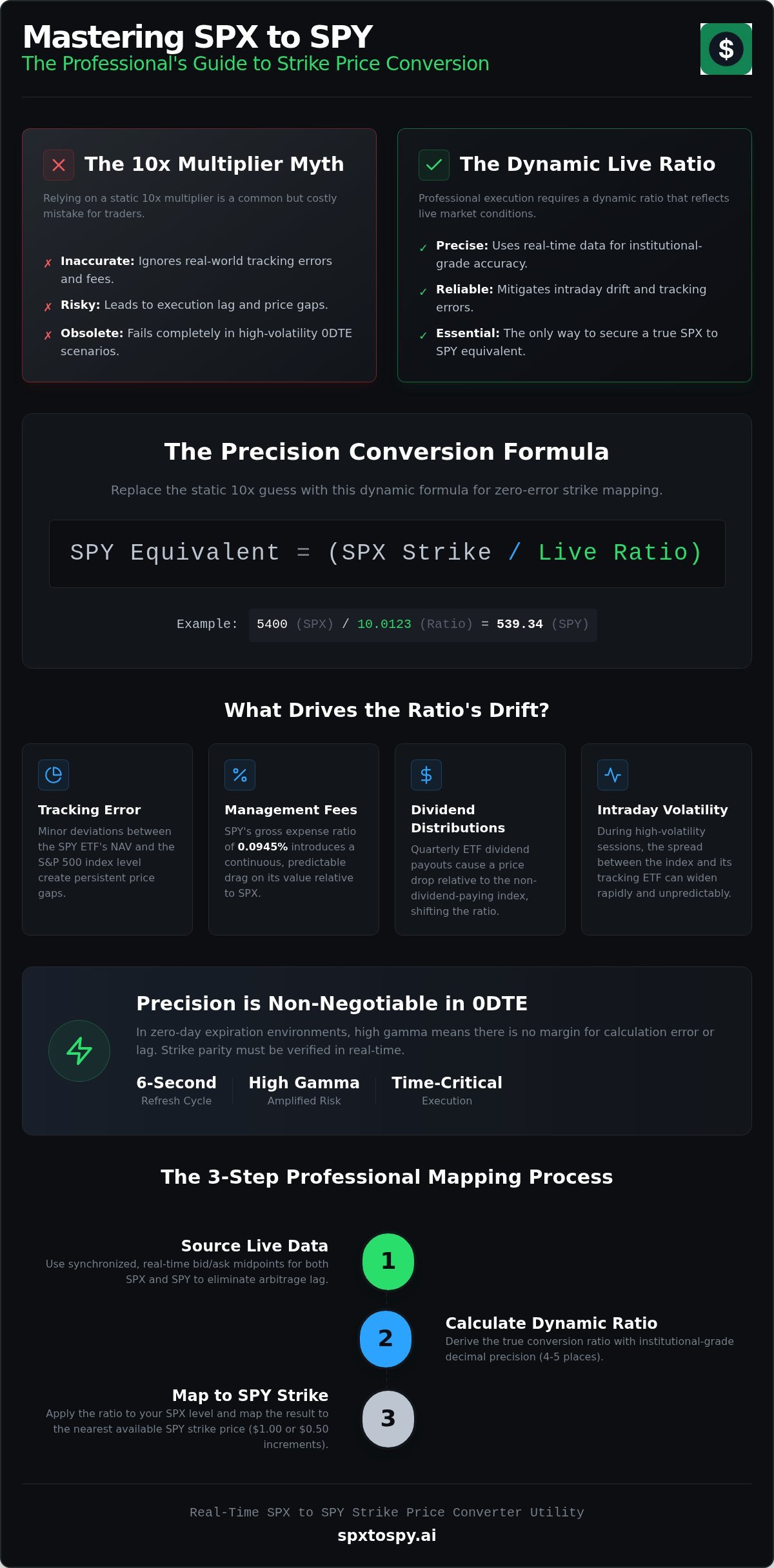
Strike mapping is a functional requirement for cross-market hedging. It defines the proportional relationship between the S&P 500 Index and the SPY ETF. Relying on a 10x multiplier leads to execution errors. The spx options to spy equivalent is a moving target. It fluctuates based on tracking error and management fees. SPY maintains a gross expense ratio of 0.0945% as of July 27, 2026. This cost, combined with dividend-adjusted price deviations, ensures that 4,500 SPX rarely aligns with 450.00 SPY. Traders must account for the underlying index vs. the tradable trust in price discovery.
The 10x Multiplier vs. Real-Time Ratios
Structural differences exist between index levels and ETF Net Asset Value (NAV). The Exchange-Traded Fund (ETF) structure introduces cash drag and management overhead. These factors cause the SPX/SPY ratio to drift away from the theoretical 10.00. A deviation of just 0.01% is significant for high-delta options. It results in strike selection errors that impact PnL. Calculating the True Ratio requires dividing the current SPX level by the live SPY bid/ask midpoint. This provides the intraday precision necessary for professional mapping. It eliminates the slippage associated with the static 10x myth.
Strike Parity in 0DTE Environments
Strike selection in 0DTE environments is time-critical. High gamma levels mean price moves are rapid. There’s no room for calculation lag. Traders often use SPX technical levels for analysis but execute on SPY for liquidity or account size constraints. Mapping these levels requires a reliable 0DTE SPX SPY Ratio: Real-Time Precision for Strike Price Mapping. This ensures that the chosen SPY strike provides the intended delta exposure. Precision mapping mitigates the risk of executing at the wrong level during volatility spikes. It ensures that the spx options to spy equivalent remains accurate during the final hours of the trading session. Verifying strike parity is essential for maintaining risk-based margin compliance under the June 2026 FINRA Rule 4210 framework.
Mathematical Mapping: Calculating SPY Equivalent Strike Prices
Execution precision depends on the application of a dynamic conversion formula. The core calculation is (SPX Strike / Live Ratio) = SPY Equivalent. This formula replaces the static 10x multiplier with a variable divisor that reflects real-time market conditions. Accurate mapping requires institutional-grade decimal precision, typically extending to four or five decimal places. Small rounding errors in the ratio result in significant strike deviations, especially for high-gamma 0DTE positions. Referencing the Cboe SPX Options Specifications confirms the $100 multiplier and cash-settlement structure, which contrasts with the physical delivery of the SPY ETF.
High-volatility sessions expand the spread between the index and the tracking vehicle. During these periods, the ratio drifts rapidly. Traders must track the SPX:SPY spread to ensure the chosen SPY strike provides the intended delta exposure. Failure to monitor this spread leads to “strike slippage,” where the executed trade no longer aligns with the technical level identified on the SPX chart. To determine the spx options to spy equivalent during fast-moving markets, the divisor must reflect the current midpoint of the bid/ask spread for both instruments. You can maintain execution accuracy by utilizing live market ratio tracking to verify these values before order entry.
Ratio Derivation Logic
Deriving a functional ratio requires synchronized data feeds. Sourcing real-time bid/ask midpoints for both SPX and SPY is the technical baseline. This process eliminates the arbitrage lag inherent in delayed retail feeds. Standardizing decimal output is necessary for compatibility with retail trading interfaces. While the internal calculation uses high precision, the final output must map to the nearest available SPY strike increments, usually $1.00 or $0.50. This standardization prevents manual calculation errors during rapid execution cycles.
Dividend Impact on Parity
The SPY ETF structure includes quarterly dividend distributions that are not present in the SPX index. These distributions cause the ETF price to drop relative to the index, shifting the equivalence ratio. Mapping protocols must account for these scheduled events. Pre-dividend ratios will differ from post-dividend ratios as the “leakage” from the distribution is priced into the ETF. A static conversion model fails to capture this shift, leading to a permanent tracking error in strike selection. Professional mapping requires an adjustment to the divisor following the ex-dividend date to maintain parity between the index level and the tradable trust.
Strategic Execution: Why Traders Map SPX Options to SPY
Retail platform constraints dictate execution choices. Platforms like Robinhood and Webull lack SPX support. Traders must utilize the spx options to spy equivalent to gain S&P 500 exposure on these interfaces. Capital efficiency is the primary driver for smaller account sizes. SPY options offer a lower notional entry point. This allows for granular position sizing and precise risk allocation. Hedging protocols require mapping SPX index levels to SPY option legs for accurate delta management. Liquidity analysis confirms that SPY strikes often provide tighter spreads for retail-sized orders. Efficient execution depends on identifying the exact strike that mirrors index technicals without overpaying for the spread.
Regulatory documentation supports this structural link. The Federal Register Notice on SPY Position Limits confirms that SPY options are approximately one-tenth the size of the SPX. Technical analysis performed on the SPX index must be converted using live ratios to ensure strike accuracy. Relying on the 10x rule without adjustment introduces tracking error. This error compromises the effectiveness of cross-market hedges. The removal of the $25,000 Pattern Day Trader (PDT) rule in June 2026 under FINRA Rule 4210 has increased the utility of SPY for active traders. This new risk-based margin framework requires precise strike mapping to maintain account equity requirements during intraday volatility.
Retail Platform Mapping Protocols
Translating SPX technical levels into SPY order entry requires a standardized protocol. Traders identify key support or resistance on the SPX chart. They then apply the live conversion ratio to locate the corresponding SPY strike. Managing American-style exercise risk is a critical requirement for SPY equivalents. Unlike SPX, SPY options are subject to early assignment. This risk increases during quarterly dividend cycles. Review the Day Trading SPX SPY Conversion: Technical Execution and Ratio Precision for specific execution workflows. Use these protocols to maintain execution speed during fast-moving market conditions.
Settlement and Tax Variables
Settlement methods differ significantly between these instruments. SPX is cash-settled upon expiration. SPY requires physical delivery of ETF shares. This distinction affects capital requirements at expiration. Tax treatment also varies. SPX gains fall under Section 1256, providing a 60/40 long-term/short-term split. SPY gains are standard capital gains based on the holding period. Strategic selection involves weighing these tax advantages against the lower entry cost of SPY. Traders often move from SPY to SPX as account equity scales to capture tax efficiencies and eliminate assignment risk. Precise mapping ensures this transition happens at the correct technical levels.
Intraday Ratio Fluctuations: Impact on Mapping Accuracy
The SPX/SPY ratio is a dynamic variable. It exhibits constant intraday drift between the 9:30 AM open and the 4:00 PM EST close. This drift occurs due to the disparate liquidity profiles of the cash index and the tradable ETF. Volatility spikes exacerbate ratio instability. During rapid price expansion, the spread between the two instruments widens. This divergence directly impacts the calculation of the spx options to spy equivalent. Relying on stale data leads to strike selection errors. Institutional-grade execution requires sub-10-second updates to account for these micro-fluctuations. Mean reversion typically occurs after opening volatility subsides, but the ratio rarely returns to a perfect 10.00.
The relationship between the S&P 500 Index and the SPY ETF is governed by arbitrage mechanics. Market participants monitor the Net Asset Value (NAV) of the ETF against the spot index level. When the ratio deviates significantly from its moving average, arbitrageurs enter the market to compress the spread. This mean reversion is a constant force, yet it is never instantaneous. Real-time data is the only defense against executing during a temporary ratio blow-out. During high-volatility sessions, such as those following Federal Reserve announcements, the ratio shifts by several basis points in seconds. This shift alters the spx options to spy equivalent instantaneously.
Accurate mapping during these spikes is essential for maintaining delta-neutrality in complex spreads. If the ratio drifts from 10.02 to 10.05, the corresponding SPY strike for a 5,000 SPX level moves by approximately 1.5 points. For a 0DTE trader, this deviation represents the difference between an In-The-Money (ITM) and Out-Of-The-Money (OTM) contract. Verification of the current divisor is a mandatory step in the order entry sequence. Maintaining a zero-error strike mapping protocol requires current data. Verify your trade levels against live market ratio tracking to ensure execution remains aligned with technical targets.
Monitoring the 6-Second Refresh
Technical architecture must support high-frequency data ingestion. A 6-second refresh cycle is the threshold for 0DTE scalping precision. This frequency captures the micro-drift that slower retail tools ignore. Slower refresh rates result in execution lag. Traders using 1-minute or 5-minute data operate on obsolete ratios. Review the SPX SPY Ratio Fluctuation: Intraday Metrics for Precise Strike Mapping to understand the impact of latency on strike parity. Accurate mapping during the final hour of trading is critical for risk management.
Scalping Precision Metrics
Precision mapping reduces slippage in high-gamma environments. Ratio anomalies are most frequent during the first 15 minutes of the session and the final 30 minutes before the bell. These periods feature rapid changes in ETF NAV relative to the underlying index. Identifying these anomalies prevents entering positions at sub-optimal strike levels. For active participants, the SPX SPY Ratio for Scalping: Real-Time Precision for 0DTE Traders offers a framework for integrating these metrics into execution workflows. Use these metrics to standardize order entry across multiple platforms.
Utilizing the SPX to SPY Strike Price Converter Utility
Precise strike mapping requires a standardized input sequence. Input the target SPX strike price into the Real-Time SPX to SPY Strike Price Converter. The utility applies the current market ratio to generate the spx options to spy equivalent instantly. Verification of the 6-second refresh timestamp ensures data currency. Cross-reference the generated SPY level with the active option chain on your execution platform. This clinical approach eliminates the execution lag associated with manual 10x calculations. Data accuracy depends on the elimination of cognitive bias during fast-moving 0DTE windows. User verification of broker-specific data remains a mandatory risk-mitigation step before order transmission.
The conversion process integrates directly with technical analysis workflows. Traders identify index-level support or resistance on SPX charts. They then translate these levels into tradable SPY strikes using live market ratio tracking. High-frequency execution demands a zero-error environment. Manual calculation under pressure increases the probability of strike selection errors. The converter provides a transparent layer between raw index data and execution-ready variables. It ensures that the chosen SPY contract reflects the intended delta and gamma exposure. Maintaining this technical parity is essential for professional-grade cross-market hedging.
Operational Protocol for Day Traders
Day trading workflows must prioritize speed and accuracy. Input SPX strike targets for immediate SPY mapping. Monitor the live ratio timestamp to confirm data currency. Execute trades based on clinical data output rather than approximate values. This protocol reduces the time between technical signal identification and order entry. It minimizes the impact of intraday ratio drift. Constant monitoring of the refresh cycle ensures that mapping remains accurate during volatility expansion. Reliability is established through the frequency of data updates and the precision of the output decimal values.
Optimizing High-Frequency Mapping
Workflow optimization requires the integration of the converter into a multi-screen environment. Position the utility alongside the SPY option chain for rapid visual cross-referencing. Use the live ratio as a secondary confirmation for market volatility. Significant ratio shifts often precede price action in the underlying ETF. This integration reduces the cognitive load during high-stakes execution windows. It allows the trader to focus on market direction rather than mathematical conversion. Standardizing the mapping process creates a repeatable execution framework. This framework is necessary for scaling S&P 500 exposure across different account sizes and platform types.
Optimizing Execution with Real-Time Strike Parity
Precision mapping eliminates the execution lag inherent in manual ratio calculations. Static 10x multipliers are mathematically insufficient for high-gamma environments. Intraday drift and dividend-adjusted price deviations create significant strike selection errors during fast-moving sessions. Mastering the spx options to spy equivalent requires a transition from static assumptions to dynamic, data-driven execution protocols. Maintaining strike parity is essential for risk-based margin compliance under the 2026 FINRA framework. Accurate mapping ensures that your S&P 500 exposure remains aligned with technical targets across all platforms.
Operational efficiency depends on high-frequency data ingestion. Ratios refreshed every 6 seconds provide the resolution required for 0DTE traders. Live intraday market tracking ensures that mapping remains accurate during volatility expansion. Precise data is the foundation of successful cross-market hedging and capital efficiency on retail platforms. Broker verification remains a critical safety protocol for final strike selection before order transmission. Standardizing your workflow with real-time metrics reduces cognitive load and execution slippage.
Access the Real-Time SPX to SPY Converter to secure institutional-grade strike mapping for your next trade. Accurate data leads to consistent execution results.
Frequently Asked Questions
How do I convert an SPX strike to a SPY equivalent strike?
Divide the target SPX strike by the live market ratio to determine the spx options to spy equivalent. For a 5,000 SPX level with a 10.02 ratio, the equivalent SPY strike is 499.00. Institutional-grade mapping requires decimal precision to at least four places. This process eliminates the calculation errors inherent in the static 10x multiplier myth. It ensures execution aligns with technical targets on retail platforms.
Why is the SPX to SPY ratio not exactly 10.00?
Tracking error, management fees, and cash drag cause the ratio to drift from 10.00. SPY has a gross expense ratio of 0.0945% as of July 2026. These structural costs ensure the ETF price does not maintain a perfect 1/10th relationship with the index. Intraday liquidity imbalances between the cash index and the tradable trust contribute to constant ratio deviations. Precise mapping requires monitoring these micro-fluctuations in real time.
Can I trade SPX options on Robinhood using SPY equivalents?
Robinhood does not support SPX options; traders must use SPY equivalents to replicate S&P 500 exposure. Mapping SPX technical levels to SPY strikes allows for capital-efficient trading on platforms with limited instrument access. This strategy is effective for smaller account sizes due to the lower notional value of SPY contracts. Traders must account for American-style exercise risk and physical settlement when using this retail mapping protocol.
How often does the SPX to SPY conversion ratio change?
The ratio fluctuates continuously throughout the trading session. Professional utilities provide a 6-second refresh frequency to capture these intraday shifts. Significant drift occurs during high-volatility events, such as Federal Reserve announcements, or following quarterly dividend distributions. Sub-10-second updates are a technical requirement for 0DTE scalping precision. Relying on stale data leads to strike selection errors and increased slippage during rapid price moves.
What is the impact of dividends on SPX to SPY strike mapping?
Quarterly SPY dividends reduce the ETF price relative to the SPX index. This event causes the equivalence ratio to shift. Mapping protocols must adjust for this dividend leakage to maintain strike parity after the ex-dividend date. A static conversion model fails to capture this structural change. Professional mapping requires a dynamic divisor that reflects the post-dividend Net Asset Value of the ETF. This adjustment prevents permanent tracking error in strike selection.
Is the SPX to SPY converter accurate for 0DTE options?
The converter is specifically designed for 0DTE precision. High gamma levels in zero-day contracts make strike selection time-sensitive. The 6-second refresh cycle ensures the spx options to spy equivalent remains current during the final hours of trading. This frequency captures micro-drift that slower retail tools ignore. Accurate mapping reduces the risk of executing at the wrong level during volatility spikes. It is the clinical standard for 0DTE execution.
What is the difference between SPX and SPY option settlement?
SPX options are cash-settled and follow European-style exercise rules; they cannot be exercised before expiration. SPY options require physical delivery of ETF shares and allow American-style early exercise. SPX gains qualify for Section 1256 tax treatment, providing a 60/40 long-term/short-term split. SPY gains are taxed as standard short-term or long-term capital gains based on the holding period. These differences affect capital requirements and net profitability for traders.
How does the SPX:SPY ratio affect scalping strategies?
Ratio anomalies during market open and close create slippage risks for scalpers. These periods feature rapid changes in ETF Net Asset Value relative to the underlying index. Identifying these deviations allows traders to avoid entering at sub-optimal strikes. Precise mapping reduces the gap between technical signals and order entry. This is critical for maintaining profitability in high-frequency 0DTE strategies. It standardizes execution across multiple trading platforms and reduces cognitive load.