
Relying on a static 10:1 multiplier for spx spy ratio arbitrage is a technical error that ensures execution slippage. In fast-moving 0DTE markets, the 0.0945% SPY expense ratio and the 1.01% dividend yield create constant fluctuations in the underlying price relationship. You recognize that manual calculation delays and inaccurate strike mapping on retail platforms lead to missed fills or broken hedges. These errors are unacceptable when managing high-notional SPX contracts against liquid SPY legs. Precision is the only metric that matters for delta-neutral stability.
This guide provides the technical mapping required to execute precise options conversions and identify ratio deviations with clinical accuracy. You’ll gain the ability to maintain real-time strike equivalence despite the April 2026 SEC Section 31 fee adjustments and new Cboe complex instrument charges. We’ll detail the exact mathematical steps for identifying arbitrage opportunities, mapping strikes across fragmented platforms, and executing 0DTE trades with the speed demanded by institutional-grade volatility. The focus remains on functional data and immediate execution logic for professional environments.
Key Takeaways
- Identify structural price divergence between SPX cash indices and SPY ETF instruments beyond the 10:1 nominal baseline.
- Calculate real-time cost of carry and dividend yield impacts to isolate spx spy ratio arbitrage opportunities.
- Map SPX strikes to SPY equivalents with clinical accuracy to prevent execution errors on retail trading platforms.
- Manage dual-leg execution risks including SPY early assignment and intraday liquidity slippage.
- Integrate live market ratio tracking for sub-second strike price translation during high-volatility 0DTE sessions.
Defining the SPX to SPY Price Relationship
SPX and SPY track the same underlying large-cap basket. Their structural architecture differs fundamentally. SPX is a broad-based capitalization-weighted index. SPY is an Exchange Traded Fund (ETF) designed to replicate index performance. These differences in vehicle construction drive the mechanics of spx spy ratio arbitrage. Precision in mapping these instruments is mandatory for delta-neutral execution.
Liquidity profiles dictate execution speed. SPY offers high retail volume; 64.37 million shares daily. Institutional flow favors SPX for notional efficiency. One SPX contract equals ten SPY contracts in nominal terms. Mapping these liquidity pools requires sub-second precision. Ratio deviations occur during high-volatility 0DTE windows. Clinical accuracy in strike mapping prevents delta leakage. Execution delays result in slippage that erodes arbitrage margins.
Index vs ETF Mechanics
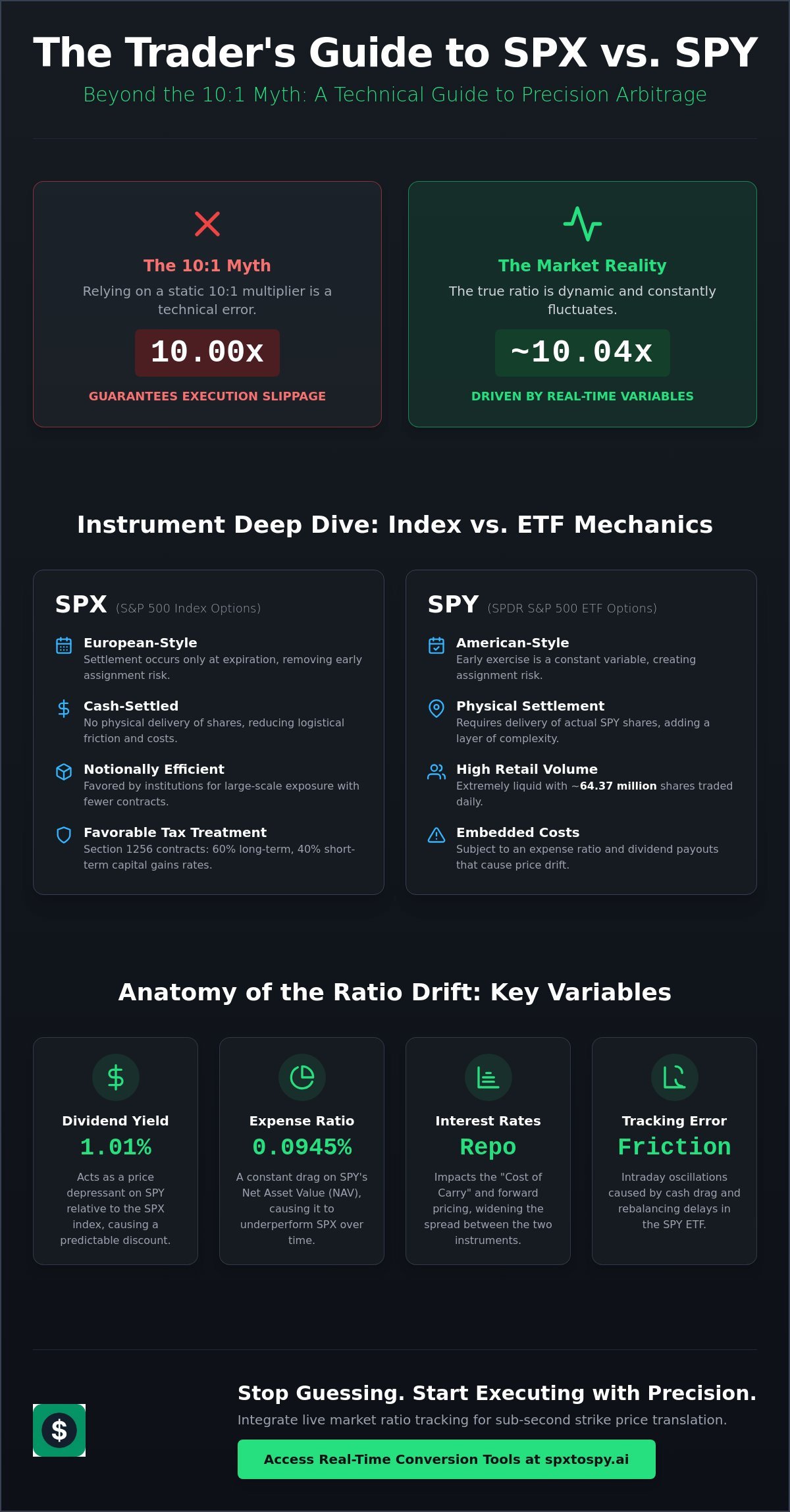
SPX options are European-style. Settlement occurs only at expiration. They are cash-settled based on the SET opening price. Section 1256 tax treatment applies; 60% long-term and 40% short-term capital gains rates. SPY options are American-style. Early exercise is a constant variable. Settlement requires physical delivery of shares. SPY carries an annual expense ratio of 0.0945%. Dividends yield approximately 1.01% to 1.02%. These factors cause the ETF price to drift from the index value. This drift creates the spread necessary for spx spy ratio arbitrage.
- SPX: Cash-settled. No early assignment risk. Favorable tax treatment.
- SPY: Physical settlement. Early exercise risk. Quarterly dividend impact.
- Settlement Friction: Cash settlement removes the logistical costs of share delivery.
The 10x Multiplier Benchmark
The nominal baseline is 10.00. One SPX contract represents ten times the notional value of one SPY contract. Market prices rarely align with this integer. Dividends and management fees erode the SPY net asset value (NAV) relative to the SPX index. Cash-settlement mechanics in SPX remove the friction of share delivery. High-frequency mapping requires monitoring the live ratio, not the static 10x approximation. The ratio functions as a fluid coefficient reflecting the cumulative impact of dividends, fees, and interest rates over time.
Tracking the deviation requires real-time data. A 5500 SPX strike does not always correlate to a 550 SPY strike. The actual ratio might sit at 10.04 or 9.98 depending on market conditions. Inaccurate mapping leads to mismatched strikes. This creates unintended directional exposure. Reliable execution depends on identifying the exact ratio at the millisecond of entry.
Mechanics of Ratio Deviation and Arbitrage
The “Cost of Carry” model defines the spread between SPX and SPY. This relationship is not a fixed 10:1 constant. It is a mathematical output of dividend yields, interest rates, and management fees. For 2026, the SPY dividend yield averages 1.01% to 1.02%. This yield acts as a price depressant on the ETF relative to the index. SPX is a pure price index; it doesn’t distribute dividends. Consequently, SPY trades at a discount to its 10x SPX equivalent to account for cash distributions held within the trust before payout. These structural drifts form the basis for spx spy ratio arbitrage.
The 0.0945% SPY expense ratio further erodes the net asset value (NAV) over time. Traders must quantify these drifts to identify when the market price deviates from theoretical fair value. Clinical accuracy in these calculations is the difference between a profitable hedge and a losing position. Execution requires monitoring these variables in real time to capture fleeting mispricings.
Variables Affecting the Ratio
Interest rates dictate the forward pricing of the index. The risk-free rate, often tied to the overnight repo rate, influences the cost of holding a position. Higher rates widen the spread between the spot index and the ETF. This occurs because the index reflects the future value of the basket, while the ETF reflects current holdings minus fees. Tracking error in the SPY ETF introduces additional noise. While the fund aims for replication, slight delays in rebalancing or cash drag during high-volatility periods cause the ratio to oscillate. Quarterly rebalancing cycles and monthly options expirations introduce predictable cyclicality. Monitoring these shifts requires live market ratio tracking to maintain execution accuracy.
- Dividend Yield: 1.01% to 1.02% impact on SPY NAV.
- Expense Ratio: 0.0945% annual drag on ETF pricing.
- Interest Rates: Forward pricing divergence based on repo rates.
- Tracking Error: Intraday oscillations from rebalancing friction.
Arbitrage Signal Identification
Signal detection relies on mean reversion. The 10x ratio serves as a long-term anchor, but intraday deviations provide scalping opportunities. When the ratio moves beyond two standard deviations from its short-term moving average, a mean reversion trade is signaled. Traders use these signals to determine strike mispricing. An overvalued SPX strike relative to its SPY counterpart allows for a delta-neutral spread. Precision is mandatory; a deviation of 0.02 in the ratio translates to significant price differences on high-notional SPX contracts. Successful execution depends on identifying these gaps before the market corrects the tracking error.
SPX to SPY Strike Mapping for Execution
Static mapping is a failure point in high-frequency environments. The common retail assumption of dividing SPX strikes by ten leads to significant delta misalignment. In 0DTE scalping, a deviation of 0.05 in the ratio represents a 2.5 to 5.0 point strike error on the SPY leg. This error invalidates the hedge and introduces unintended directional bias. Precise spx spy ratio arbitrage requires adjusting strike selection based on the live coefficient. You must account for the SEC Section 31 transaction fee of $20.60 per million, effective April 4, 2026, which impacts the net profit of high-notional conversions.
Delta and Gamma neutrality across these instruments isn’t a fixed state. Because one SPX contract has ten times the notional value of SPY, the hedging ratio must be dynamic. If the live ratio sits at 10.045, holding ten SPY contracts against one SPX contract leaves a residual delta of 0.045 per point of movement. In volatile sessions, this residual exposure compounds. Professional execution demands mapping to the strike that minimizes this residual delta while maintaining liquidity. Retail platforms like Robinhood offer high liquidity but lack the sophisticated mapping tools required for clinical accuracy.
Live Conversion Protocols
Execution begins with a three-step validation process. First, obtain the 6-second refreshed ratio to identify the current price relationship. Second, apply this ratio to your target SPX strike to find the theoretical SPY equivalent. Third, select the nearest liquid SPY strike that aligns with your risk parameters. For complex instruments, remember the Cboe SPXW fee effective April 1, 2026, which can range up to $4,000 daily depending on the volume of multi-leg structures created. Speed is the primary variable; manual calculation is not a viable strategy for 0DTE execution.
Precision Mapping Table
The impact of ratio drift is most visible when comparing mapping results at different coefficients. Consider an SPX target strike of 5600. At a nominal 10.00x ratio, the SPY equivalent is 560.00. If the live ratio shifts to 10.05x due to dividend pricing or repo rate changes, the equivalent SPY strike drops to 557.21. Mapping to the 560 strike in this scenario creates a 2.79 point over-valuation on the ETF leg. This discrepancy is even more pronounced for ITM (In-the-money) options where intrinsic value dominates. OTM (Out-of-the-money) mapping must prioritize Gamma stability to prevent rapid hedge erosion during price spikes. Accurate spx spy ratio arbitrage depends on this granular level of strike differentiation. Understanding SPX options strike price increments across standard 5-point and 25-point intervals is essential for selecting the nearest liquid strike without introducing residual delta exposure.
- 10.00x Ratio: SPX 5600 maps to SPY 560.
- 10.05x Ratio: SPX 5600 maps to SPY 557.21.
- Residual Risk: Unmapped strikes result in 2.79 points of unhedged exposure per contract.
- Platform Limitation: Retail brokers don’t automate this drift adjustment.
Risk Mitigation in High-Frequency Ratio Trading
Risk management in spx spy ratio arbitrage focuses on structural settlement differences and execution friction. Dual-leg arbitrage requires simultaneous fills across two distinct liquidity pools. Slippage on either leg invalidates the mathematical edge. SPY options carry American-style exercise rights; SPX options are European-style. This distinction creates asymmetric assignment risk. Managing these variables requires constant monitoring of strike parity and settlement windows. Functional efficiency depends on identifying these hazards before deploying capital.
Pin risk at expiration remains a critical variable. SPY options involve physical delivery of shares. A position pinned near the strike at 4:00 PM EST introduces overnight price risk. SPX options settle in cash based on the SET opening price or the PM closing index value. This removes share delivery logistics. Traders must calculate the break-even spread while accounting for the SEC Section 31 transaction fee of $20.60 per million. These costs compress margins in high-frequency environments. Use the live market ratio tracking tool to quantify these costs in real-time.
Assignment and Settlement Risks
Early assignment risk is specific to SPY. Deep ITM SPY puts are vulnerable during dividend weeks. If the dividend exceeds the remaining time value, early exercise is mathematically optimal for the holder. This forces the arbitrageur into an unintended long or short stock position. SPX’s cash-settled nature eliminates this risk. It provides a cleaner settlement path for 0DTE scalps. Traders must evaluate the SPX SPY Strike Equivalence to ensure the hedge remains intact during these high-risk windows. Settlement friction in SPY can lead to capital lock-ups that prevent immediate re-entry.
- SPY Assignment: High risk for ITM puts near ex-dividend dates.
- SPX Settlement: Cash-only. No physical share delivery.
- Pin Risk: SPY requires active management at the 4:00 PM close.
- Tax Status: SPX Section 1256 (60/40 rule) vs. SPY security status.
Technical Execution Hazards
Data latency is a primary execution hazard. A 1-second delay in ratio refresh leads to inaccurate strike mapping. In 0DTE markets, volatility spikes cause the SPX:SPY ratio to oscillate rapidly. Executing on stale data results in mismatched deltas. Broker-specific execution delays compound this issue. Retail platforms often prioritize order flow over sub-millisecond fill speed. Traders must account for the Cboe Complex Instrument Creation Fee, effective April 1, 2026. This fee scales based on the number of complex structures created. Success requires a clinical focus on these technical constraints. Reliability is the only metric for high-frequency performance. Familiarity with SPX options strike price increments and granularity shifts across expiration cycles reduces the latency introduced by manual strike selection during volatile sessions.
Real-Time Conversion for Market Execution
Execution speed determines profitability in spx spy ratio arbitrage. Manual strike mapping is an operational failure. Automated translation removes calculation latency. The 6-second refresh frequency ensures data currentness. Intraday scalping requires immediate strike price equivalence. You can’t rely on static charts or legacy spreadsheets during high-volatility events. The transition from SPX to SPY involves complex mathematical variables. These include the 1.01% dividend yield and the interest rate environment. Static 10x approximations lead to strike misalignment. Sub-second precision is the only defense against delta drift.
The clinical interface is designed for rapid scanning. Information is presented in a predictable, modular fashion. There is no linguistic fluff. The layout prioritizes functional efficiency over aesthetic engagement. Data points are delivered in quick, rhythmic bursts. This mirrors the pulse of a live data feed. Professional traders require objective data to make time-sensitive decisions. The SPX to SPY Converter acts as a silent, efficient digital assistant. It remains hyper-focused on the relationship between SPX and SPY. It never strays into broader market commentary. This reinforces its identity as a dedicated single-purpose utility.
Utilizing the SPX to SPY Converter
Input target SPX strikes into the system. Receive instant SPY equivalents. The algorithm applies the live market ratio coefficient. It incorporates the cumulative impact of the 0.0945% SPY expense ratio and the 1.01% dividend yield. Monitor the live ratio for deviation signals. These signals indicate when the 10:1 nominal baseline is invalid. Verify strikes before broker execution to prevent delta leakage. Precision is mandatory for 0DTE structures. The tool provides a transparent layer between the user and market variables. No definitions are provided. The user must understand market instruments before interaction. Functional accuracy is the priority.
- Automated Translation: Converts SPX strikes to SPY equivalents instantly.
- Live Market Ratio Tracking: Monitors deviations from the 10.00x nominal benchmark.
- 6-Second Refresh: Provides current data for high-frequency scalping.
- Strike Verification: Reduces the risk of inaccurate mapping on retail platforms.
Optimizing Scalping Efficiency
High-frequency environments demand reduced cognitive load. 0DTE markets move at sub-second intervals. Automated tools allow you to focus on order entry. Accuracy remains constant despite rapid price action. The system accounts for the SEC Section 31 transaction fee of $20.60 per million. It mitigates the risk of execution delays on retail platforms. Every second saved reduces the impact of slippage. Reliability is the primary metric for success. Inaccurate mapping results in unintended directional exposure. Clinical accuracy ensures your hedge remains delta-neutral in spx spy ratio arbitrage environments. Convert SPX to SPY Strikes Now for immediate execution mapping.
Institutional Execution Standards for 2026
Execution standards for 2026 require accounting for the 0.0945% SPY expense ratio and the 1.01% dividend yield. Static mapping is an operational risk. SEC Section 31 fee adjustments of $20.60 per million and Cboe complex instrument charges mandate clinical accuracy in break-even calculations. You’ve identified the structural divergence between cash-settled SPX and physically-settled SPY. Maintaining delta-neutral stability in high-frequency 0DTE environments depends on sub-second data refresh. Clinical mapping prevents unintended directional exposure during volatility spikes.
Efficiency in spx spy ratio arbitrage requires removing manual calculation friction. High-frequency environments demand technical precision for strike mapping to avoid gamma leakage. The clinical, ad-supported free utility provides 6-second data refresh rates for immediate intraday translation. Accuracy is the only metric for risk mitigation in liquid options markets. Reliability depends on the frequency of your data input. Execute with institutional precision.
Access Real-Time SPX to SPY Conversion Data
Frequently Asked Questions
Is the SPX to SPY ratio always 10 to 1?
No. The 10:1 ratio is a nominal baseline only. Real-time drift occurs due to the 0.0945% SPY expense ratio and quarterly dividend distributions. These factors cause the ETF price to deviate from the pure index value. Precise execution requires monitoring the live coefficient rather than assuming a static integer.
How does the SPX SPY ratio affect 0DTE options trading?
It dictates strike selection and delta neutrality. In 0DTE markets, sub-second ratio shifts cause strike price misalignment between the two instruments. Inaccurate mapping leads to unintended directional exposure. Traders use the current ratio to identify the exact SPY equivalent for an SPX target strike to maintain hedge integrity.
Why do traders arbitrage between SPX and SPY?
Traders exploit pricing inefficiencies in the cost of carry model. Successful spx spy ratio arbitrage captures deviations between the cash-settled index and the physically-settled ETF. This strategy also balances the Section 1256 tax advantages of SPX with the high retail liquidity and smaller contract size available in SPY.
What is the most accurate way to convert SPX strikes to SPY?
Automated conversion using live market ratio tracking is the most accurate method. Manual division by ten fails to account for intraday price drift. Digital converters apply a 6-second refreshed ratio to identify the precise ETF strike. This ensures clinical accuracy for high-frequency execution and complex multi-leg structures.
Does the SPY dividend affect the SPX SPY ratio?
Yes. Dividends depress the SPY price relative to the SPX index. SPY has a dividend yield of approximately 1.01% to 1.02%. Because SPX is a price index and doesn’t distribute cash, the ETF trades at a persistent discount to the 10x index baseline. This divergence is a primary driver of ratio volatility.
Can I use the SPX to SPY Converter for Robinhood trades?
Yes. The converter facilitates strike selection for any retail brokerage interface. Retail platforms like Robinhood don’t provide native ratio mapping tools. Using an external converter allows you to identify the correct SPY strike for execution based on institutional-grade data. This reduces the risk of mapping errors during fast-moving sessions.
What is the refresh rate of the SPX SPY ratio tracker?
The tracker refreshes every 6 seconds. This frequency supports the requirements of intraday scalping and 0DTE execution. High-frequency updates are necessary to maintain accuracy during volatility spikes. Stale data results in inaccurate strike mapping and increased slippage costs during dual-leg arbitrage entries.
Are SPX options safer than SPY for arbitrage?
Safety is defined by settlement and tax parameters. SPX options are European-style and cash-settled, removing early assignment risk. SPY options are American-style and physically settled, introducing pin risk and early exercise hazards. While SPX offers cleaner settlement, SPY provides higher liquidity for smaller position sizes. Risk mitigation depends on your specific execution environment.