Static 10:1 multipliers for spx puts to spy puts conversion are functionally obsolete in high-gamma 0DTE environments. Relying on fixed ratios ignores dynamic intraday basis deviations between the S&P 500 index and the SPY ETF. Strike price slippage is the direct result of manual calculation lag. Precise mapping is a technical requirement for maintaining risk parity and avoiding liquidity mismatches across execution platforms.
Accurate strike selection requires real-time data integration to counter volatility-induced errors. This technical brief establishes the framework for precision SPX-to-SPY mapping using verified market ratios and structural analysis. The following sections detail exact strike price conversion, ratio deviation triggers, and optimized execution workflows for Robinhood and Thinkorswim. The objective is functional efficiency through data-centric mapping protocols.
Key Takeaways
- Execute precise spx puts to spy puts conversion by accounting for dynamic basis deviations rather than relying on static 10:1 approximations.
- Leverage SPX structural advantages within retail account constraints by mapping positions to liquid SPY equivalents.
- Evaluate the impact of Section 1256 tax treatment and cash settlement mechanics on cross-instrument strike selection.
- Implement a standardized two-step protocol to identify target strikes and integrate live SPX:SPY ratios for immediate execution.
- Eliminate manual calculation errors during high-volatility 0DTE windows using automated converters with 6-second refresh intervals.
Why Convert SPX Puts to SPY Equivalents?
Execution logic dictates instrument selection based on liquidity, account size, and platform access. Institutional flow typically originates in SPX due to its cash-settled nature and favorable tax treatment. Retail traders often lack direct access to SPX options on specific platforms like Robinhood. Consequently, spx puts to spy puts conversion becomes a functional necessity for mirroring institutional hedges or managing delta exposure within smaller capital pools. Precise mapping ensures that the risk profile remains consistent across different instruments.
Hedging and Speculation Dynamics
Traders utilize SPY puts to protect portfolios benchmarked against the S&P 500 index. Institutional hedging via stock market index options relies on the large notional value of the SPX. Retail participants must translate these institutional data points into physically settled SPY equivalents to manage margin requirements effectively. Standard SPX contracts control approximately $500,000 in notional value when the index is at 5,000. SPY contracts control $50,000. This 10:1 notional difference allows retail accounts to scale positions without over-leveraging.
- Capital Efficiency: SPY allows for granular position sizing in accounts under $25,000.
- Platform Availability: Many mobile-first brokerages do not support index options, requiring a conversion to ETF-based puts.
- Liquidity Management: SPY often provides tighter bid-ask spreads for smaller order sizes during high-volatility sessions.
The Need for Precision in Put Selection
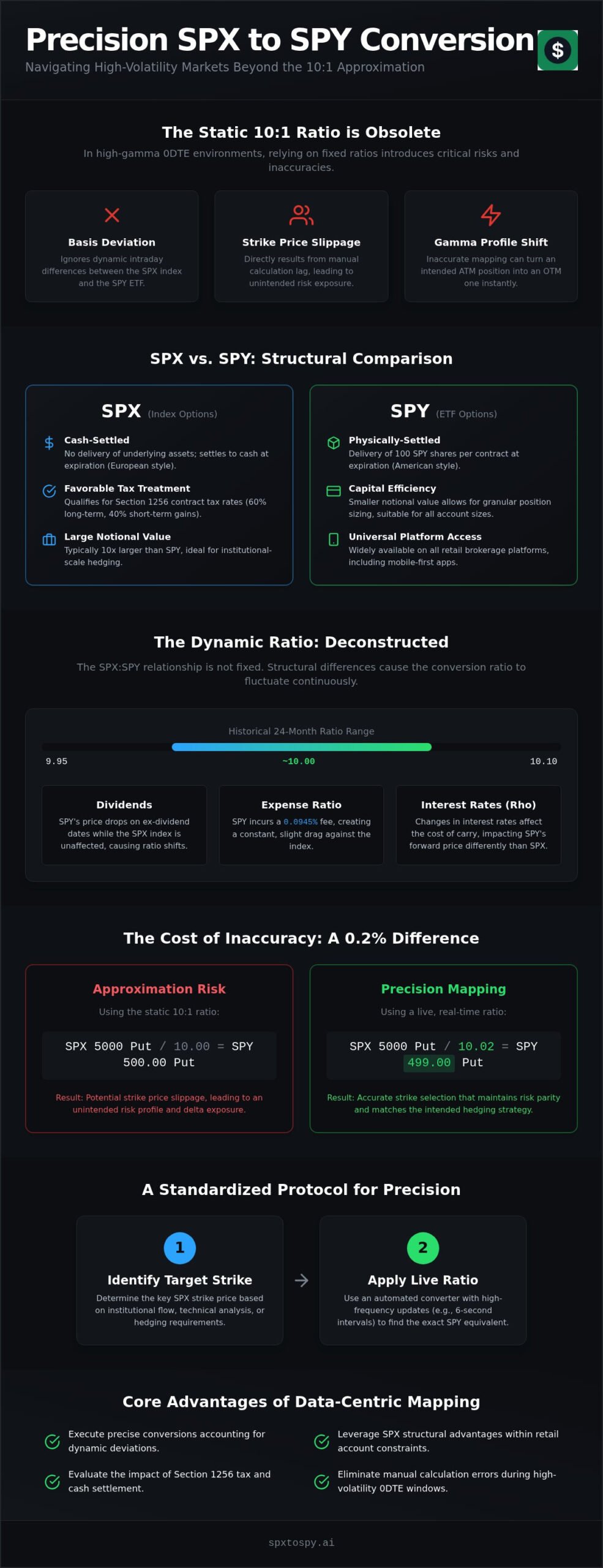
Approximate 10:1 ratios create strike price slippage. A 4,500 SPX strike doesn’t always correlate perfectly to a 450 SPY strike. Tracking errors occur due to SPY’s dividend yield and expense ratio. These variables cause the SPX:SPY ratio to fluctuate intraday. Relying on a fixed multiplier during fast market moves leads to inaccurate delta exposure. Spx puts to spy puts conversion must account for these dynamic basis deviations to maintain technical accuracy.
Inaccurate mapping shifts the gamma profile of the position. Execution of an “out-of-the-money” put that was intended to be “at-the-money” results in immediate theta decay and reduced vega exposure. High-frequency 0DTE strategies demand exact strike matching. Even a 0.1% deviation in the ratio can result in selecting a strike that is 1-2 points off on the SPY chain. Precision is the difference between a functional hedge and an unhedged loss. Manual calculation lag increases the risk of entering trades at stale prices.
The Mathematical Ratio: Why 10:1 is an Approximation
Precision spx puts to spy puts conversion requires moving beyond the 10:1 heuristic. This constant assumes absolute parity that doesn’t exist in live markets. SPY’s a tradable trust. It incurs an expense ratio of 0.0945% and accumulates dividends. SPX is a mathematical index. These structural differences ensure the ratio’s a dynamic variable rather than a fixed integer. Static multipliers ignore these variables, leading to execution errors during high-volatility sessions.
Dividends drive ratio drift. When SPY goes ex-dividend, the ETF price drops by the dividend amount. The SPX index remains unaffected. This event shifts the conversion factor instantly. Rho, or interest rate sensitivity, also impacts the relationship. High-interest environments increase the cost of carry for underlying holdings. This affects the forward price of SPY differently than the cash index. Reviewing SPX contract specifications confirms that while the multiplier’s fixed at $100, the underlying price relationship isn’t. Interest rate fluctuations change the forward pricing curve. As rates rise, the gap between the spot price and the future price of the index widens. SPY options price in the physical storage of ETF shares. SPX options are cash-settled. This difference in settlement mechanics creates a wedge in the conversion ratio.
The historical range of the SPX:SPY ratio has fluctuated between 9.95 and 10.10 over the last 24 months. A 0.05 deviation represents a 5-point difference on a 5,000-level index. Traders ignoring this variance accept unnecessary basis risk. Functional mapping requires accounting for the current cost of carry and dividend projections. Use a live ratio tracker to verify strike equivalents before order entry.
Intraday Ratio Fluctuations
Volatility spikes expand the spread between the index and the ETF. Arbitrageurs close these gaps, but execution lag persists during high-gamma events. Real-time accuracy depends on monitoring the live spx spy ratio throughout the trading session. Tracking error between SPX and SPY currently manifests as a 0.05% to 0.15% deviation from the theoretical 10:1 parity depending on the dividend cycle.
Decimal Precision in Strike Mapping
Rounding errors compound. Converting an SPX 5800 put using a 10.02 ratio yields a 578.84 target. An SPX 5800 put at a 9.98 ratio yields 581.16. Selecting a 580 strike in the first scenario creates a delta mismatch. For large positions, these errors result in significant capital misallocation. Precise spx puts to spy puts conversion eliminates this risk by mapping to the nearest liquid strike based on the actual market ratio. Automated mapping tools provide the necessary precision for high-frequency execution. The SPX SPY strike mapping tool delivers the zero-latency data refresh required to prevent these decimal-level errors during live trading sessions.
SPX Puts vs. SPY Puts: Structural Comparison
Instrument structure dictates risk management protocols. SPX options are Section 1256 contracts. This designation applies a 60/40 tax rule. 60% of gains are taxed at long-term capital gains rates. 40% are taxed at short-term rates. SPY options follow standard equity taxation where the holding period determines the rate. Traders executing spx puts to spy puts conversion must factor in this post-tax yield variance. Section 1256 status for SPX is independent of holding duration. This provides a structural advantage for active traders compared to SPY’s short-term capital gains rates for positions held under one year.
Settlement and Assignment Risk
Settlement mechanics differ fundamentally. SPX uses cash settlement. No shares change hands at expiration. SPY requires physical delivery. Assignment results in the transfer of 100 shares per contract. SPX is European-style. Exercise occurs only at expiration. SPY is American-style. Early assignment is a constant variable for sellers. Review the SPX vs SPY Settlement Difference: Technical Comparison for Traders (2026) for detailed risk parameters. Retail accounts lacking margin for share delivery must prioritize cash-settled instruments or manage SPY positions aggressively before expiration.
Contract Multipliers and Notional Value
Notional exposure determines capital allocation. One SPX contract has a $100 multiplier. At an index level of 5,800, the notional value is $580,000. One SPY contract represents 100 shares. At a price of $580, the notional value is $58,000. Spx puts to spy puts conversion requires a 10-contract SPY position to mirror a single SPX contract. Bid-ask spreads on SPY are typically tighter in absolute terms. However, cumulative commission costs on 10 SPY contracts often exceed the single-contract SPX fee. Balance execution precision against transaction drag.
Liquidity profiles vary by volume and strike density. SPY offers $1 strike intervals. SPX typically utilizes $5 intervals. SPY’s granular chain allows for tighter delta targeting. Bid-ask spreads in SPY often sit at $0.01 for at-the-money puts. SPX spreads are wider, frequently $0.10 to $0.50, but represent 10x the notional value. Effective spread costs are comparable when adjusted for contract size. Physical delivery in SPY introduces pin risk. SPX eliminates this through cash settlement based on the SET opening print or 4:00 PM closing value depending on the series. European-style SPX puts protect against early assignment during volatile price swings. This is critical for credit spread sellers. American-style SPY puts allow for immediate exercise but expose sellers to dividend-related assignment risk.
Protocol for Converting SPX Puts to SPY
Technical mapping requires a standardized workflow to eliminate execution lag. Precise spx puts to spy puts conversion ensures that the intended delta exposure is maintained when transitioning between index and ETF instruments. Systematic mapping depends on a high-frequency data feed to prevent strike selection errors. This process isn’t a one-time calculation but a continuous adjustment protocol. Traders must synchronize strike selection with the live index value to avoid entering positions with unintended moneyness.
- Step 1: Identify Target SPX Strike: Select the SPX put strike based on technical resistance levels or institutional order flow data.
- Step 2: Retrieve Live Ratio: Access the current SPX:SPY basis. This value typically fluctuates between 9.95 and 10.10.
- Step 3: Calculate SPY Midpoint: Divide the SPX strike price by the live market ratio to determine the exact theoretical SPY equivalent.
- Step 4: Select Nearest Liquid Strike: Compare the calculated midpoint to the SPY option chain. Identify the strike with the highest open interest and tightest bid-ask spread near that value.
Manual Calculation Formula
The primary formula for conversion is: SPY Equivalent = SPX Strike / Current Market Ratio. For example, an SPX 5925 strike divided by a 10.015 ratio results in a 591.61 SPY target. Traders must then choose between the 591 or 592 SPY put strike. In-the-money (ITM) deltas require higher precision to maintain intrinsic value parity. Out-of-the-money (OTM) selections focus on vega and gamma exposure. If the calculated midpoint falls between strikes, rounding toward the higher delta strike increases protection but raises the premium cost. Verify these outputs against the Index Options Strike Price Converter to ensure alignment with real-time market data.
0DTE Execution Specifics
0DTE scalping introduces extreme gamma sensitivity during the final hour of trading. Strike mapping must occur within seconds of the price move to capture rapid premium expansion. Manual calculation in high-volatility environments carries significant risk. Price fluctuations between the index and the ETF cause the ratio to shift by several basis points in minutes. The SPY Calculator: Precision SPX Strike Price Conversion for 0DTE Traders provides the required speed for these environments. Tracking error, currently averaging 0.05% to 0.15%, makes a static 10.00 divisor obsolete for 0DTE execution. Accuracy is mandatory for maintaining the intended risk-reward profile. Map your strikes instantly using the Real-Time SPX to SPY Strike Price Converter.
Real-Time Conversion with SPX to SPY Utility
Functional efficiency in spx puts to spy puts conversion depends on data latency. Manual calculations introduce human error and execution delay. Automated mapping protocols eliminate these variables. The SPX to SPY Converter utilizes a 6-second refresh interval to maintain strike price accuracy during high-velocity market phases. Direct mapping of SPX put strikes to liquid SPY counterparts ensures risk parity across platforms. This tool functions as a precision instrument for traders navigating the spread between index and ETF pricing. Verify all strike outputs with your broker’s order entry system before final execution. Data accuracy is a technical requirement for maintaining the intended delta profile.
High-frequency data feeds are essential for 0DTE strategies. Ratio drift occurs constantly as the underlying index moves. A 10:1 approximation fails when the market ratio shifts to 10.02 or 9.98. These minor deviations result in selecting incorrect strikes on the SPY chain. Automated conversion prevents this slippage. The utility provides a clinical, objective data point for immediate action. It removes the need for mental arithmetic during fast market moves. Reliability is established through the frequency of data updates and the focus on the specific SPX:SPY relationship.
Tool Features for Day Traders
Precision entry requires constant ratio monitoring. The converter provides live ratio tracking to identify basis deviations instantly. A minimalist interface facilitates rapid scanning during peak market hours. Traders can access the SPX SPY Ratio Tool Online: Technical Reference for Real-Time Strike Mapping for technical alignment. Functional design prioritizes speed over aesthetic complexity. The layout is modular. Information is presented in a predictable format. This allows for instant processing of current market variables. There’s no linguistic fluff. The output is purely data-centric.
Optimizing Trade Workflow
Integrate the converter into the primary trading workspace. Position the utility adjacent to the option chain for immediate reference. This configuration reduces cognitive load and latency in decision-making. 0DTE put scalping demands sub-second strike identification. Maintaining consistency in cross-instrument strategies requires a single source of truth for ratio data. Spx puts to spy puts conversion becomes a streamlined process when automated. Data-centric workflows replace speculative approximations. Use the spx spy strike mapping tool to verify the current SPY equivalent of institutionally traded SPX strikes. This ensures that retail execution matches institutional intent. The objective is total functional alignment between the two instruments.
Optimized Strike Mapping Protocols
Technical risk management requires transitioning from static heuristics to dynamic data integration. Precise spx puts to spy puts conversion eliminates the tracking errors inherent in fixed 10:1 multipliers. Structural parity between index and ETF instruments is maintained through continuous ratio monitoring. Active traders must prioritize functional accuracy to avoid strike slippage during high-gamma 0DTE events. Relying on stale data points compromises the integrity of the hedge. Precise mapping ensures that the intended delta and gamma profiles remain intact across execution platforms.
Manual calculations introduce unacceptable latency in fast-moving markets. Use a dedicated utility to synchronize strike selection with live market variables. Access the Real-Time SPX to SPY Converter for immediate technical mapping. This free technical utility provides a 6-second refresh interval for maximum 0DTE precision. It’s designed for high-frequency environments where strike accuracy is mandatory. Maintain total execution control through verified data feeds. Functional efficiency is the primary driver of professional trading performance. Precision mapping yields consistent execution results.
Frequently Asked Questions
How do I convert an SPX put strike to SPY?
Divide the target SPX strike price by the current live market ratio. Select the nearest liquid strike on the SPY option chain based on the calculated midpoint. Precise mapping requires real-time ratio tracking to account for intraday basis deviations.
Is the SPX to SPY ratio always 10 to 1?
No. The 10:1 ratio is a theoretical approximation. Actual market ratios fluctuate between 9.95 and 10.10. Variables include SPY dividend yields, expense ratios, and interest rate carry costs. Static multipliers lead to strike selection errors.
Why do traders use SPX puts instead of SPY puts?
SPX options offer Section 1256 tax treatment with a 60/40 capital gains split. Cash settlement eliminates the requirement for share delivery at expiration. European-style exercise removes the risk of early assignment for option sellers.
What is the best tool for SPX to SPY strike conversion?
The Real-Time SPX to SPY Strike Price Converter is the standard utility for active traders. It features a 6-second refresh interval for high-frequency data accuracy. It’s specifically designed for 0DTE precision and strike mapping.
Does the SPX:SPY ratio change during market hours?
Yes. Intraday volatility and tracking error cause the ratio to shift constantly. Real-time monitoring is required to maintain risk parity. Manual calculations become obsolete during high-gamma market events due to calculation lag.
Can I trade SPX options on Robinhood?
No. Robinhood does not support index options. Traders must execute spx puts to spy puts conversion to gain S&P 500 exposure on that platform. Precise mapping ensures that the SPY position mirrors the intended SPX risk profile.
How does the SPY dividend affect strike price conversion?
Ex-dividend events lower the SPY price relative to the SPX index. This shift expands the conversion ratio away from 10.00. Precise spx puts to spy puts conversion must account for this dividend drag to prevent selecting the wrong strike.
What happens if I hold an SPX put through expiration?
Positions are cash-settled based on the difference between the strike and the settlement value. Net profits are credited to the account; losses are debited. No shares of the underlying index change hands. This eliminates physical delivery risk.