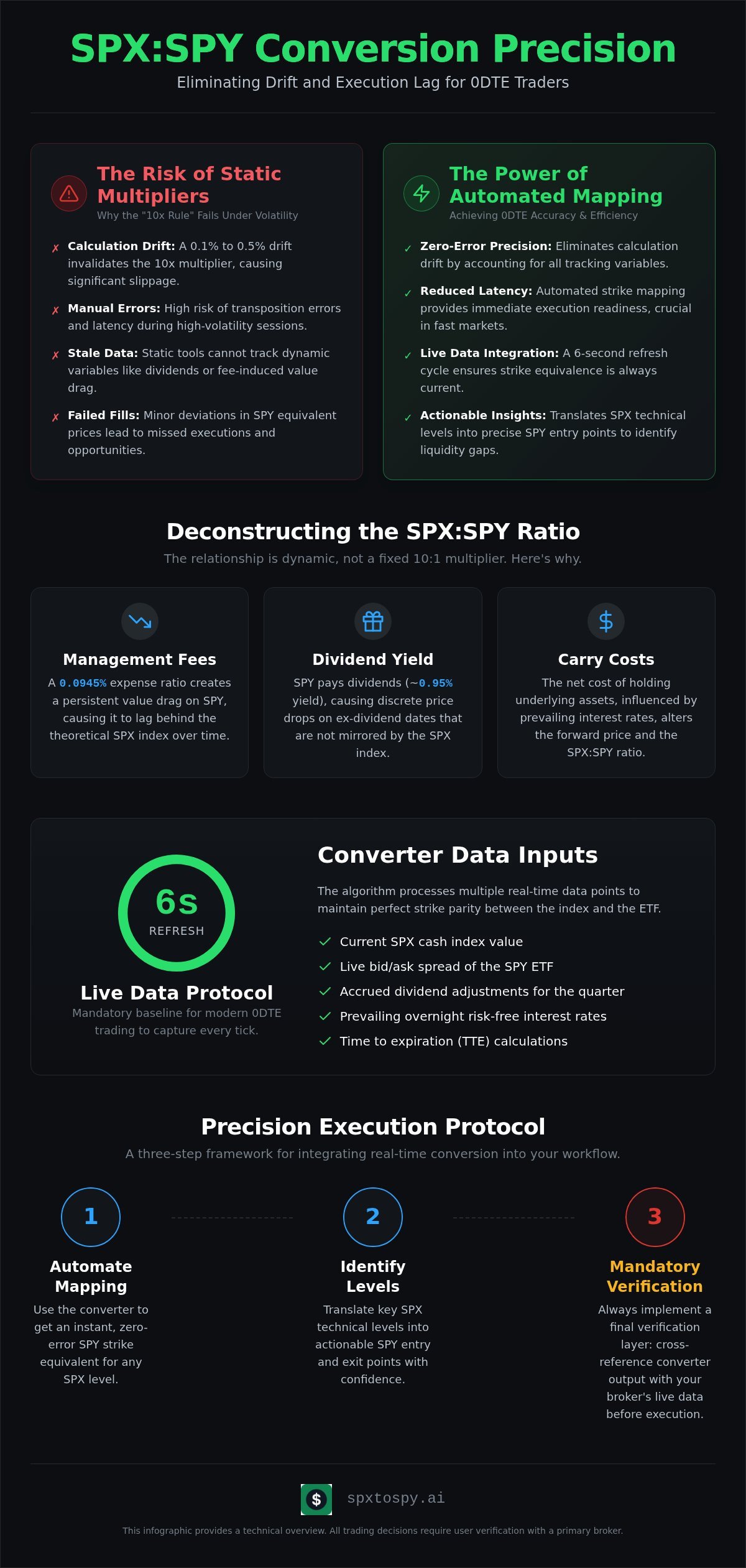
A 0.5% drift in the SPX:SPY ratio invalidates standard 10x calculations during high-volatility sessions. Traders frequently encounter slippage due to manual errors or stale conversion data. This spy spx price converter serves as a precision instrument to eliminate these technical failures. It provides a purely functional mapping utility designed for 0DTE accuracy and immediate execution readiness. You recognize that dividend-induced shifts and management fees create a dynamic relationship that static tools cannot track.
This resource delivers zero-error strike mapping through a six-second data refresh cycle. We provide the technical parameters for converting SPX strikes to SPY equivalents with absolute precision. This guide covers the impact of the current 0.95% dividend yield on carry rates, the application of Section 1256 tax benefits for 2026, and the necessity of real-time ratio tracking. All strike price outputs require user verification with a primary broker before execution. The focus remains on data-centric utility and functional efficiency for the active market participant.
Key Takeaways
- Eliminate the 0.1-0.5% calculation drift caused by static 10x multipliers by accounting for current dividend yields and tracking error variables.
- Reduce execution latency and transposition risks during high-volatility sessions through automated strike price mapping.
- Utilize the spy spx price converter to maintain precise strike equivalence with a six-second data refresh protocol.
- Identify liquidity gaps and translate SPX technical levels into actionable SPY entry points with professional-grade accuracy.
- Implement a mandatory verification layer by cross-referencing real-time converter outputs with broker data prior to final trade execution.
Eliminating Execution Lag with Real-Time Price Conversion
Strike mapping is the technical cornerstone of S&P 500 derivative parity. It requires the precise translation of cash index values into actionable ETF strike levels. High-frequency trading environments leave no room for approximation or manual delay. A spy spx price converter provides the necessary data layer for rapid decision-making. Limit order placement relies on exact price points. Even a three-cent deviation in the SPY equivalent results in failed fills during high-velocity market moves. Fill rates decline when traders rely on stale or rounded conversion data. Operational efficiency depends on real-time data integration. It must account for current market spreads and intraday volatility. Precision determines the difference between a captured profit and a missed execution window.
The 10x Multiplier Myth
The 10x multiplier is a dangerous structural simplification. The SPDR S&P 500 ETF Trust (SPY) is a tradable security subject to active market mechanics. In contrast, the SPX is a theoretical benchmark. Management fees of 0.0945% create a persistent value drag. Dividend distributions further decouple these two instruments over time. Static conversion factors fail to track these dynamic variables. Quantitative risks include selecting strikes that are technically out-of-the-money despite perceived index proximity. A ratio drift of only 0.1% translates to a significant error on a high-value index. Precision mapping ensures the chosen strike reflects the true market relationship. Reliable utilities track the dynamic spread between the cash index and the trust without manual intervention.
Time-Sensitivity in 0DTE Option Strategies
0DTE trading requires absolute mathematical accuracy. Delta-neutral positioning shifts with every index tick. Stale ratios lead to incorrect strike ladders and failed hedging. A six-second refresh rate is the mandatory baseline for modern day trading. It captures the 0.95% dividend yield impact on carry rates instantly. Automated strike translation removes the high probability of human transposition errors. This spy spx price converter allows for rapid mobile and desktop scanning. Traders identify liquidity gaps between the index and the ETF without calculation lag. Rapid execution readiness is compromised by manual latency. The utility acts as a transparent layer for strike selection. Maintain a risk-aware stance. Verify all mapping data against live broker quotes. Precision is the primary defense against execution slippage during volatile sessions.
Mechanics of the SPX:SPY Ratio: Beyond the 10x Multiplier
Nominal 10:1 ratios ignore structural tracking errors. The mathematical relationship is a function of net asset value minus management drag and accrued distributions. Intraday mean reversion occurs as arbitrageurs normalize the spread during high-volume windows. Using a spy spx price converter ensures these variables are integrated into the strike mapping process. Precise strike selection requires accounting for the expense ratio that creates persistent tracking lag between the ETF and the cash index. The ratio is approximately 1/10th of the index value but remains non-fixed due to active market mechanics.
Dividend Impact on ETF Valuation
SPY dividend yield is verified at approximately 0.95% as of June 2026. Ex-dividend dates trigger discrete price drops in the ETF. These movements are not mirrored by the SPX index. This mechanical shift temporarily widens the conversion gap. Traders must adjust SPX strike expectations during quarterly distribution cycles to avoid selecting non-equivalent strikes. Quarterly distribution cycles often result in a 0.2% to 0.4% divergence from the nominal 10x multiplier. This deviation is significant for 0DTE scalpers targeting tight profit targets. Real-time mapping compensates for this distribution-induced drift.
Carry Costs and Interest Rate Variables
Risk-free rates dictate the forward price of the index. Carry costs represent the net cost of holding the underlying assets. This calculation subtracts dividends from the prevailing interest rate. Sudden Fed rate pivots alter the SPX:SPY ratio by changing these carry requirements. Live conversion algorithms utilize this computational logic to maintain strike parity. High-frequency scalping requires strike mapping that reflects current interest rate environments.
The algorithm processes several data points to maintain parity:
- Current SPX cash index value.
- Live bid/ask spread of the SPY ETF.
- Accrued dividend adjustments for the current quarter.
- Prevailing overnight risk-free interest rates.
- Time to expiration (TTE) for the specific option series.
Intraday volatility creates temporary ratio dislocations. High-volume sessions force the ratio back toward its technical mean through institutional arbitrage. Mapping must remain dynamic to capture these shifts. Static calculations fail during rapid price discovery phases. Ratio compression often occurs during the final hour of trading. Market makers delta-hedge their positions. This creates a predictable mean reversion pattern. Traders must monitor this for precise entry. Strike mapping is a continuous calculation. It’s not a one-time adjustment. Professional traders use a spy spx price converter to ensure data accuracy during these critical periods.
Risks of Manual Strike Mapping in High-Volatility Environments
High-volatility sessions increase cognitive load. Manual strike mapping introduces transposition errors. Transposition risk spikes during rapid price discovery phases. A spy spx price converter mitigates these operational failures. Latency arbitrage occurs when manual calculation delays prevent optimal fills. Retail traders often miss entry windows due to calculation lag. Market makers utilize algorithmic speed to exploit these delays. Stale conversion ratios lead to incorrect limit price settings. Fill rates drop as the underlying moves away from the calculated strike. Operational risk management requires automated parity tracking.
Manual mapping risks include:
- Incorrect decimal placement during rapid index moves.
- Failure to account for the 0.0945% SPY expense ratio drag.
- Inaccurate strike selection for 0DTE credit spreads.
- Negative slippage due to multi-second calculation latency.
- Asymmetrical risk profiles in delta-neutral strategies.
Arithmetic Errors in Fast Markets
Decimal placement mistakes occur frequently during fast markets. A single digit error invalidates strike parity. “Close enough” mapping results in failed multi-leg executions. Broken wing butterfly strategies require exact strike intervals. A 1-point strike error in SPX options represents a $100 notional deviation per contract. This compounding effect destroys expected P&L on high-leverage spreads. Professional execution requires zero-error strike translation. Multi-leg strategies amplify the financial impact of a single mapping mistake. Four-leg iron condors become asymmetrical and unhedged. Precise mapping is a mandatory requirement for capital preservation.
Stale Data and Ratio Deception
Stale premium data from non-refreshing web tables creates ratio deception. Using “Last Close” ratios for intraday 0DTE trading is technically reckless. Intraday ratios fluctuate based on the 0.0945% expense ratio and the 0.95% dividend yield impact. Market makers exploit retail traders who use outdated conversion metrics. Reliable mapping requires a six-second refresh protocol. Access 0DTE SPX SPY Ratio: Real-Time Precision for technical details on ratio stability. This spy spx price converter ensures strike equivalence matches current market conditions. Verify all outputs with live broker quotes before submission. Seconds lost in manual calculation allow market-making algorithms to adjust bid-ask spreads. This results in negative slippage. The delay between index level identification and ETF strike selection must be minimized. Manual processes cannot compete with the 6-second refresh rate of a dedicated utility.
Strategic Strike Selection Using Live SPY Equivalent Metrics
Technical execution requires a systematic workflow for level translation. Traders identify SPX price targets using institutional order flow or volume profile analysis. Translating these levels into SPY trade entries necessitates a real-time spy spx price converter. The process involves inputting the target SPX strike to receive the current SPY equivalent, adjusted for the 0.0945% expense ratio. This protocol ensures that limit orders reside at mathematically sound levels. It prevents “chasing” price action based on rounded 10x estimates. Precise mapping allows for the optimization of credit spread widths. Traders maintain consistent risk to reward ratios across both instruments by verifying strike parity every six seconds.
Workflow for cross-instrument hedging:
- Identify SPX long exposure delta.
- Input SPX downside targets into the mapping utility.
- Select equivalent SPY put strikes for protective positioning.
- Verify bid-ask spreads for cost-efficient execution.
Mapping Technical Support and Resistance
Psychological levels in the SPX often cluster at round numbers like 5000 or 5500. These don’t map to exact round numbers in SPY due to dividend-induced drift. Identifying “off-ratio” opportunities allows for more precise entry. Mapping support and resistance requires a 9:30 AM EST protocol. Traders must update conversion metrics at the open to account for overnight funding shifts. This spy spx price converter provides the necessary granularity for these adjustments. Access the real-time conversion utility to establish baseline levels before the opening bell.
Arbitrage and Liquidity Analysis
Comparing bid-ask spreads reveals liquidity advantages. SPX options offer superior tax treatment under Section 1256 contracts. However, SPY often provides tighter spreads during low-volume periods. Conversion metrics help determine the most cost-effective venue. Technical differences in settlement also influence instrument selection. Review the SPX vs SPY Settlement Difference to understand how cash settlement versus physical delivery impacts your strategy. Liquidity gaps between equivalent strikes signal arbitrage potential. Institutional traders monitor these dislocations to capture micro-spreads. Mapping accuracy remains the primary requirement for successful cross-instrument execution. Stale data results in negative slippage and failed parity trades.
SPX to SPY Converter: Operational Specifications and Data refresh
Operational efficiency requires high-frequency data updates. This spy spx price converter utilizes a strict six-second refresh protocol. Rapid ratio tracking ensures strike parity during high-volatility sessions. The system supports bidirectional conversion. Traders translate SPX index levels to SPY strike prices or reverse the calculation as needed. This bidirectional functionality facilitates complex cross-instrument hedging and liquidity arbitrage analysis. Mathematical precision is maintained through continuous monitoring of the SPX:SPY relationship. All outputs are provided as a free utility supported by display advertising. It’s essential to maintain a risk-aware stance. Users must verify all strike mapping data with their primary broker before executing any trades. Risk management protocols demand independent verification of all automated outputs to prevent execution errors.
- Six-second data refresh rate for intraday accuracy.
- Real-time ratio tracking for 0DTE precision.
- Bidirectional SPX/SPY conversion functionality.
- Minimalist interface optimized for rapid mobile scanning.
Technical Architecture and Refresh Frequency
Sub-10-second updates are mandatory for the 2026 market environment. Market makers adjust bid-ask spreads in milliseconds. Stale data results in immediate execution failure or significant negative slippage. The technical architecture prioritizes low-latency browser performance for professional use. It bypasses heavy graphical assets to ensure rapid rendering on both mobile and desktop devices. Data sourcing involves direct feeds from underlying index values and current ETF price points. The algorithm calculates the dynamic ratio by accounting for current dividend yields and tracking errors. This prevents the 0.1% to 0.5% drift typical of static 10x multipliers. High-frequency scalpers require this level of technical granularity for 0DTE strategies. Reliability is the primary metric for tool performance in fast-moving sessions.
User Interface for Active Traders
The user interface features a modular design for maximum functional efficiency. It’s optimized for side-by-side use with professional trading platforms and live order books. Utilitarian layouts eliminate unnecessary cognitive load during high-stress trading periods. There are no distracting feature-heavy portals or peripheral market commentary to slow down the user. The focus remains strictly on strike mapping and real-time ratio tracking. Rapid scanning is facilitated through a repetitive, formulaic layout where data points are prioritized. Information is presented in predictable, modular blocks. This design caters to users who need to process data instantly and move on to the next task. It removes linguistic fluff and marketing hyperbole. Access the Real-Time SPX to SPY Converter to initiate strike mapping for the current session. The utility acts as a silent digital assistant for precise execution readiness. Constant motion in the live data feed mirrors the pulse of the market. Functional efficiency is prioritized over emotional engagement.
Precision Execution and Strike Parity Protocols
Strike mapping accuracy is the primary requirement for successful S&P 500 options execution. Static 10x multipliers ignore the 0.0945% SPY expense ratio and the 0.95% dividend yield impact on carry rates. This spy spx price converter eliminates calculation drift by providing dynamic ratio tracking for active traders. It functions as a precision instrument to reduce manual transposition errors and latency arbitrage during high-volatility sessions. The utility features a no-fluff clinical interface optimized for rapid mobile and desktop scanning. Ratios refresh every six seconds to maintain data integrity for 0DTE strategies. It’s a 100% free technical utility that acts as a transparent data layer between the cash index and the tradable ETF. Operational risk management requires that users verify all strike price outputs with their broker before final execution. Rapid decision-making depends on real-time parity data. Maintain a risk-aware stance and prioritize functional efficiency in every trade entry. Ensure execution precision in every session.
Convert SPX to SPY Strikes in Real-Time
Frequently Asked Questions
Why is the SPX to SPY ratio not exactly 10 to 1?
Structural differences between the cash index and the ETF cause this deviation. SPY has a gross expense ratio of 0.0945% and a dividend yield of 0.95% as of June 2026. These variables create persistent tracking lag. Management fees and distribution cycles cause the ratio to deviate from the nominal 10x multiplier. Intraday volatility and carry costs further decouple these instruments. Precise mapping requires accounting for these dynamic variables rather than using static estimates.
How often does the SPX to SPY converter refresh its data?
The system utilizes a six-second refresh protocol. This frequency is mandatory for the 2026 high-frequency market environment. Rapid updates ensure ratio accuracy during price discovery phases. Sub-10-second cycles are critical for maintaining strike parity in volatile sessions. This spy spx price converter prioritizes low-latency data delivery. Constant motion in the live feed mirrors the pulse of the underlying market. Functional efficiency remains the primary metric for data refresh. It serves as a precision instrument.
Can I use this tool for 0DTE options strike mapping?
This utility is specifically designed for 0DTE and day trading precision. Zero-day strategies require absolute strike equivalence to maintain delta-neutral positioning. The six-second refresh rate captures intraday ratio shifts instantly. Traders identify liquidity gaps and translate technical levels into actionable entries. Precise mapping reduces slippage in fast-moving environments. It acts as a transparent layer for strike selection during zero-day sessions. Independent verification with a broker is mandatory before execution. Data accuracy is the cornerstone of success.
Does the converter account for SPY dividend distributions?
Yes. The algorithm integrates current dividend yield data into its mathematical derivation. SPY has a verified dividend yield of approximately 0.95% as of June 2026. Ex-dividend dates trigger discrete price drops in the ETF not mirrored by the SPX index. The converter compensates for this distribution-induced drift. It ensures the strike mapping reflects the real ratio rather than a nominal index value. Tracking these quarterly shifts is essential for strike parity. Precision mapping accounts for all underlying fund distributions.
Is there a difference in tax treatment between SPX and SPY options?
SPX options are classified as Section 1256 contracts. This designation provides a 60/40 tax split. 60% of gains are taxed at long-term rates and 40% at short-term rates. The blended rate is approximately 26.8% for the 2026 tax year. SPY options are taxed at standard short-term rates if held for less than one year. Traders use a spy spx price converter to map strikes while optimizing for these tax advantages. This results in significant capital efficiency.
Why should I verify strike prices with my broker after using a converter?
Broker verification is a mandatory risk management protocol. The converter is a free technical utility provided for reference. Execution platforms have proprietary data feeds and bid-ask spreads. Discrepancies may occur due to local latency or specific broker calculation logic. Direct trade execution is not supported by this tool. Independent verification prevents transposition errors and ensures the selected strike matches live market availability. Users maintain responsibility for all trade execution decisions. Accuracy remains the priority for all market participants.
What is the most accurate way to convert SPX strikes to SPY for Robinhood or Webull?
Utilize the real-time mapping utility for precise strike translation. Robinhood and Webull users often trade SPY due to smaller account requirements. Translating SPX technical levels into SPY strikes requires a dynamic ratio tracker. Input the target SPX index level to receive the current ETF equivalent. This method accounts for the 0.0945% expense ratio and current interest rate variables. It is more accurate than manual 10x estimates which lead to execution slippage. Accuracy is mandatory for retail traders.