
The standard 10:1 multiplier is a mathematical approximation that fails during high-volatility 0DTE sessions. Precision execution requires a dynamic ratio to account for the tracking error between SPX cash settlement and SPY market price. In the first quarter of 2026, 0DTE contracts accounted for 50.11% of index option volume. This volume density demands absolute accuracy. Inaccurate day trading spx spy conversion leads to strike price selection errors and unnecessary slippage. You understand that manual calculations and delayed data refreshes are insufficient for high-frequency environments.
This technical guide provides the framework for zero-latency conversion and exact strike price mapping for retail brokers. We eliminate the friction of decimal slippage through ratio precision. You’ll master the intraday shifts between the index and the ETF to ensure strike alignment. The content covers technical execution under the June 2026 risk-based margin framework and Section 1256 tax advantages. We analyze the specific data points required to maintain a functional edge in rapid market movements. This is a clinical breakdown of the mathematical relationship between these two market instruments.
Key Takeaways
- Identify the structural divergence between SPX index cash levels and SPY market pricing to synchronize data monitoring with trade execution.
- Optimize day trading spx spy conversion by replacing static 10x multipliers with live, dynamic ratios to eliminate decimal slippage.
- Implement a systematic strike mapping protocol that aligns primary SPX technical levels with current SPY market equivalents.
- Mitigate execution latency using 6-second refresh cycles to maintain precision during 0DTE high-frequency scalping sessions.
- Integrate real-time ratio tracking to ensure accurate strike selection and reduce the financial impact of tracking errors.
Mechanics of SPX to SPY Conversion for Intraday Trading
Effective day trading spx spy conversion relies on the mathematical relationship between the S&P 500 Index (SPX) and the SPDR S&P 500 Trust ETF (SPY). SPX represents the weighted theoretical value of 500 constituent stocks. SPY functions as a tradable security designed to track that index. Traders monitor SPX for macro technical levels and institutional order flow but often execute on SPY to manage smaller contract sizes or leverage specific ETF liquidity profiles. These instruments aren’t identical. Structural divergence is constant. Technical execution requires synchronization between the cash index calculation and the ETF market price.
Primary differences involve settlement and exercise styles. SPX utilizes cash settlement and European-style exercise. There’s no risk of early assignment. SPY utilizes physical delivery and American-style exercise. This introduces assignment risk, particularly near dividend dates. Market hours also create pricing gaps. SPX quotes continue through extended global trading hours. SPY liquidity concentrates during US regular trading hours. Conversion protocols must account for these variables to prevent execution errors. Failure to synchronize these data points results in strike price misalignment.
Index vs. ETF: Structural Pricing Differences
The SPX:SPY ratio is approximately 10:1 but fluctuates due to tracking error and fund expenses. SPY carries an expense ratio and experiences dividend drag. As of July 2026, the SPY dividend yield is approximately 1.01%. This yield reduces the ETF’s net asset value relative to the cash index over time. Intraday volatility further detaches the two prices. SPX is a theoretical calculation. SPY is a market-clearing price. Supply and demand imbalances in the ETF lead to temporary premium or discount states against the index cash value. These deviations require constant monitoring for accurate strike mapping. Understanding the mechanics of spx spy ratio fluctuation and its intraday drivers is essential for maintaining strike parity between the cash index and its physically settled counterpart.
The Necessity of Real-Time Mapping
Static multipliers are obsolete for high-frequency environments. 0DTE volume reached 50.11% of index option trading in Q1 2026. This concentration of liquidity requires sub-10-second accuracy. A 10x rule fails when the actual market ratio shifts to 10.0124 or 9.9985. These micro-fluctuations result in wrong strike selection. Scalpers require 6-second refresh intervals to maintain precision. Day trading spx spy conversion must be verified against live broker feeds before order entry. Accuracy prevents decimal slippage. Inaccurate mapping increases transaction costs through poor strike alignment. Precision data is the only defense against tracking error during high-velocity moves. Verification of the current ratio is a mandatory pre-trade protocol.
The Mathematical Ratio: Why the 10x Rule Fails
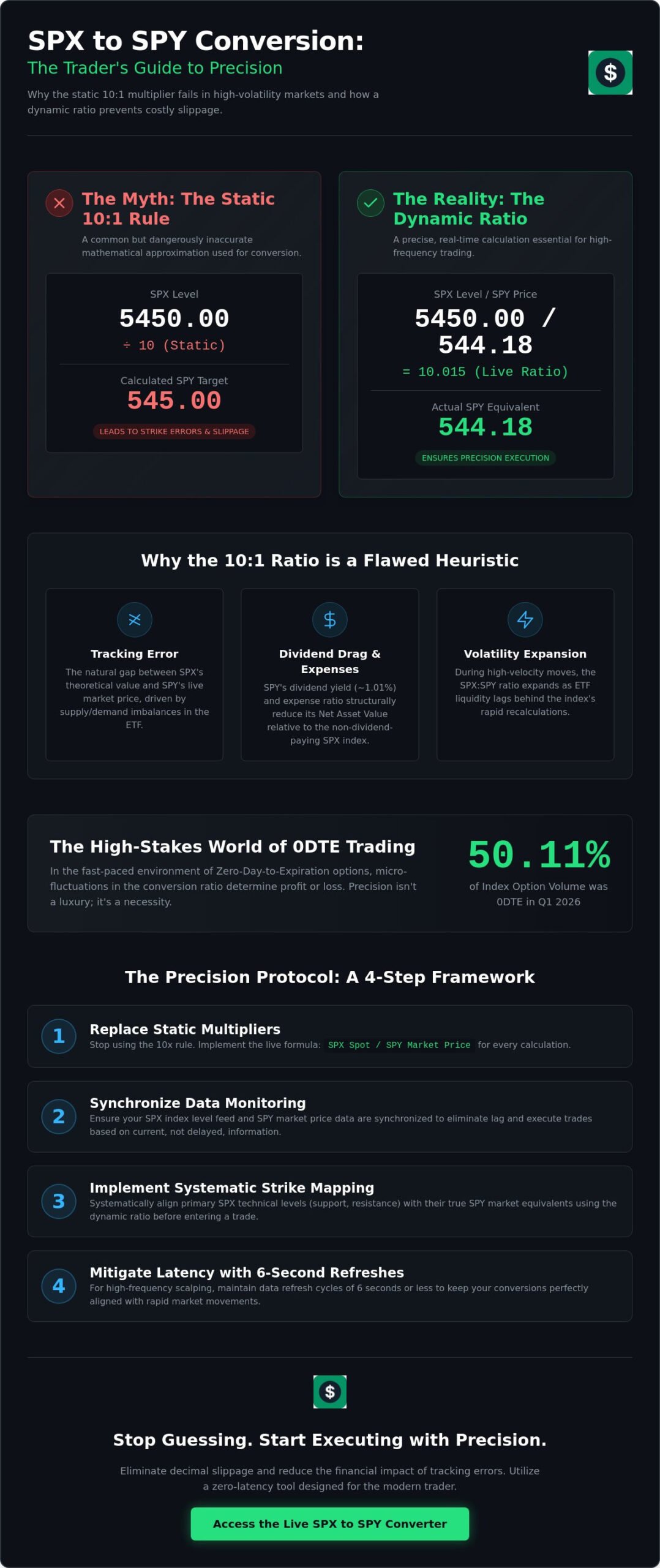
The nominal 10:1 multiplier is a heuristic, not a technical constant. Precise day trading spx spy conversion requires a real-time calculation: SPX Spot / SPY Market Price. While the market assumes a clean division, live ratios often fluctuate between 9.985 and 10.025. This variance represents the tracking error. Small decimal shifts determine whether a strike is ITM or OTM at expiration. Inaccurate mapping causes strike selection errors that negate the tax advantages of index products. Even a 0.001 shift in the ratio can move the SPY equivalent by 5 to 10 cents, which fundamentally alters the delta and theta of an option contract.
Tracking Error and Dividend Adjustments
Tracking error is the delta between theoretical index value and ETF market price. SPY dividends create a structural wedge in the 10x ratio. As of July 2026, the SPY dividend yield is 1.01%, with an annualized payout of approximately $7.52. This distribution reduces the ETF’s net asset value independently of index movement. Fund expenses and management fees further erode the nominal parity. These factors ensure the ratio never stays at exactly 10.000 for extended periods. Traders ignoring these adjustments will consistently miscalculate the expected move and breakeven points for short-dated contracts.
Volatility and the SPX:SPY Spread
Ratio expansion occurs during high-velocity market sell-offs. Volatility spikes create temporary disconnects between cash index calculations and ETF order book liquidity. Arbitrage mechanics eventually force mean reversion, but the lag is dangerous for 0DTE scalpers. Low-liquidity pre-market sessions produce “jumpy” data points where the bid-ask spread on the ETF widens faster than the index updates. Institutional traders utilize these spreads to capture micro-alpha, while retail participants often suffer from decimal slippage. For a deeper technical breakdown, consult this academic analysis of SPX vs. SPY regarding pricing efficiency and structural divergence.
Precision is the only defense against tracking error. Q1 2026 data shows 0DTE volume at 50.11%, making execution speed critical. Calculating the dynamic ratio manually during a 20-point SPX move is impossible. Traders must utilize a Real-Time SPX to SPY Strike Price Converter to maintain alignment during high-frequency sessions. This protocol ensures that the “last digit” precision remains intact across all intraday cycles. Verify ratios every 6 seconds to account for rapid mean reversion. Failure to monitor the dynamic ratio leads to execution on stale levels. High-frequency day trading spx spy conversion demands clinical accuracy over nominal approximations. Maintain a strict focus on the decimal delta to preserve capital during volatility spikes.
Mapping SPX Strike Prices to SPY Equivalents
Precision execution requires a systematic protocol to translate theoretical index levels into tradable ETF strikes. The day trading spx spy conversion process must be completed within seconds to maintain alignment with price action. Use the following five-step technical workflow for strike mapping:
- Step 1: Identify the primary technical level. Establish the target entry or exit point on the SPX cash index. Resistance at 5450.00 serves as the baseline.
- Step 2: Capture the live market ratio. Divide the current SPX spot price by the SPY market price. A sample ratio of 10.0124 accounts for tracking error and dividend drag.
- Step 3: Calculate the theoretical strike. Divide the SPX technical level (5450) by the live ratio (10.0124). This yields a raw SPY equivalent of 544.32.
- Step 4: Round to liquid increments. SPY options trade in $0.50 or $1.00 intervals. Round 544.32 to the nearest liquid strike, which is 544.50 or 544.00, depending on the desired delta.
- Step 5: Validate the option chain. Confirm the premium, bid-ask spread, and open interest for the selected SPY strike before order entry.
Conversion Protocol for 0DTE Options
0DTE contracts represented 50.11% of index option volume in early 2026. This density creates rapid delta shifts. Mapping strikes to SPX support and resistance levels requires accounting for the SPY bid-ask spread. Wide spreads in the ETF can negate the precision of the conversion math. Traders must use a Real-Time SPX to SPY Strike Price Converter to eliminate manual rounding errors. Automated calculation ensures that the mapped strike remains accurate as the ratio fluctuates during high-velocity sessions. Stale data leads to strike selection errors that increase slippage costs.
Broker-Specific Execution: Robinhood and Webull
Retail platforms like Robinhood and Webull do not offer direct SPX trading. Users analyze the cash index for technical clarity but must execute on SPY. This creates a mapping gap. Day trading spx spy conversion on these platforms introduces “pin risk.” SPY options settle via physical delivery, which requires sufficient collateral to hold the underlying shares if assigned. SPX options utilize cash settlement, removing this risk. Traders must manage collateral requirements strictly. The elimination of the Pattern Day Trader (PDT) rule on June 4, 2026, allows for increased frequency, but it places a greater emphasis on understanding the new risk-based margin framework under FINRA Rule 4210. Precise strike mapping prevents unintended assignment and collateral liquidation during 0DTE expiration cycles.
Critical Variables for 0DTE Scalping and High-Frequency Trading
Execution in 0DTE environments demands sub-decisecond precision. Latency is the primary risk factor. Industry standards dictate a 6-second data refresh for day trading spx spy conversion. Stale ratios lead to strike selection errors during high-velocity price discovery. Inaccurate mapping results in immediate slippage. This cost is compounded by gamma risk. Near-the-money options exhibit extreme sensitivity to underlying price shifts. A minor ratio misalignment misplaces the strike relative to the Greeks. SPY liquidity provides high fill rates for retail sizes, but institutional SPX flow dictates the broad market direction. Synchronizing these two data streams is mandatory for scalping profitability. Technical traders must prioritize the following variables:
- Latency: The time delay between index price updates and ETF order book movement.
- Slippage: The financial loss incurred when executing at a strike misaligned with the cash index.
- Gamma Risk: Accelerated delta changes in 0DTE contracts as they approach expiration.
- Liquidity Gaps: Temporary bid-ask spread widening during low-volume intervals.
High-Frequency Metrics and Data Refresh
Profitability in 0DTE scalping relies on current ratio accuracy. Stale ratios cause strike selection lag. A 0.01 deviation in the ratio can result in a $1.00 difference in SPY strike mapping at higher price levels. This discrepancy forces execution on suboptimal strikes. Delta and theta values become misaligned with the intended technical setup. Monitoring the SPX:SPY relationship requires automation. Manual calculation is too slow for 0DTE velocity. High-frequency traders analyze the ratio’s mean reversion tendencies to time entries. To maintain technical alignment, utilize the Real-Time SPX to SPY Strike Price Converter for instant ratio updates. Constant verification ensures the strike remains at the intended technical level during rapid price shifts. Automated protocols eliminate the cognitive load of mental math during fast market moves. For a comprehensive breakdown of how ratio deviations directly impact entry timing, the technical framework for spx spy ratio for scalping details the mechanics of maintaining mathematical certainty during high-frequency 0DTE sessions.
Managing Intraday Volatility Spikes
Ratio behavior shifts during high-impact events. FOMC and CPI releases trigger rapid ratio expansion. Bid-ask spreads on SPY widen instantly. Conversion logic must account for these liquidity gaps. Wide spreads increase the effective cost of entry. Slippage during these windows can exceed 5 cents per contract. Risk mitigation requires strike verification before order finalization. Verify the mapped strike against the live option chain. Confirm that the premium reflects the current ratio, not a stale print. High-frequency day trading spx spy conversion requires clinical focus on these variables. Failure to account for volatility-induced ratio shifts leads to capital erosion. Maintain execution discipline through automated tracking tools. Accuracy is the only defense against tracking error during news-driven volatility. Monitor the ratio refresh cycles to ensure data integrity during peak volume periods. A detailed analysis of spx spy ratio fluctuation intraday metrics provides the quantitative framework for understanding how expense ratios, cash drag, and macroeconomic variables drive these deviations during high-impact sessions.
Utilizing the SPX to SPY Converter for Technical Precision
Technical precision in day trading spx spy conversion requires automated data synchronization. The Real-Time SPX to SPY Strike Price Converter provides this critical functionality. Operational specifications prioritize a 6-second refresh protocol. This frequency aligns with high-frequency scalping requirements for 0DTE contracts. Manual calculations are insufficient for current market velocity. The utility calculates the dynamic ratio by dividing the SPX spot price by the SPY market price. It provides instant strike translation across the entire option chain. This protocol minimizes the risk of executing on stale data points. Synchronized data is the baseline for professional execution.
Workflow integration follows a modular structure. Traders establish technical levels on the SPX cash index first. They input these levels into the converter interface. The tool identifies the corresponding SPY strike based on the live ratio. It accounts for the tracking error identified in previous sections. This automation reduces the time between technical signal and order execution. Ratio monitoring allows for the identification of mean reversion opportunities. Use the converter as a primary data source for strike alignment. Verify the output against the broker order entry screen. Precision mapping is mandatory for capital preservation.
Operational Efficiency for Active Traders
Operational efficiency relies on the elimination of manual friction. Active traders must remove spreadsheet-based calculation layers. These legacy systems suffer from data refresh lag and input errors. The converter features a mobile-responsive design. This enables synchronization across multiple devices. The interface is strictly utilitarian. No aesthetic fluff. No marketing distractions. The layout is optimized for rapid scanning. This clinical environment supports high-frequency decision-making. Traders maintain a distraction-free workflow through this dedicated utility. Functional speed is the priority.
Security and Verification Protocols
Professional execution requires a risk-aware stance. The tool includes a mandatory broker verification disclaimer. Users must confirm all strike equivalents with their primary brokerage platform before trade entry. This protocol balances speed with user-led verification. The tool prioritizes functional efficiency. It delivers the specific variables required for 0DTE mapping. The focus remains on the mathematical relationship between the index and the ETF. Access the Live SPX to SPY Converter to implement real-time ratio tracking. Effective day trading spx spy conversion is the result of disciplined technical execution and precise data mapping. Maintain alignment with the live ratio to mitigate tracking error risks. Verify strikes every session.
Technical Alignment for High-Frequency Execution
Precision in day trading spx spy conversion requires a shift from nominal 10x multipliers to dynamic, real-time ratio tracking. Tracking error and dividend drag ensure that static calculations remain inaccurate during 0DTE volatility. Traders must prioritize sub-10-second data refreshes to eliminate decimal slippage and strike selection errors. Effective mapping between SPX technical levels and SPY option chains preserves capital during high-velocity price moves. High-frequency environments demand clinical accuracy over heuristic approximations. Manual calculations introduce unacceptable latency into the trading workflow. Accuracy is the only defense against tracking error.
Beyond the technical demands of the market, traders often look for ways to manage the physical toll of high-stress sessions. For professionals located in Florida, finding a reputable provider for Botox in Bradenton FL can help maintain a relaxed and confident appearance, regardless of market volatility.
Maintain a functional edge by automating the conversion process. The Real-Time SPX to SPY Strike Price Converter provides 6-second ratio updates through a minimalist, low-latency interface designed for specialized high-frequency day traders. This utility removes the cognitive load of manual math and ensures strike alignment across all intraday cycles. Verification remains a mandatory protocol. Utilize professional tools to synchronize cash index analysis with ETF execution. Execute Precision Conversions with the SPX to SPY Tool to maintain technical integrity in fast markets. Achieve absolute strike alignment today.
Frequently Asked Questions
How often does the SPX to SPY ratio change?
The ratio changes continuously during active market sessions. Updates occur with every price tick of the underlying index constituents and ETF market trades. Real-time shifts reflect the tracking error between the theoretical index value and the tradable trust. High-frequency day trading spx spy conversion requires monitoring these fluctuations to maintain strike alignment. Ratios typically deviate from the nominal 10.00 level due to intraday liquidity imbalances and bid-ask spread widening.
Why is the SPX to SPY ratio not exactly 10:1?
Tracking error, expense ratios, and dividend drag prevent a perfect 10:1 parity. SPY is a tradable security with management fees and cash holdings that diverge from the theoretical SPX index calculation. This structural wedge expands over time as dividends are accrued and fees are deducted from the ETF’s net asset value. Intraday volatility further detaches the market-clearing price of SPY from the mathematical value of the S&P 500 constituents.
Can I use this converter for SPXW (Weekly) options?
Yes, the conversion logic applies to SPXW weekly options. Weekly contracts utilize the same underlying cash index levels as standard monthly expirations. Technical levels established on the SPX index require the same ratio mapping whether trading 0DTE weeklies or longer-dated options. The converter provides the necessary strike translation for any contract tracking the S&P 500 index. Precise mapping remains mandatory to ensure delta and gamma alignment across all expiration cycles.
Is the SPX to SPY converter accurate for 0DTE trading?
The utility is specifically optimized for 0DTE trading requirements. Accuracy depends on the 6-second refresh protocol to account for rapid gamma shifts near expiration. High-frequency day trading spx spy conversion during 0DTE sessions demands sub-10-second data to mitigate decimal slippage. Stale ratios lead to strike selection errors that negate the technical edge. Automated tracking provides the precision required to align SPX technical support with liquid SPY option strikes during high-velocity moves.
How do dividends affect the SPX to SPY conversion?
Dividends cause a discrete reduction in the ETF’s net asset value relative to the cash index. As of July 2026, the SPY dividend yield is approximately 1.01%. This yield creates a permanent gap in the SPX:SPY ratio that widens on ex-dividend dates. Conversion math must account for this drag to prevent overestimating the ETF’s price level. Failure to adjust for dividend distributions results in selecting strikes that are misaligned with the actual market-clearing price.
Do I need to verify strike prices with my broker after using a converter?
Mandatory broker verification is a standard risk mitigation protocol. Users must confirm all converted strike equivalents against their primary brokerage’s live option chain before order entry. Data latency or feed discrepancies between third-party utilities and broker execution platforms can occur. Verification ensures that the mapped strike possesses the intended liquidity, bid-ask spread, and open interest. This final check is the only defense against execution errors caused by stale data refreshes.
What is the difference between SPX cash settlement and SPY physical delivery?
SPX options utilize cash settlement while SPY options settle via physical delivery of shares. Cash settlement removes the risk of share assignment and the associated collateral requirements. Physical delivery in SPY introduces pin risk and potential liquidation if the account lacks capital to hold the underlying security. These structural differences affect how traders manage positions near expiration. Conversion strategies must account for the different capital and risk profiles associated with each settlement style.
Can I convert SPY prices back to SPX using this tool?
The mathematical relationship between the index and the ETF is bidirectional. Traders can multiply the SPY price by the live ratio to identify the corresponding SPX level. This inverse calculation is useful for identifying index-level resistance based on ETF-specific price action. The converter handles the ratio tracking required for both directions. Maintaining a consistent ratio across all calculations ensures that technical levels remain synchronized regardless of which instrument is analyzed first.